KandooAI
Juggernaut
Downloads
Model Report
Overview
Juggernaut is a generative AI model designed for high-quality image synthesis, with a particular emphasis on photorealism and versatility. Built as a "checkpoint merge" model using Stable Diffusion 1.5 as its foundational base, Juggernaut was first released on December 24, 2023 by KandooAI. Through successive iterations, Juggernaut has incorporated elements from various community models and datasets to enhance its image generation capabilities across a diverse range of visual domains.
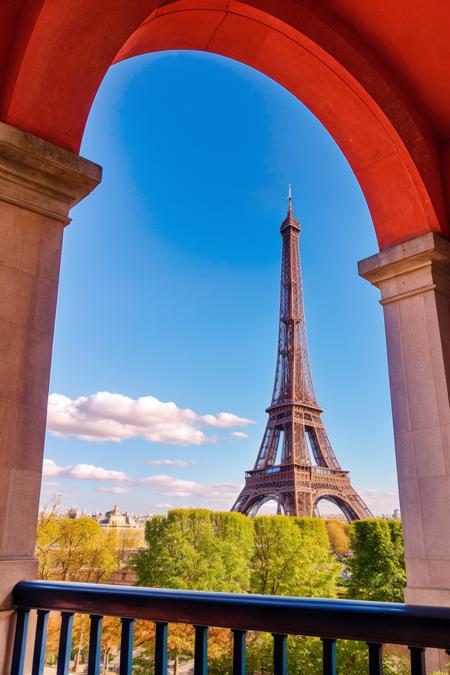
Figure 1. Photorealistic rendering of the Eiffel Tower generated by the Juggernaut model, demonstrating its architectural imagery capabilities. Prompt: 'Eiffel Tower in azure and red tones.'
Model Architecture and Development
Juggernaut is classified as a checkpoint merge model, which means it is produced by combining weights from multiple existing models, rather than being trained exclusively from scratch or via fine-tuning. The base foundation is Stable Diffusion 1.5, a diffusion-based generative framework widely used in the community. Juggernaut also incorporates elements from other prominent models, including Absolute Reality, epiCRealism V3, and others, depending on the version.
The merging process employs specific weights for each contributing model to achieve a fine-grained blend of capabilities. For example, one notable iteration—Juggernaut "Aftermath"—relied on distinct merge proportions of various models such as Absolute Reality, epiCRealism V3, Humans, RPG 5, among others. This approach allows Juggernaut to balance different visual qualities, such as photorealism, skin tones, portrait lighting, and stylistic breadth.
The model is distributed in the SafeTensor format, promoting security and efficiency, with the pruned FP16 variant occupying approximately 1.99 GB.
Training Data and Iterative Versions
The evolution of Juggernaut has involved several prominent versions, each introducing novel features and dataset sources. The "Reborn" version, released as of October 5, 2024, utilizes a subset of the JuggernautXL dataset, adapted specifically for the Stable Diffusion 1.5 model base. This release also updated integration of the epICRealism model while removing others such as RPG and Divas, reflecting evolving priorities in the merge recipe.
Previous versions—such as "Aftermath", "Final", and their variants—experimented with different combinations of datasets and merge weights. The development process draws from large collections of photorealistic, stylized, and character-centric imagery to maximize output diversity.
The merging methodology incorporates not only models but also specialized resources such as the NinjaFix by chillpixel and skin or lighting enhancers. Juggernaut’s iterative refinement ensures both visual quality and adaptability to a broad range of prompts.
Capabilities and Applications
Juggernaut is engineered for broad photorealistic image synthesis, excelling in the generation of realistic humans, objects, landscapes, and fantastical scenes. It is frequently used for tasks such as architectural renders, product concept art, character and asset creation for games and comics, and contemporary photography simulations.
The model responds well to a wide array of prompts—ranging from detailed depictions of urban environments and vehicles to fantasy elements such as dragons or robots. Its outputs often feature nuanced lighting, vibrant colors, and intricate details, making it suitable for both creative and professional applications.
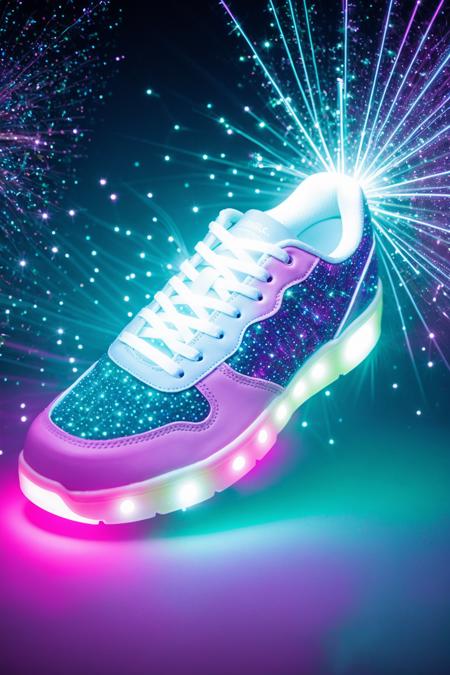
Figure 2. Juggernaut output: Bioluminescent sneaker made of light beams, bubbles, and particles. Prompt: 'A bioluminescent sneaker, radiating light beams and glittering particles.'
The model is often used with prompt tags such as "woman", "clothing", "anime", "outdoors", "comics", "photography", "architecture", "fantasy", "city", "robot", "landscape", and "sci-fi", reflecting its versatility.
Performance, Community Adoption, and Limitations
As of the latest data, Juggernaut has received positive reviews from the community, with more than 2,400 ratings and an excess of 1.2 million downloads. Its popularity is partly attributable to its photorealistic quality and adaptability.
Reported limitations include some regressions in anatomical accuracy in later versions. For instance, users have noted that while the "Aftermath" version performed well in rendering hands, subsequent releases such as "Reborn" and "Final" occasionally produced deformities in finger generation.
Additionally, while models based on the SDXL architecture offer extended capabilities, they typically require significantly more computational resources. Juggernaut is utilized by users operating on hardware with moderate memory capacity, as it provides quality without the higher VRAM demands seen in larger models.

Figure 3. Juggernaut Negative Embedding sample: High-detail asset generation for character design.
Model Usage, Settings, and Ecosystem
To maximize image quality and maintain coherence, suggested parameters for Juggernaut include an image size of 512x768 pixels, using the DPM++ 2M Karras sampler, at 35 steps and a classifier-free guidance (CFG) value of 7. For higher-resolution outputs, users may employ a HiRes Fix workflow, applying samplers such as 4xNMKD Siax 200k with additional steps and moderate denoising.
Juggernaut can be extended or enhanced through related resources provided by its creator and collaborators, such as the Juggernaut Negative Embedding for prompt refinements, the Tone Range Compressor (VAE), and LoRA models like the Elixir — Enhancer LoRA.
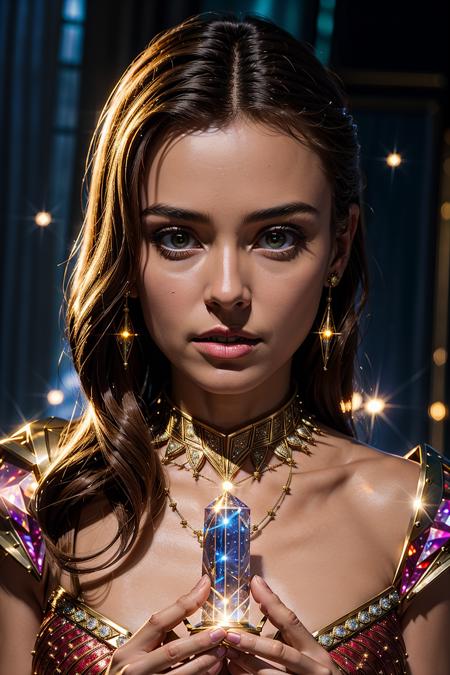
Figure 4. Sample output using Elixir — Enhancer LoRA: A woman holding a luminous crystal. Prompt: 'A woman adorned in intricate jewelry, holding a glowing crystal in a magical atmosphere.'
The model itself is distributed under the CreativeML Open RAIL-M license with an addendum, ensuring open research access under specified guidelines.
Related Models and Further Resources
Juggernaut exists within a family of related generative models. JuggernautXL, for example, is a larger-scale model from which datasets have been selectively used in Juggernaut’s merges. Users seeking further control or creative options may explore Absolute Reality, epiCRealism V3, RPG 5, and other individual components involved in Juggernaut’s development.
Additional model enhancements are available through VAEs and LoRAs tailored to specific domains, such as portrait lighting or fantasy art.
External Links
- Civitai Guide to Model Resource Types
- How to Use Models (Civitai Wiki)
- SD 1.5 Base Model explanation (YouTube)
- CreativeML Open RAIL-M License
- KandooAI's Twitter
- KandooAI's Instagram
- JuggernautXL (RunDiffusion)
- Absolute Reality (Civitai)
- epiCRealism V3 (Civitai)
- Humans (Civitai)
- RPG 5 (Civitai)
- Divas (Civitai)
More in the Stable Diffusion 1 Family
Stable Diffusion 1.1
Stable Diffusion 1.5
OpenJourney v4
Photon
Analog Diffusion
Dreamshaper
Realistic Vision
Meina Mix
epiCRealism
Absolute Reality
Cyber Realistic
MajicMIX Realistic
epiCPhotoGasm
ControlNet SD 1.5 Canny
ControlNet SD 1.5 IP2P
ControlNet SD 1.5 Depth
ControlNet SD 1.5 MLSD
ControlNet SD 1.5 Normal
ControlNet SD 1.5 Open Pose
ControlNet SD 1.5 Scribble
ControlNet SD 1.5 Segmentation
ControlNet SD 1.5 Soft Edge
ControlNet SD 1.5 Inpaint
ControlNet SD 1.5 Line Art
ControlNet SD 1.5 Lineart Anime
ControlNet SD 1.5 Shuffle
ControlNet SD 1.5 Tile
ControlNet 1.5 IP Adapter
ControlNet 1.5 QR Code
Compatible Apps
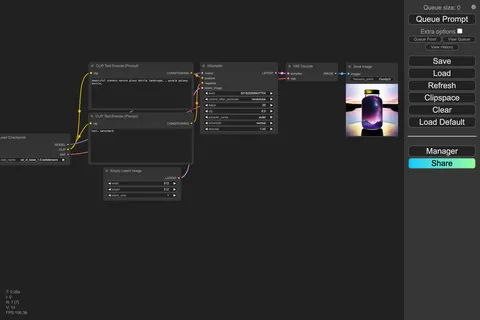
ComfyUI
A node-based workflow builder for advanced image and video generation, ideal for custom pipelines, fine control, and power users.
Web UI · API
Image Generation · Video Generation
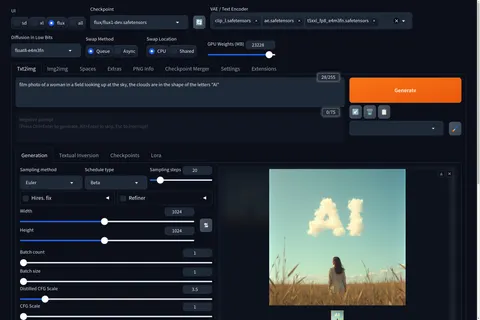
Stable Diffusion WebUI Forge
A faster, more experimental Stable Diffusion WebUI variant focused on improved resource use, quicker inference, and modern model support.
Web UI · API
Image Generation
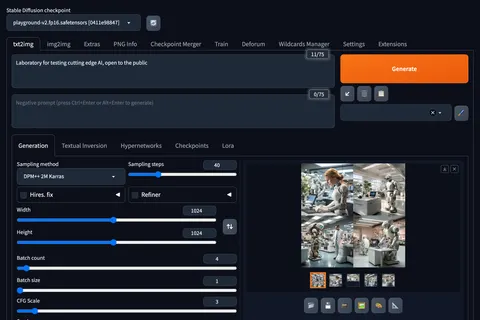
Stable Diffusion Web UI
A full-featured Stable Diffusion interface with deep controls for prompting, inpainting, extensions, and advanced image workflows.
Web UI · API
Image Generation · Video Generation
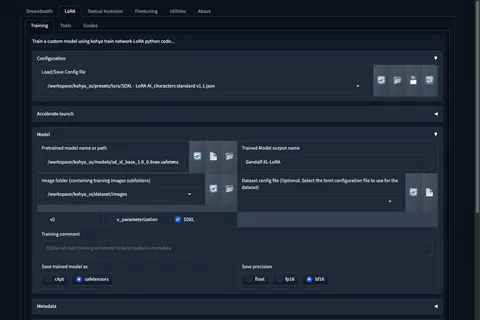
Kohya's GUI
Train LoRAs and fine-tunes for Stable Diffusion and FLUX with a popular GUI for Kohya-based training workflows.
Web UI · API
Fine-Tuning · Image Generation