lllyasviel
ControlNet SD 1.5 MLSD
Downloads
Model Report
Overview
ControlNet SD 1.5 MLSD is a model within the ControlNet 1.1 suite, designed to provide precise structural control to image generation tasks by leveraging Mobile-optimized Line Segment Detection (M-LSD). This model allows users to guide Stable Diffusion 1.5 outputs using straight lines identified from input images, making it especially useful for applications where geometric consistency and linear features are paramount. ControlNet 1.1 maintains architectural continuity with ControlNet 1.0 while offering improvements in data quality, robustness, and training procedures.
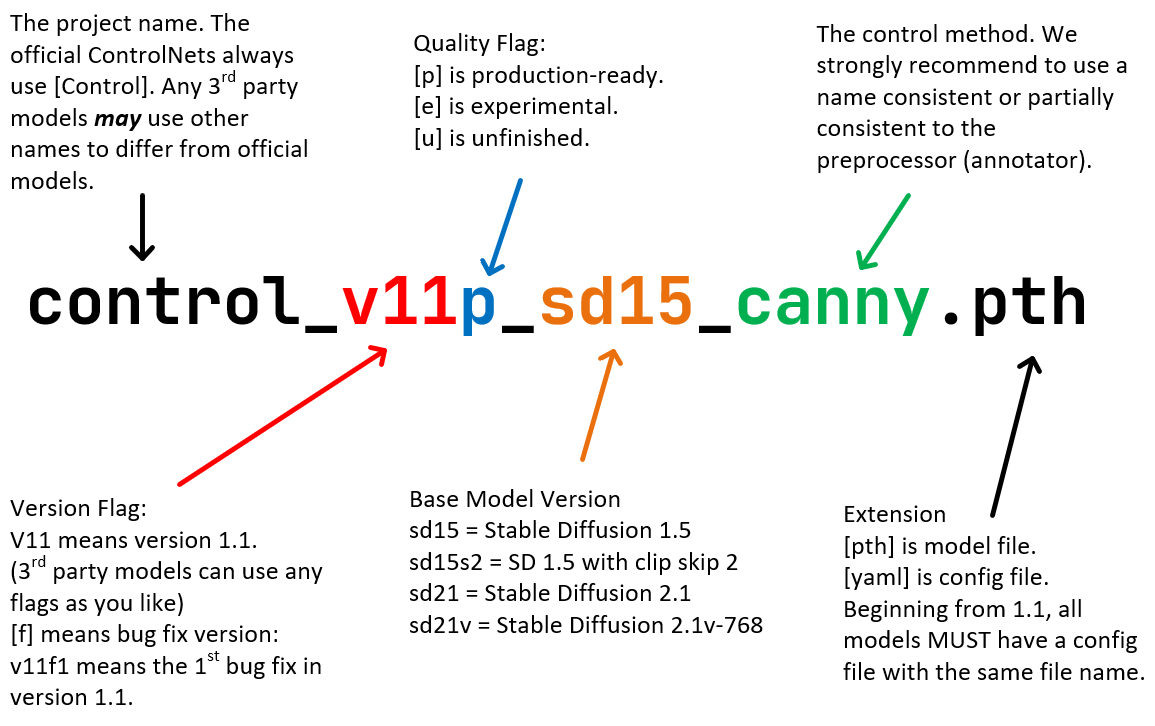
Figure 1. Diagram illustrating the Standard ControlNet Naming Rules (SCNNRs) used in the ControlNet 1.1 model suite.
Model Architecture and Technical Innovations
ControlNet SD 1.5 MLSD adopts the same neural network architecture as its predecessor, ControlNet 1.0. This architectural consistency facilitates compatibility across versions and ensures a stable foundation for ongoing research and deployment. The key input to the model is a set of straight lines extracted by the MLSD preprocessor, which serves as a structural constraint during image synthesis.
The model is distributed via the files control_v11p_sd15_mlsd.pth and control_v11p_sd15_mlsd.yaml. During inference, global average pooling is used between the ControlNet Encoder outputs and the Stable Diffusion UNet layers to optimize feature transmission across the network. Additionally, the model is designed to interact exclusively with the conditional side of the Classifier-Free Guidance (CFG) scale, a behavior that can be controlled using the YAML configuration file's global_average_pooling item.
Data, Training, and Improvements
Considerable enhancements were introduced in ControlNet 1.1 MLSD to resolve data-related limitations observed in previous releases. The training dataset was refined by eliminating duplicated grayscale images, removing low-quality samples, and correcting prompt-image pair mismatches, resulting in increased robustness and reliability.
The dataset was further expanded by appending 300,000 new images, each selected on the basis of containing more than sixteen straight lines as determined by MLSD analysis. Data augmentation strategies, including random left-right flipping, were applied to enhance the model's generalization. Training resumed from the MLSD 1.0 checkpoint and involved an additional 200 GPU hours of computation using A100 80G GPUs.
The central training signal for this model derives from M-LSD Lines, ensuring that structural accuracy in generated outputs is prioritized.
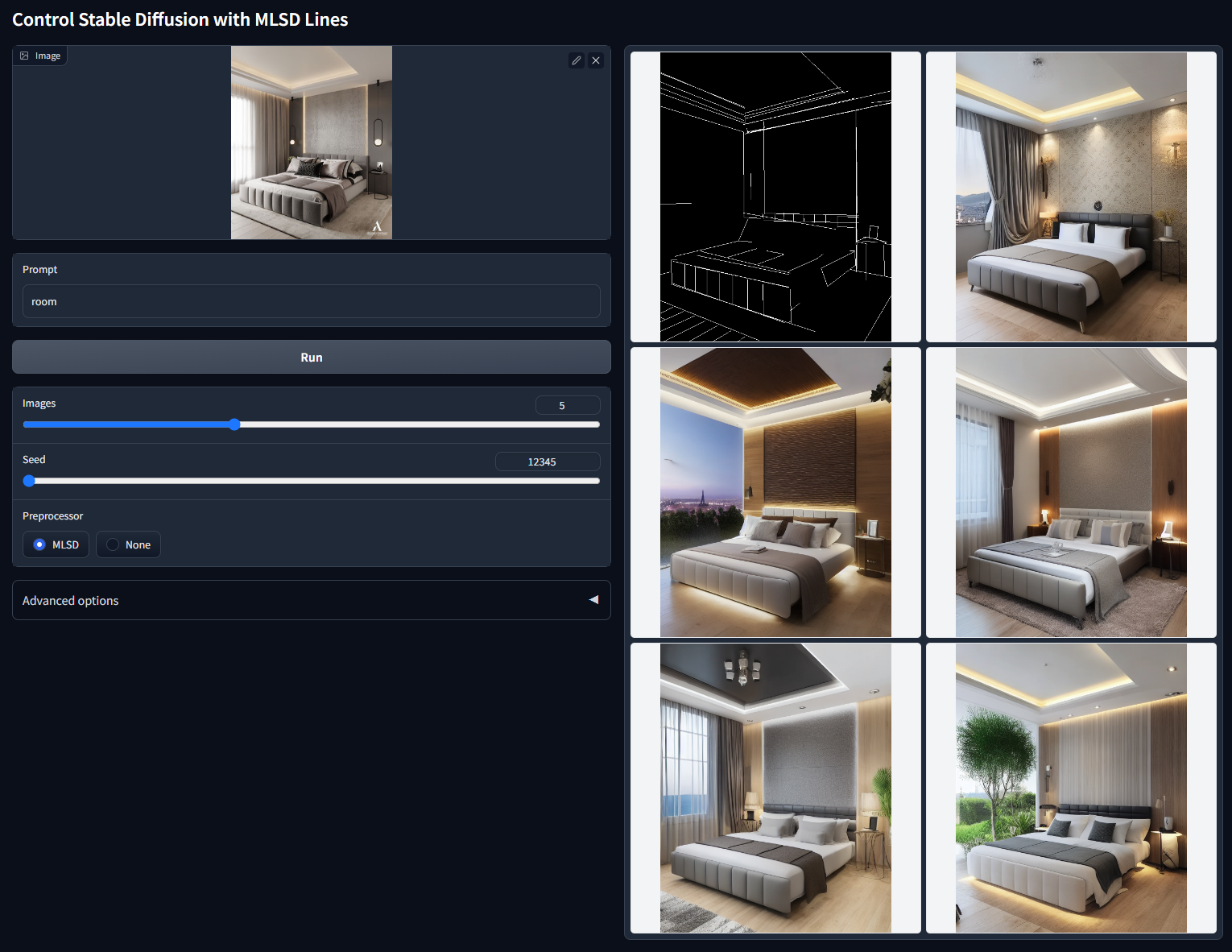
Figure 2. Batch test output from the ControlNet 1.1 MLSD model using prompt 'room' and random seed 12345, demonstrating M-LSD line structure control.
Applications and Use Cases
ControlNet SD 1.5 MLSD is particularly well-suited to applications that require adherence to geometric structures, such as interior design visualizations, architectural sketches, and scenes where linearity and spatial coherence are vital. By using M-LSD as a preprocessor, the model enables users to infuse a high degree of shape guidance into image generation without sacrificing the creative flexibility afforded by Stable Diffusion 1.5. This approach empowers users to produce variations of visual content that are constrained by real or imagined sets of straight lines, facilitating tasks ranging from synthetic data generation for computer vision to design prototyping.
Comparative Models and Alternative Approaches
ControlNet 1.1 encompasses a broader suite of models, each optimized for different control signals. Other notable variants include models for Canny edge detection, depth maps, semantic segmentation, normal maps, and pose estimation, among others. Some models in the family, such as those for content shuffle or tile-based control, are marked as experimental and may require additional validation before use in production contexts.
Alongside ControlNet, the Control-LoRA approach provides an alternative mechanism for model control, achieving similar goals via low-rank parameter-efficient fine-tuning. Control-LoRAs enable model size reductions—down from 4.7GB for standard ControlNet models to approximately 738MB for Rank 256 variants and around 377MB for Rank 128—making them attractive for environments with limited resources.
Limitations and Operational Notes
While ControlNet SD 1.5 MLSD demonstrates robust performance in line-guided generation, certain limitations and caveats are noted. Experimental models within ControlNet 1.1, such as Shuffle, Instruct Pix2Pix, and Tile, may produce inconsistent results requiring selective curation.
For users seeking integration with the Automatic1111 (A1111) toolkit, it is recommended to use the dedicated sd-webui-controlnet extension, as the primary ControlNet 1.1 repository is not structured as an A1111 extension, and multi-ControlNet support is currently A1111-exclusive.
Some specialized models, such as Anime Lineart, impose further operational constraints, including the lack of support for Guess Mode and the requirement for external checkpoint files not bundled within the core release.
Release History and Documentation
ControlNet 1.1 was released as a nightly build, with eleven production-ready models and three experimental models announced in the suite. The official documentation, hosted on the project’s GitHub, is continuously updated as the project evolves.
External Resources
- ControlNet GitHub Repository — Home of the ControlNet open-source project.
- ControlNet-v1-1 HuggingFace Model Page — Official repository for downloading ControlNet 1.1 model checkpoints.
- Annotators HuggingFace Models — Preprocessors needed for running various ControlNet models.
- runwayml/stable-diffusion-v1-5 HuggingFace — Official Stable Diffusion v1.5 model files.
- sd-webui-controlnet GitHub Repository — The recommended Automatic1111 extension for ControlNet integration.
- Control-LoRA documentation — Technical reference for parameter-efficient ControlNet alternatives.
- Lineart Image-to-Line-Drawings Dataset — Dataset used in lineart-based ControlNet training.
- Instruct Pix2Pix Dataset — Dataset underlying experimental Pix2Pix-based model variants.
- Project Annotator Documentation — Technical details on annotator preprocessing and Shuffle model.
More in the Stable Diffusion 1 Family
Stable Diffusion 1.1
Stable Diffusion 1.5
OpenJourney v4
Photon
Juggernaut
Analog Diffusion
Dreamshaper
Realistic Vision
Meina Mix
epiCRealism
Absolute Reality
Cyber Realistic
MajicMIX Realistic
epiCPhotoGasm
ControlNet SD 1.5 Canny
ControlNet SD 1.5 IP2P
ControlNet SD 1.5 Depth
ControlNet SD 1.5 Normal
ControlNet SD 1.5 Open Pose
ControlNet SD 1.5 Scribble
ControlNet SD 1.5 Segmentation
ControlNet SD 1.5 Soft Edge
ControlNet SD 1.5 Inpaint
ControlNet SD 1.5 Line Art
ControlNet SD 1.5 Lineart Anime
ControlNet SD 1.5 Shuffle
ControlNet SD 1.5 Tile
ControlNet 1.5 IP Adapter
ControlNet 1.5 QR Code
Compatible Apps
ComfyUI
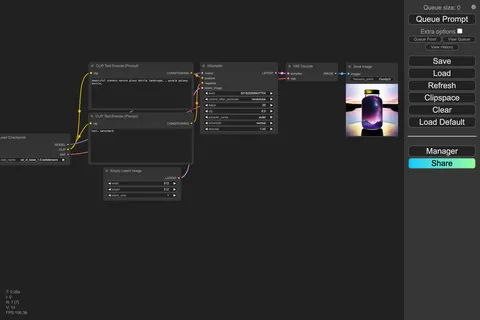
A node-based workflow builder for advanced image and video generation, ideal for custom pipelines, fine control, and power users.
Web UI · API
Image Generation · Video Generation
Stable Diffusion WebUI Forge
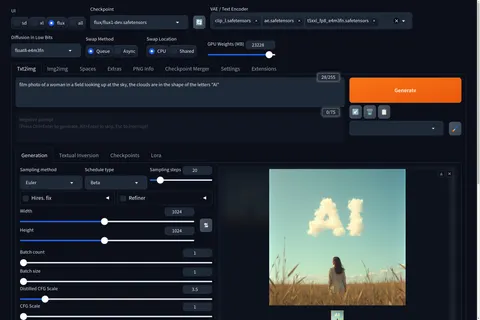
A faster, more experimental Stable Diffusion WebUI variant focused on improved resource use, quicker inference, and modern model support.
Web UI · API
Image Generation
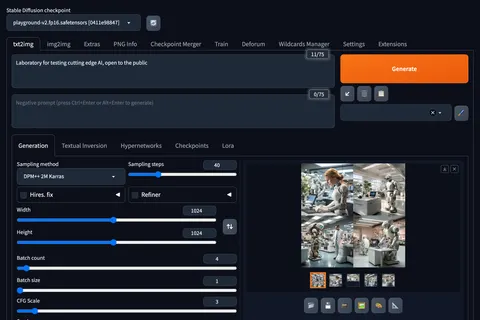
Stable Diffusion Web UI
A full-featured Stable Diffusion interface with deep controls for prompting, inpainting, extensions, and advanced image workflows.
Web UI · API
Image Generation · Video Generation
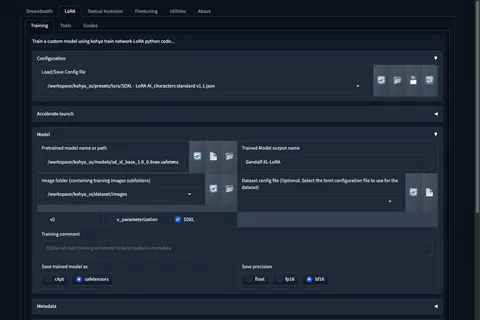
Kohya's GUI
Train LoRAs and fine-tunes for Stable Diffusion and FLUX with a popular GUI for Kohya-based training workflows.
Web UI · API
Fine-Tuning · Image Generation