lllyasviel
ControlNet SD 1.5 IP2P
Downloads
Model Report
Overview
ControlNet SD 1.5 IP2P, also known as ControlNet Instruct Pix2Pix, is an advanced generative image model included in the ControlNet 1.1 release. Developed as part of a suite of models designed to extend and precisely guide the capabilities of Stable Diffusion 1.5, this variant focuses on image-to-image translation directed by both descriptive and instructional text prompts. Its design enables nuanced alterations of visual content, facilitating complex transformations that respond to high-level user input.
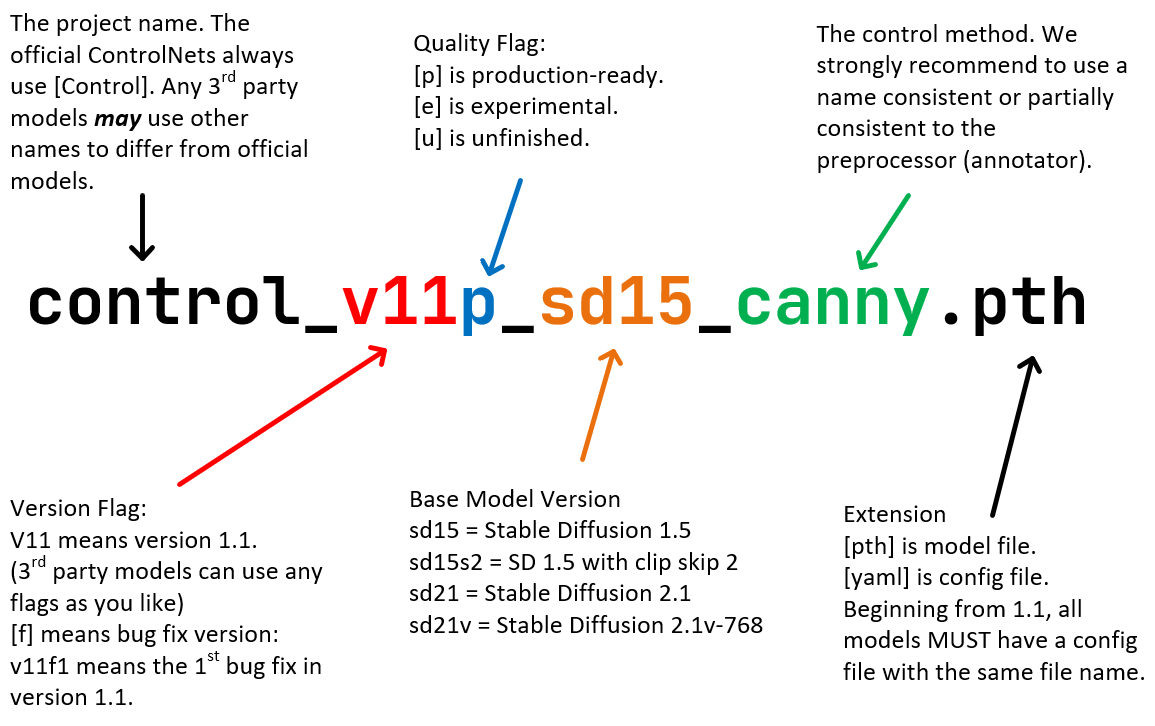
Figure 1. Diagram illustrating the naming convention of ControlNet models for the 1.1 release, breaking down the components of filenames such as 'control_v11p_sd15_canny.pth'.
Technical Capabilities and Architecture
ControlNet SD 1.5 IP2P builds upon the neural architecture first established with ControlNet 1.0, maintaining compatibility and consistency across the 1.1 model suite. Specifically tailored for Stable Diffusion 1.5, it introduces a mechanism to interpret and apply user instructions directly to the image editing process. The model implements a specialized version of the Classifier-Free Guidance (CFG) system—differing from the original Instruct Pix2Pix in that it requires only single CFG tuning rather than double CFG adjustment, thereby simplifying user operation and reducing risk of prompt misalignment.
The architectural design incorporates a global average pooling layer between the ControlNet encoder outputs and the U-Net layers of Stable Diffusion. This addition, detailed through the model's configuration options, enables efficient integration of conditioning information from text instructions, supporting robust and flexible control during inference.
Training Methodology and Dataset
The model is trained on the Instruct Pix2Pix dataset, utilizing a unique approach that blends two types of textual guidance. During training, 50% of prompts are explicit instructions (such as "make the boy cute"), while the other 50% are direct image descriptions ("a cute boy"). This balanced regime allows the model to interpret both instructional and descriptive prompts, enhancing its versatility in real-world scenarios. Such dual conditioning facilitates image edits that are both precise—guided by clear directives—and stylistically adaptable to looser, thematic descriptions.
Functional Performance and Limitations
ControlNet SD 1.5 IP2P is categorized as an experimental model within the ControlNet 1.1 release. It is capable of executing a diverse range of text-guided image edits, from environmental alterations to object and style transformations. For example, the prompt "make it winter" reliably transforms summer scenes into snowy landscapes, demonstrating contextually relevant changes. However, the model sometimes exhibits inconsistent output quality and may require cherry-picking for optimal results, especially with complex or ambiguous instructions.
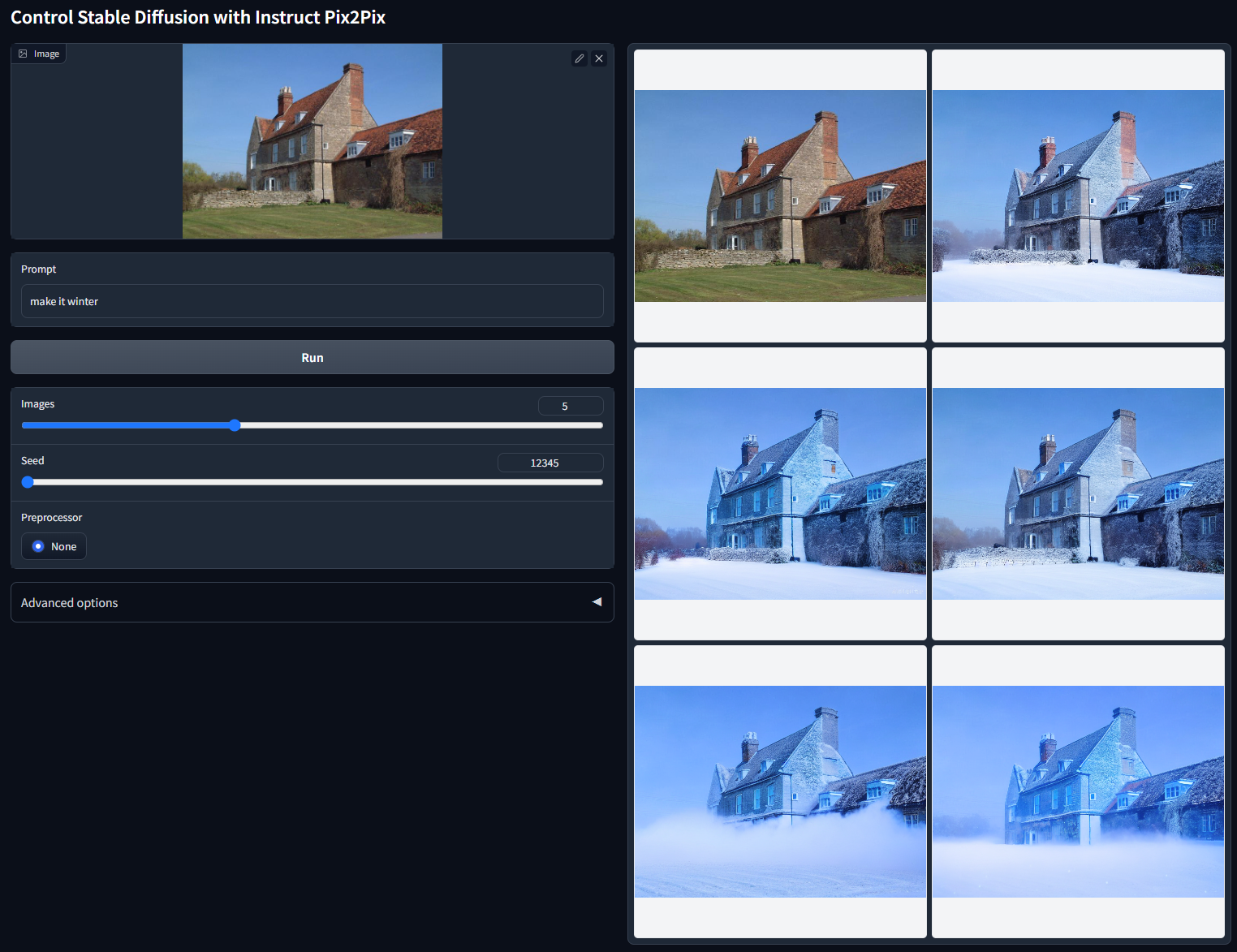
Figure 2. Output images generated with the prompt 'make it winter', demonstrating transformation of a stone house scene to winter using ControlNet SD 1.5 IP2P.
Transformation fidelity varies with input complexity. Straightforward prompts yield strong results, while more abstract requests such as "make he iron man" demonstrate the model's interpretative capacity but may produce less consistent output without manual selection.
Comparative Context within the ControlNet Model Family
ControlNet 1.1 includes a suite of 14 models, spanning production-ready and experimental variants, each tailored for specific control modalities or tasks. Alongside SD 1.5 IP2P, experimental models such as ControlNet Shuffle and ControlNet Tile explore novel editing paradigms. Production-ready models provide specialized control through features like canny edge maps, depth estimation, pose guidance, and artistic lineart, as detailed in the ControlNet-v1-1 Hugging Face Model Page.
This extensible model family supports a diverse array of image manipulation tasks, leveraging the same stable architectural backbone as ControlNet SD 1.5 IP2P. Furthermore, the development of low-rank adaptation solutions such as Control-LoRA illustrates continued innovation in parameter-efficient model control.
Applications and Use Cases
ControlNet SD 1.5 IP2P is primarily designed for text-driven image-to-image translation. It enables users to adjust existing photographs or artwork according to high-level instructions, facilitating edits such as environmental changes ("make it winter"), stylistic modifications ("make it look like a painting"), and conceptual transformations. Its support for both instructional and descriptive language allows broad integration into workflows spanning visual storytelling, creative design, and rapid prototyping.
Development, Availability, and Licensing
Ongoing development of ControlNet SD 1.5 IP2P and related models is managed on the official ControlNet GitHub repository, where technical updates, bug fixes, and new features are regularly documented. While the precise licensing details are not explicitly stated, the repository is publicly accessible for research and development, with configuration files and model checkpoints available for academic and creative exploration.
Helpful Links
- ControlNet 1.1 Hugging Face Model Page
- Stable Diffusion v1-5 Hugging Face Model Page
- ControlNet Annotators on Hugging Face
- ControlNet GitHub Repository
- Instruct Pix2Pix Dataset and Code
- Bae's surface normal estimation for ControlNet
- ScanNet Project for Normal Maps Protocol
- Image-to-Line-Drawings Training Data Source
- Control-LoRA Adaptation Project
More in the Stable Diffusion 1 Family
Stable Diffusion 1.1
Stable Diffusion 1.5
OpenJourney v4
Photon
Juggernaut
Analog Diffusion
Dreamshaper
Realistic Vision
Meina Mix
epiCRealism
Absolute Reality
Cyber Realistic
MajicMIX Realistic
epiCPhotoGasm
ControlNet SD 1.5 Canny
ControlNet SD 1.5 Depth
ControlNet SD 1.5 MLSD
ControlNet SD 1.5 Normal
ControlNet SD 1.5 Open Pose
ControlNet SD 1.5 Scribble
ControlNet SD 1.5 Segmentation
ControlNet SD 1.5 Soft Edge
ControlNet SD 1.5 Inpaint
ControlNet SD 1.5 Line Art
ControlNet SD 1.5 Lineart Anime
ControlNet SD 1.5 Shuffle
ControlNet SD 1.5 Tile
ControlNet 1.5 IP Adapter
ControlNet 1.5 QR Code
Compatible Apps
ComfyUI
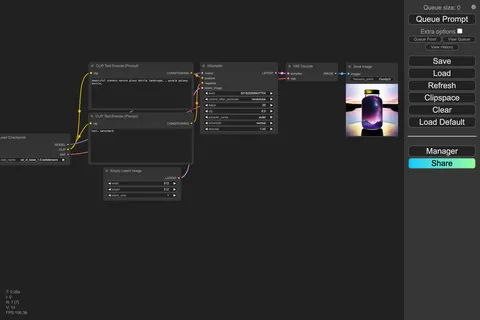
A node-based workflow builder for advanced image and video generation, ideal for custom pipelines, fine control, and power users.
Web UI · API
Image Generation · Video Generation
Stable Diffusion WebUI Forge
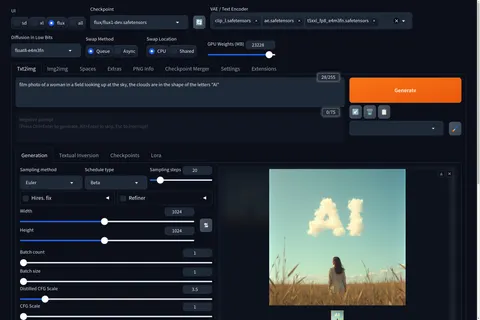
A faster, more experimental Stable Diffusion WebUI variant focused on improved resource use, quicker inference, and modern model support.
Web UI · API
Image Generation
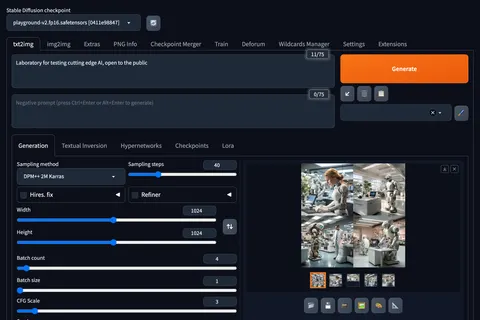
Stable Diffusion Web UI
A full-featured Stable Diffusion interface with deep controls for prompting, inpainting, extensions, and advanced image workflows.
Web UI · API
Image Generation · Video Generation
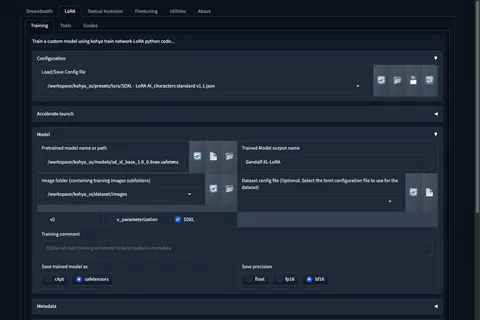
Kohya's GUI
Train LoRAs and fine-tunes for Stable Diffusion and FLUX with a popular GUI for Kohya-based training workflows.
Web UI · API
Fine-Tuning · Image Generation