Photographer
Photon
Downloads
Model Report
Overview
Photon is a generative artificial intelligence model designed for the creation and enhancement of photorealistic images. Developed as a checkpoint merge based on the Stable Diffusion 1.5 framework, Photon integrates various training adaptations and model refinements to deliver outputs reflecting its training objectives with minimal user prompting. The model is noted for its image refinement abilities, versatility in generative tasks, and suitability for further tuning using low-rank adaptation methods.
Model Architecture and Development
Photon's architecture is rooted in the Stable Diffusion 1.5 latent diffusion model, a widely adopted open-source text-to-image generation system. The Photon checkpoint is classified as a checkpoint merge, having drawn from an assortment of prior model versions and fine-tuned LORA modules, each tailored to specific visual attributes and subject matter.
During its development, the model’s creator—operating under the pseudonym "Photographer"—employed a chaotic process, first merging earlier trained models, then iteratively training LORA adapters on AI-generated, photorealistic datasets. These LORA modules were integrated back into the model using dynamically weighted blending strategies to address specific representational shortcomings, particularly in the depiction of hands. While some resolution was achieved, limitations in anatomical accuracy persisted in initial releases.
Training Methods and Data
The core refinements in Photon are driven by low-rank adaptation (LORA) methods that facilitate efficient retraining and merging across thematic domains. Much of the training involved curating and leveraging AI-generated photorealistic images rather than employing large-scale, human-annotated collections.
The project's stated ambition was to scale the training dataset to include between 5,000 and 50,000 high-quality, AI-crafted photorealistic samples, with the ultimate goal of further automating the refinement and blending process. This approach emphasizes adaptability, making Photon particularly effective for developing new custom LORA modules tailored to specific stylistic or semantic requirements.
Technical Capabilities and Features
Photon’s principal function is the generation of photorealistic imagery. Its outputs exhibit characteristics of photorealism, though users note a distinction between near-photorealism and photographic fidelity. The model functions as a refiner, capable of transforming certain types of visually unrefined images into outputs consistent with photorealistic styles. This refinement occurs with minimal reliance on complex or verbose prompting.
Photon is also recognized for its robust performance in pseudo image-to-image (IMGtoIMG) tasks. In these contexts, the model consistently produces realistic outputs when low denoising settings are selected, while high redrawing intensities may introduce a stylized, two-dimensional effect inconsistent with photorealism.
Another notable feature of Photon is its compatibility with further LORA-based training, making it suitable for users seeking to customize or extend its capabilities for niche visual effects or subject domains.
Applications and Use Cases
Photon serves several primary uses in the field of generative AI. It is frequently utilized to produce photorealistic images based on textual descriptions for content creation. The model’s image-refining capability is applied in post-processing pipelines, where AI-generated imagery can be transformed into compositions reflecting photorealistic characteristics without extensive manual intervention.
Additionally, Photon is widely employed as a foundation for LORA training, enabling targeted fine-tuning by researchers and artists. Its capabilities in image-to-image workflows allow for the realistic transformation or enhancement of existing images, contributing to its applicability within digital media and content creation domains.
Performance, Limitations, and Community Reception
Since its publication on June 5, 2023, the model has been used for image generation. The model file, in fp16 pruned format, occupies 1.99 GB, reflecting its modeling scale.
Photon exhibits versatility, responsiveness to prompt variations, and effective refinement performance. However, certain limitations have been documented. Users have reported persistent challenges with accurate hand generation, despite ongoing efforts to address these anatomical issues through iterative LORA mixing. When employing high redrawing (denoising) settings in the image-to-image pipeline, results may skew towards a flat, two-dimensional aesthetic, eroding photorealistic qualities.
While the license for the model aligns with the CreativeML Open RAIL-M standard, an addendum provides additional guidance on redistribution and responsible use.
Legal Information and Licensing
Photon is released under the CreativeML Open RAIL-M License, which mandates responsible and ethical application of the model and its derivatives. Users are encouraged to consult the accompanying license addendum for detailed stipulations on permissible and restricted uses.
Helpful Links
More in the Stable Diffusion 1 Family
Stable Diffusion 1.1
Stable Diffusion 1.5
OpenJourney v4
Juggernaut
Analog Diffusion
Dreamshaper
Realistic Vision
Meina Mix
epiCRealism
Absolute Reality
Cyber Realistic
MajicMIX Realistic
epiCPhotoGasm
ControlNet SD 1.5 Canny
ControlNet SD 1.5 IP2P
ControlNet SD 1.5 Depth
ControlNet SD 1.5 MLSD
ControlNet SD 1.5 Normal
ControlNet SD 1.5 Open Pose
ControlNet SD 1.5 Scribble
ControlNet SD 1.5 Segmentation
ControlNet SD 1.5 Soft Edge
ControlNet SD 1.5 Inpaint
ControlNet SD 1.5 Line Art
ControlNet SD 1.5 Lineart Anime
ControlNet SD 1.5 Shuffle
ControlNet SD 1.5 Tile
ControlNet 1.5 IP Adapter
ControlNet 1.5 QR Code
Compatible Apps
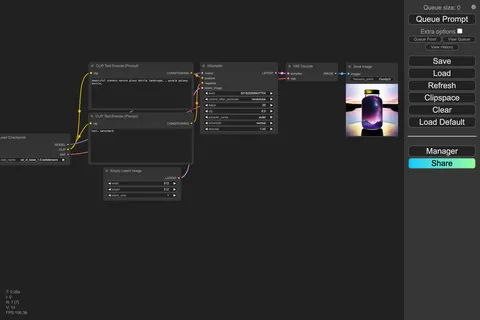
ComfyUI
A node-based workflow builder for advanced image and video generation, ideal for custom pipelines, fine control, and power users.
Web UI · API
Image Generation · Video Generation
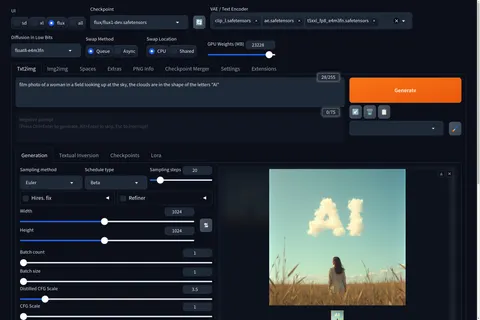
Stable Diffusion WebUI Forge
A faster, more experimental Stable Diffusion WebUI variant focused on improved resource use, quicker inference, and modern model support.
Web UI · API
Image Generation
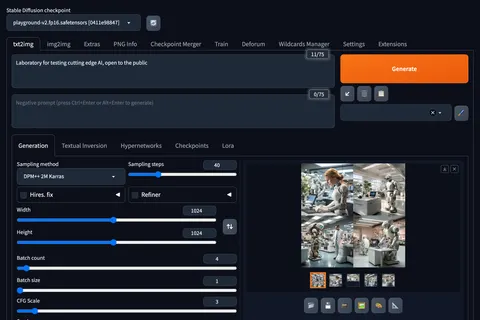
Stable Diffusion Web UI
A full-featured Stable Diffusion interface with deep controls for prompting, inpainting, extensions, and advanced image workflows.
Web UI · API
Image Generation · Video Generation
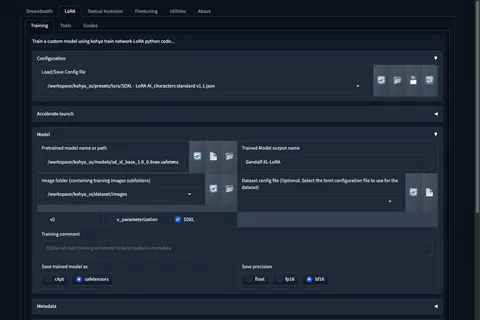
Kohya's GUI
Train LoRAs and fine-tunes for Stable Diffusion and FLUX with a popular GUI for Kohya-based training workflows.
Web UI · API
Fine-Tuning · Image Generation