lllyasviel
ControlNet SD 1.5 Line Art
Downloads
Model Report
Overview
ControlNet SD 1.5 Line Art is a deep learning model designed to provide fine-grained control over Stable Diffusion 1.5 image generation via line art inputs. Developed as part of the ControlNet 1.1 release, it extends the ControlNet architecture to enable precise conditioning of generative outputs based on structural cues from line drawings. This approach enables detailed and reproducible modification of generated images, making it especially applicable to tasks requiring alignment with user-provided sketches or extracted outlines.
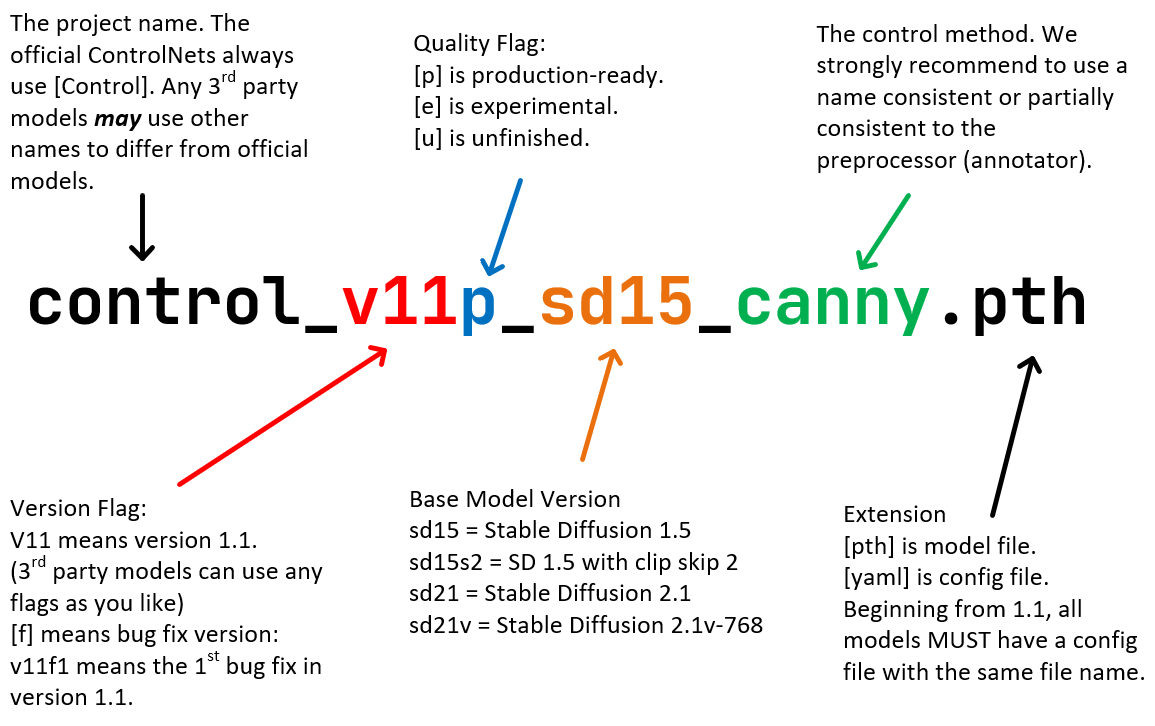
Figure 1. Diagram explaining the Standard ControlNet Naming Rules (SCNNRs) used for ControlNet 1.1 models, detailing each segment of the model filename.
Architecture and Model Family
ControlNet SD 1.5 Line Art is part of the ControlNet 1.1 release, which includes fourteen models designed for a variety of conditioning modalities such as depth, normals, canny edges, and more. All 1.1 models retain the neural network structure first established in ControlNet 1.0, adhering strictly to the architecture to maintain backward compatibility and reproducibility. The ControlNet 1.1 documentation provides a detailed breakdown of the naming conventions and architecture, exemplified by the model filename control_v11p_sd15_lineart.pth and its associated configuration file.
The Line Art variant is specially trained to accept both automatically extracted line art from existing images and user-created manual sketches. This allows for flexible guidance, using either precise contours or more expressive, rough outlines.
Technical Capabilities
ControlNet SD 1.5 Line Art enhances image generation by enforcing structural fidelity to provided line art constraints. The model is capable of handling a range of input complexity, from sparse, manually sketched outlines to intricate line extractions. Using Stable Diffusion 1.5 as its generative backbone, the model preserves the compositional intent specified by line art while adhering to the semantic and aesthetic guidance described in natural language prompts.
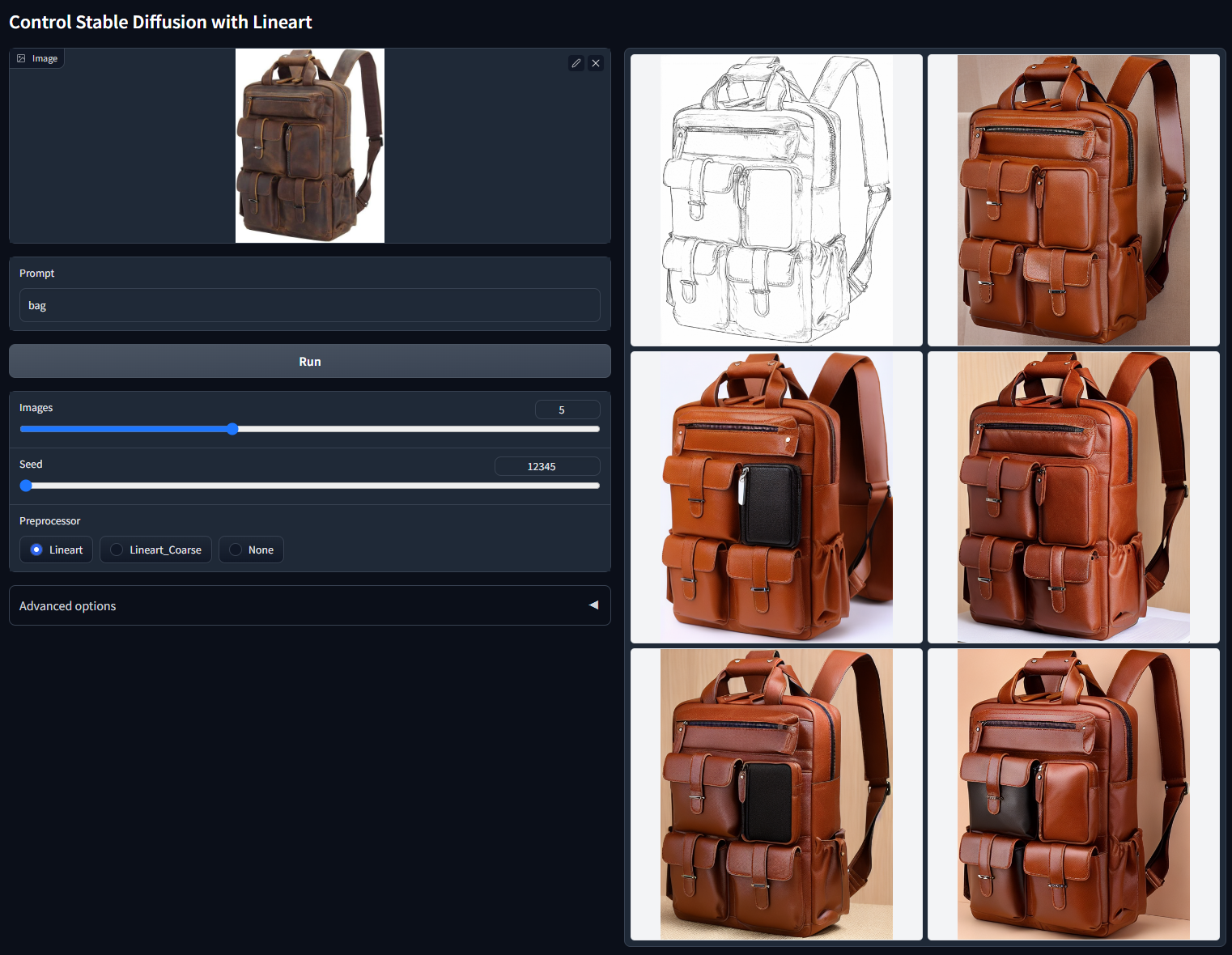
Figure 2. Demonstration of image generation guided by extracted line art of a backpack, using the prompt 'bag'. The right panel shows five model outputs conditioned on the lineart.
Diverse input types are supported:
- Extracted Line Art: Outlines derived algorithmically from photographs, using pre-built preprocessors.
- Coarse or Detailed Line Art: The model accepts different levels of abstraction, allowing creative interpretation.
- Manual Line Drawings: Original user sketches serve as direct structure for image synthesis.
Preprocessor algorithms, such as those for line detection or edge mapping, can be toggled to match the user's needs, ensuring that structural elements from the input are accurately reflected in the output.

Figure 3. Example generation where a photo of a woman is transformed via coarse lineart extraction and the prompt 'Michael Jackson's concert', producing portraits aligned structurally to the original.
Training Data and Methodology
ControlNet SD 1.5 Line Art is trained using the awacke1/Image-to-Line-Drawings dataset, which includes a mixture of automatically extracted line drawings and hand-drawn samples. Data augmentation strategies were applied to increase robustness, permitting the model to generalize across both artificial and organic line art styles.
Improvements over earlier versions stem from refining training protocols, such as de-duplicating grayscale samples to reduce bias, filtering out low-quality or artifact-laden images, and correcting misalignment in text-image prompt pairings. These optimizations, outlined in the 1.1 release notes, have contributed to increased reliability and accuracy in conditioned image generation tasks.
Variants and Related Models
A notable variant within the ControlNet line art family is the ControlNet 1.1 Anime Lineart model, optimized for generation from anime-style line drawings. This version employs longer prompt sequences and alternate tokenization strategies, enhancing its ability to synthesize images in stylized, illustrative domains. Training details for the anime variant are not publicly described but it is engineered to leverage the unique properties of anime line art inputs.
Within the broader ControlNet 1.1 ecosystem, a series of models support other conditioning signals, including depth maps, normal maps, canny edge detections, soft edges, segmentation masks, pose estimation, scribbles, and more, each with their dedicated pre- and post-processing pathways as described in the model documentation. For context, this demonstrates the modularity and extensibility of the ControlNet design.
Use Cases
The principal application of ControlNet SD 1.5 Line Art is the generation of images that precisely adhere to the compositional constraints set by line drawings. This is particularly suitable for image-based content creation pipelines where user-provided or algorithmically extracted line art serves as a blueprint or guide for generating illustrations, concept art, or visualizations.

Figure 4. Generation results from a manually drawn wolf head sketch and the prompt 'wolf', illustrating flexibility in responding to hand-drawn structural guides.
In creative settings, the model facilitates:
- Translating rough sketches or contour maps into richly rendered images.
- Creating multiple stylistic interpretations from a single line art base.
- Ensuring reproducibility of structural features across different images.
- Supporting workflow integration for illustrators and designers seeking to iterate rapidly from outline to completed image.
The anime-oriented variant expands these capabilities to stylized illustration workflows. Model controls, such as prompt length and application of LoRA-based fine-tuning, allow for further refinements suited to specific artistic goals.
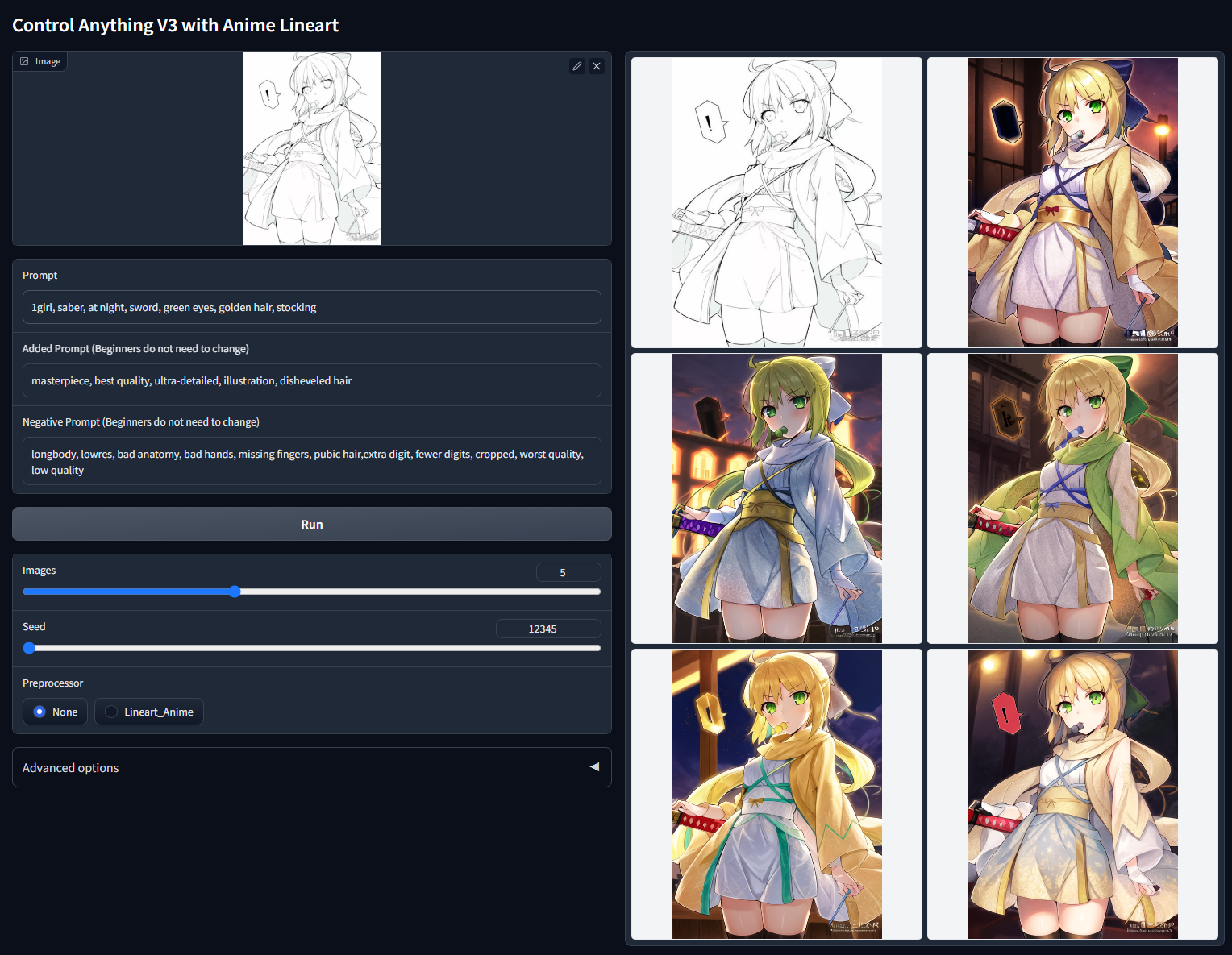
Figure 5. Outputs generated from an anime character line art, prompted with '1girl, saber, at night, sword, green eyes, golden hair, stocking', demonstrating the specialization of the Anime Lineart model.
Limitations
While ControlNet SD 1.5 Line Art and its anime-specific counterpart offer robust control, there are some constraints. For example, the anime lineart variant does not support Guess Mode and may require external files for demonstration or evaluation, as noted in the project documentation. Certain experimental models in the series, such as Instruct Pix2Pix, may require user moderation of outputs or parameter adjustments to obtain optimal results.
License and Availability
As of the latest available documentation, explicit license information for the SD 1.5 Line Art model and the broader ControlNet-v1-1-nightly repository is not provided. Users are advised to consult the official repository for updates regarding licensing and usage restrictions.
Helpful Links
- ControlNet-v1-1 HuggingFace Model Repository – Download and model documentation.
- Stable Diffusion 1.5 – Required base model for operation.
- ControlNet-v1-1-nightly GitHub Repository – Development, updates, and technical details.
- HuggingFace Annotators Model Page – Annotator modules and preprocessors.
- sd-webui-controlnet GitHub Plugin – Implementation extension for Automatic1111.
- Multi-ControlNet Feature Documentation – Guidance on using multiple ControlNet models in combination.
- Issue Tracking ControlNet 1.1 A1111 Update – Community discussion of integration status.
- Bae's Normalmap Estimation and ScanNet Protocol – Resources related to sibling ControlNet models.
For further technical insights and up-to-date information, refer to the ControlNet-v1-1-nightly project page.
More in the Stable Diffusion 1 Family
Stable Diffusion 1.1
Stable Diffusion 1.5
OpenJourney v4
Photon
Juggernaut
Analog Diffusion
Dreamshaper
Realistic Vision
Meina Mix
epiCRealism
Absolute Reality
Cyber Realistic
MajicMIX Realistic
epiCPhotoGasm
ControlNet SD 1.5 Canny
ControlNet SD 1.5 IP2P
ControlNet SD 1.5 Depth
ControlNet SD 1.5 MLSD
ControlNet SD 1.5 Normal
ControlNet SD 1.5 Open Pose
ControlNet SD 1.5 Scribble
ControlNet SD 1.5 Segmentation
ControlNet SD 1.5 Soft Edge
ControlNet SD 1.5 Inpaint
ControlNet SD 1.5 Lineart Anime
ControlNet SD 1.5 Shuffle
ControlNet SD 1.5 Tile
ControlNet 1.5 IP Adapter
ControlNet 1.5 QR Code
Compatible Apps
ComfyUI
A node-based workflow builder for advanced image and video generation, ideal for custom pipelines, fine control, and power users.
Web UI · API
Image Generation · Video Generation
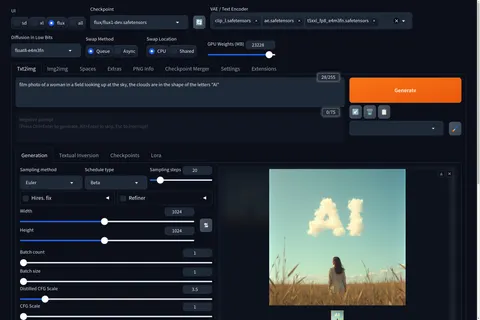
Stable Diffusion WebUI Forge
A faster, more experimental Stable Diffusion WebUI variant focused on improved resource use, quicker inference, and modern model support.
Web UI · API
Image Generation
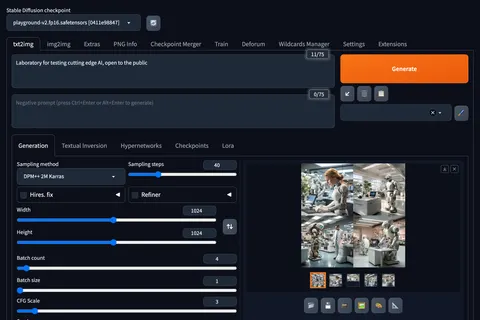
Stable Diffusion Web UI
A full-featured Stable Diffusion interface with deep controls for prompting, inpainting, extensions, and advanced image workflows.
Web UI · API
Image Generation · Video Generation
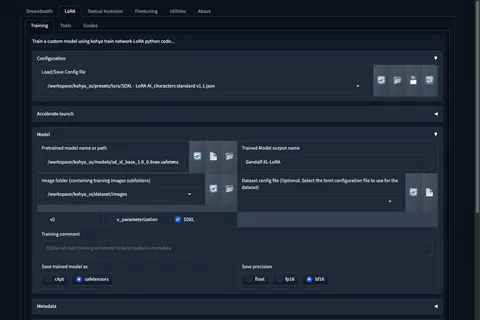
Kohya's GUI
Train LoRAs and fine-tunes for Stable Diffusion and FLUX with a popular GUI for Kohya-based training workflows.
Web UI · API
Fine-Tuning · Image Generation