stabilityai
ControlNet SDXL Depth
Released
2023-08-29
Family
Stable Diffusion XL
Type
ControlNet Model
Downloads
Model Report
Overview
The depth-specific variant of ControlNet 1.1 for Stable Diffusion 1.5, formally known as control_v11f1p_sd15_depth, is a generative artificial intelligence model that enables the targeted guidance of Stable Diffusion 1.5 using depth maps. As part of the ControlNet 1.1 release, it preserves the architecture of previous ControlNet models while introducing improvements in robustness and quality that facilitate more accurate image synthesis conditioned on depth estimations. By integrating depth information, this model extends the capabilities of diffusion models to produce images that adhere closely to the spatial constraints and three-dimensional cues embedded in input depth maps.
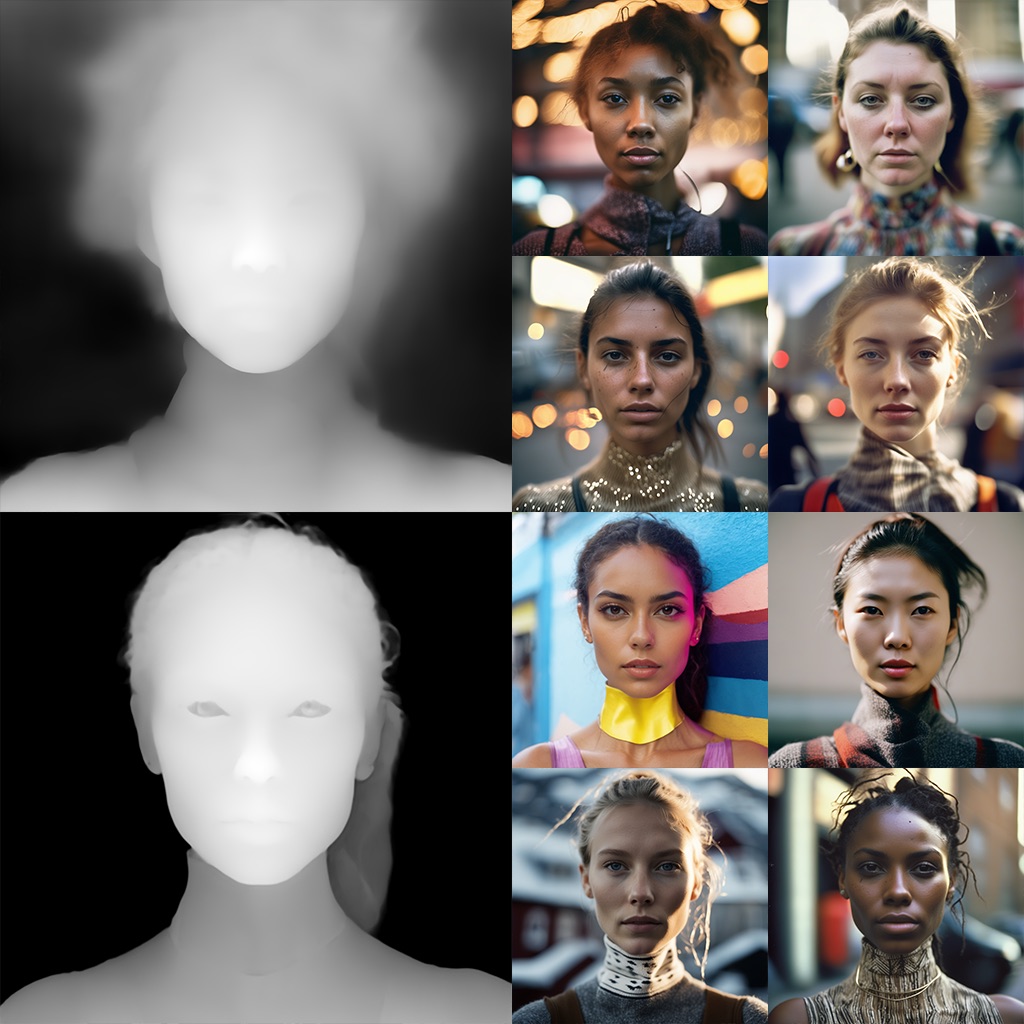
Figure 1. Visualization of depth map-based image generation using a grayscale depth map and resulting portrait outputs. Prompt: Women’s portrait synthesis with grayscale depth control.
Model Architecture and Operation
This model is grounded in the ControlNet 1.1 architecture, closely following the network design of ControlNet 1.0. The model functions as a conditional control system layered upon the Stable Diffusion framework, providing additional input channels that align the generative process with external structural cues, particularly those encoded in depth maps.
Depth maps, which may originate from monocular depth estimation algorithms or real-world 3D renderers, are preprocessed and entered into the model. The depth-aware conditioning enables the diffusion process to respect the foreground-background relationships, occlusion order, and relative distances expressed in the map. This is achieved without architectural divergence from earlier ControlNet versions, ensuring model stability and reproducibility as the developers deliberately deferred major changes until future releases.
ControlNet's codebase is primarily implemented in Python, facilitating modifiability and integration within established diffusion pipelines.
Training Data and Methodology
The depth-specific variant of ControlNet 1.1 was trained using a multi-source dataset that amalgamates depth maps produced by MiDaS, Leres, and Zoe Depth methods. Training incorporated data augmentation strategies, including random left-right flipping, and utilized depth maps across multiple input resolutions (256, 384, and 512 pixels) to bolster generalization to different scale and source variations.
Key improvements over prior models address several data quality challenges. Corrections to the training set eliminated duplicated grayscale images and low-quality samples, while also refining the correspondence between images and textual prompts. These enhancements yielded a model that is not tuned to any singular depth estimation method, resulting in robust performance even when driven by depth maps from novel sources or varying preprocessing pipelines.
To further harness resource efficiency, parallel developments such as Control-LoRA's MiDaS and ClipDrop Depth models have demonstrated that low-rank adaptation techniques can produce compact models capable of similar depth-based guidance, using training inputs like MiDaS dpt_beit_large_512 and finetuning with ClipDrop's Portrait Depth Estimation.
Applications and Use Cases
This model principally serves to guide the image generation capabilities of Stable Diffusion 1.5 according to the constraints imposed by input depth maps. The resulting system is able to generate images consistent with the geometric arrangement and spatial relationships of objects specified by the depth input. This is particularly useful in tasks requiring fidelity to three-dimensional scene layout, such as the generation of photorealistic portraits, interior renderings, and arbitrary scene synthesis from sketched or programmatically derived depth cues.
Depth-based control is one modality among several in the broader ControlNet 1.1 family of models, which encompasses additional control types including edge, normal map, scribble, line art, soft edge, segmentation, pose (OpenPose), inpainting, and stylization controls.
Comparison within the Model Family
The depth-specific ControlNet 1.1 model is one of a suite of specialized models designed to provide conditional image generation through a diversity of input modalities. Other prominent models within the same release manage control via Canny edge detection, Bae's normal map estimation, scribble and line art inputs, semantic segmentation, and OpenPose outputs.
Efforts towards more resource-efficient deployment are realized in the form of Control-LoRA variants, which employ low-rank adaptation to reduce model size from approximately 4.7GB to as little as 377MB. This enables depth, edge, and stylization controls to be accessible on consumer hardware with a reduced computational footprint. These LoRA-based models maintain the core functionalities of their larger ControlNet counterparts, offering similar user control while facilitating broader accessibility.
Limitations and Considerations
While this model generally provides robust depth conditioning, certain modalities in the ControlNet family—such as the experimental instruct-based ip2p and the stylization-oriented shuffle—may require user discretion and iterative refinement for optimal results. Additionally, some specialized models like the anime-focused line art variant (control_v11p_sd15s2_lineart_anime.pth) are contingent on specific model checkpoints and do not support all operational modes present in other controls.
The license governing this model and its family of models has not been explicitly detailed in the available documentation.
External Resources
For further technical insights, code, and downloads:
- ControlNet-v1-1 HuggingFace Model Page
- Stable Diffusion v1-5 HuggingFace Model Page
- ControlNet Annotators HuggingFace Model Page
- sd-webui-controlnet GitHub Repository
- Automatic1111 with Multi-ControlNet Documentation
- Image-to-Line-Drawings GitHub
- Instruct Pix2Pix Dataset
- ClipDrop API Docs - Portrait Depth Estimation
More in the Stable Diffusion XL Family
Stable Diffusion XL
SDXL Turbo
SDXL Lightning
OpenDalle
Yamer's Realistic
AlbedoBase XL
Juggernaut XL
Realistic Vision XL
New Reality XL
Realism Engine SDXL
Animagine XL
Nightvision XL
Dreamshaper XL
Pony Diffusion V6 XL
ControlNet SDXL Diffusers Canny
ControlNet SDXL Canny
ControlNet SDXL Diffusers Depth
ControlNet SDXL Recolor
ControlNet SDXL IP Adapter
ControlNet SDXL Open Pose
More from stabilityai
Stable Video Diffusion
Stable Video Diffusion XT
Stable Video Diffusion XT 1.1
Stable Video 3D
Stable Video 4D
Stable Fast 3D
Stable Diffusion 2
Stable Diffusion 1.1
Stable Diffusion 1.5
Stable Diffusion 3.5 Large
Stable Diffusion 3.5 Turbo
Stable Cascade Stage A
Stable Cascade Stage B
Stable Cascade Stage C
Stable Audio Open 1.0
Compatible Apps
ComfyUI
A node-based workflow builder for advanced image and video generation, ideal for custom pipelines, fine control, and power users.
Web UI · API
Image Generation · Video Generation
Stable Diffusion WebUI Forge
A faster, more experimental Stable Diffusion WebUI variant focused on improved resource use, quicker inference, and modern model support.
Web UI · API
Image Generation
Stable Diffusion Web UI
A full-featured Stable Diffusion interface with deep controls for prompting, inpainting, extensions, and advanced image workflows.
Web UI · API
Image Generation · Video Generation
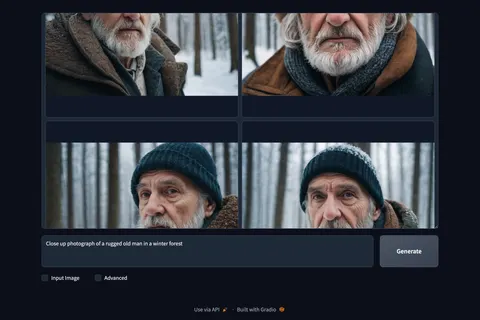
Fooocus
A beginner-friendly image generator focused on strong defaults, with built-in inpainting, outpainting, upscaling, and image prompting.
Web UI · API
Image Generation · Beginner Friendly
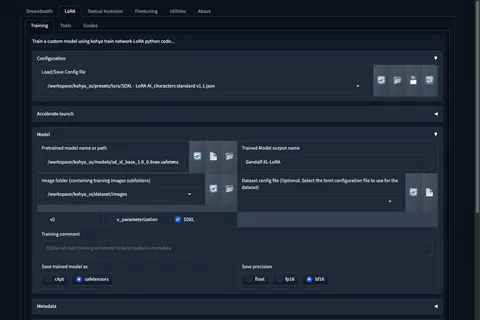
Kohya's GUI
Train LoRAs and fine-tunes for Stable Diffusion and FLUX with a popular GUI for Kohya-based training workflows.
Web UI · API
Fine-Tuning · Image Generation