stabilityai
Stable Cascade Stage B
Released
2024-02-13
Family
Stable Cascade
Type
Foundation Model
Downloads
Model Report
Overview
Stable Cascade Stage B is a key component within the Stable Cascade generative text-to-image model suite developed by Stability AI and built upon the Würstchen architecture. This diffusion-based model system is distinguished by its highly compressed latent space and multi-stage cascaded structure, delivering improvements in computational efficiency while maintaining high output fidelity. Stage B, in particular, serves as the intermediate latent super-resolution module, bridging the low-dimensional outputs of Stage C (the text-conditional latent generator) and the reconstruction capabilities of Stage A (the pixel-space decoder).

Figure 1. A collage of diverse images generated using Stable Cascade, demonstrating its versatility across various subjects, compositional styles, and artistic approaches.
Model Architecture and Functional Role
The Stable Cascade architecture is decomposed into three primary stages: Stage C (latent generator), Stage B (latent super-resolution), and Stage A (VQGAN-based latent decoder). Stage B receives compressed latents from Stage C—specifically, a 16×24×24 tensor for a 1024×1024 resolution image—and performs upsampling to a more detailed, less-compressed latent representation (4×256×256), preparing these for eventual decoding into full-resolution images by Stage A.

Figure 2. Diagram illustrating the three-stage architecture of Stable Cascade, with Stage C generating text-conditional latents, Stage B performing super-resolution in latent space, and Stage A decoding to final images.
Stage B operates as a diffusion model in the latent domain, functioning as a semantic compressor and super-resolver. It leverages conditioning from both the high-level latents generated by Stage C and the input text embeddings, allowing it to reconstruct small-scale features and fine-grained details that would be lost at high compression ratios. Two primary configurations of Stage B exist: a 700-million parameter version and an enhanced 1.5-billion parameter variant, the latter offering improved detail retention according to benchmark results.
The core of Stage B is a diffusion process that upscales heavily compressed representations while preserving alignment with the original text prompt and semantic content, a process referred to as "latent super-resolution" in the Würstchen architecture paper. A dedicated encoder network, initialized with ImageNet-pretrained weights, facilitates the creation of these highly informative latents.
Training Methodology and Data
All stages of Stable Cascade, including Stage B, are trained on a carefully filtered subset of the LAION-5B dataset. This subset underwent aggressive de-duplication and filtering to remove duplicate, inappropriate, watermarked, or low-quality content, ultimately yielding about 103 million unique image-text pairs from the original 5 billion. During training, images below 512×512 resolution were discarded, and further aesthetic and safety filtering was enforced to optimize for model robustness.
Stage B training utilized the Denoising Diffusion Probabilistic Models (DDPM) algorithm to facilitate iterative denoising and upsampling in the latent space. The implementation incorporated classifier-free guidance to enable more flexible and prompt-aligned sampling, with some training steps intentionally dropping the text condition to improve generalization.
Computationally, Stage B required approximately 11,000 A100-GPU hours for training, a figure notably lower than that required for earlier diffusion-based models such as Stable Diffusion, reflecting the efficiency gains of the cascaded architecture.
Technical Capabilities and Extensions
Stage B's principal function is to enhance the semantic and visual quality of intermediate latents. By operating as a bridge between a highly compressed representation and near-pixel-level detail, it enables the overall system to compress an image at a 42:1 ratio—from 1024×1024 to 24×24 at Stage C—then incrementally restore detail with reduced computational overhead. This stands in contrast to previous generative diffusion models, such as Stable Diffusion, which typically operate at a much lower compression factor (8:1 for the same resolution).
A key feature of Stage B is its modularity, supporting independent training or fine-tuning from the other stages. This design facilitates extensibility with popular conditioning and control frameworks, such as LoRA, ControlNet, and IP-Adapter, thus supporting creative workflows like inpainting, outpainting, edge conditioning, and super-resolution.

Figure 3. Generated image variations on a core concept, showcasing Stage B's support for semantic image transformation and detail refinement.

Figure 4. Image-to-image outputs produced by Stable Cascade, with Stage B enhancing visual detail and character variation within a fixed conceptual frame.
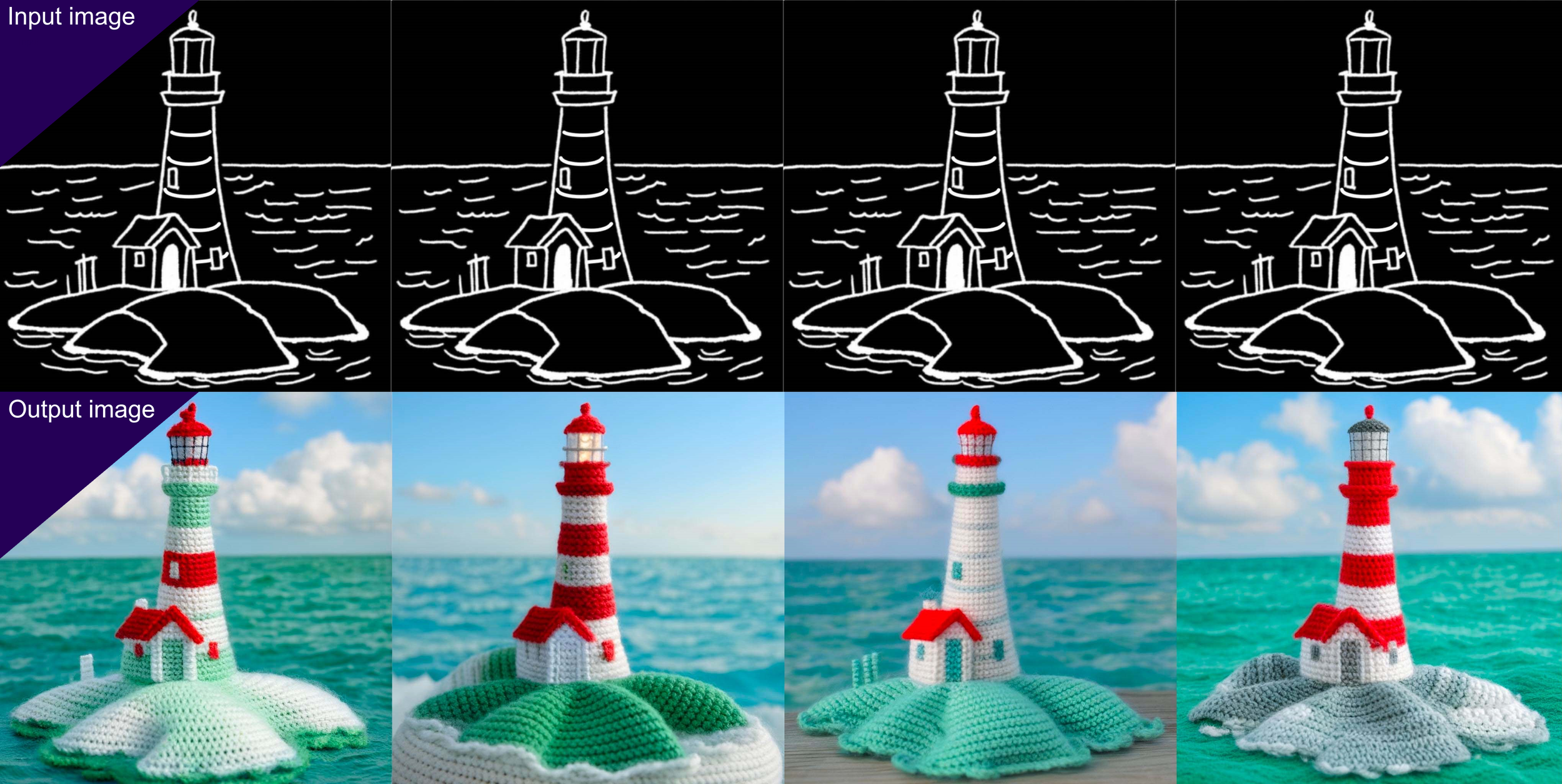
Figure 5. Canny Edge ControlNet example: using sparse edge sketches as input, Stage B outputs richly detailed, photorealistic crocheted lighthouse scenes.
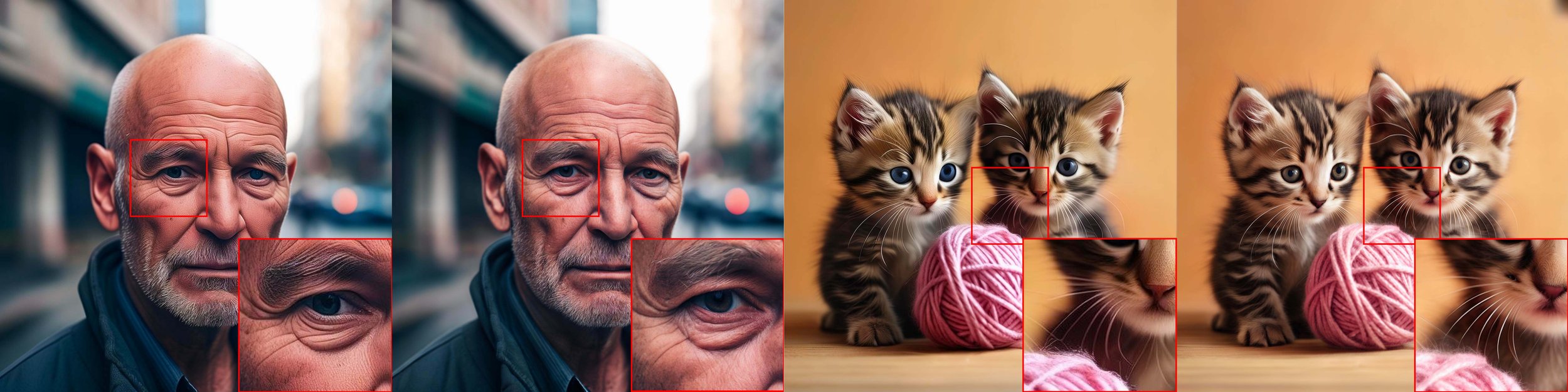
Figure 6. Visualization of the 2x Super Resolution feature, with insets highlighting the improved facial details and fur textures attributable to Stage B's upscaling.
Performance and Benchmarking
Extensive benchmarking of Stable Cascade and its constituent stages, including Stage B, has been conducted using established metrics such as Inception Score (IS), Fréchet Inception Distance (FID), and human preference evaluations. According to published evaluations, Stable Cascade demonstrates strong prompt alignment and aesthetic quality when compared to other leading generative models such as Playground v2, SDXL, SDXL Turbo, and Würstchen v2.
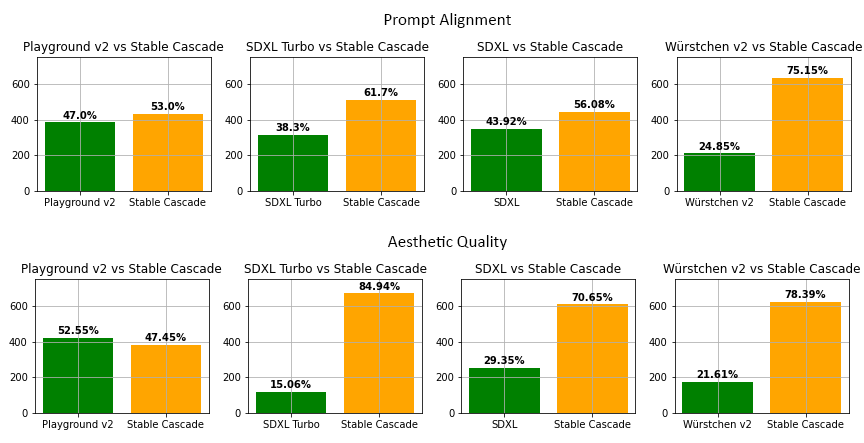
Figure 7. Bar charts reflecting Stable Cascade's comparative performance in human-rated prompt alignment and aesthetic quality against several other state-of-the-art models.
On the COCO-30k dataset, Stable Cascade achieved an Inception Score of 40.9, slightly surpassing earlier models in this comparison class, though with a higher FID of 23.6, a tradeoff attributed to smoother generated visuals. Human evaluators expressed a preference for Stable Cascade's outputs, particularly in scenarios measured by the parti-prompts dataset.
Importantly, inference speed is another domain where the system excels. Despite the large model size, the total inference latency for a 1024×1024 image is substantially reduced compared to previous generation diffusion models.

Figure 8. Comparison of inference speeds for Stable Cascade, SDXL, Playground v2, and SDXL Turbo at the same batch size, illustrating the efficiency gains from the cascaded design.
Limitations and Research Context
Stage B, while an effective module for upscaling semantic latents and integrating prompt context, does have inherent constraints. The aggressive compression used by preceding stages (especially Stage C) can challenge the fidelity of spatial compositions, such as rendering legible text or precise object quantities. Its autoencoding process remains lossy, which may limit fine-grained reconstruction in highly detailed regions. Additionally, due to the filtering of the LAION-5B dataset, certain visual styles may be over-represented in outputs.
The model is intended solely for research and non-commercial use, as governed by the Stability AI acceptable use policy. Its outputs are not guaranteed to be factual depictions of real individuals or events.
Applications
Stage B supports a range of creative and scientific workflows within the broader Stable Cascade system. Common research applications include:
- Text-to-image synthesis for artistic, aesthetic, or creative design.
- Image variation and transformation, using reference images or embeddings.
- Image-to-image generation, including inpainting, style transfer, and edge-based guidance.
- Super-resolution tasks, leveraging latent upscaling for higher resolution outputs.
These capabilities are extended through integration with open-source libraries and conditioning methods, making it a flexible tool for experimentation with image generation.
Release and Availability
Stable Cascade and its components, including Stage B, are available under a non-commercial research license. The Würstchen architecture paper was first made public in January 2024, with Stage B's algorithms and models detailed in both the main paper and accompanying technical documentation. Source code, pretrained model weights, and further documentation are provided to the research community for transparent evaluation and independent study.
Helpful Links
More in the Stable Cascade Family
Stable Cascade Stage A
Stable Cascade Stage C
More from stabilityai
Stable Video Diffusion
Stable Video Diffusion XT
Stable Video Diffusion XT 1.1
Stable Video 3D
Stable Video 4D
Stable Fast 3D
Stable Diffusion 2
Stable Diffusion 1.1
Stable Diffusion 1.5
Stable Diffusion XL
SDXL Turbo
ControlNet SDXL Canny
ControlNet SDXL Depth
ControlNet SDXL Recolor
Stable Diffusion 3.5 Large
Stable Diffusion 3.5 Turbo
Stable Audio Open 1.0
Compatible Apps
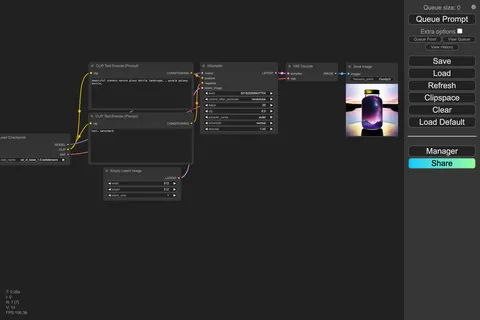
ComfyUI
A node-based workflow builder for advanced image and video generation, ideal for custom pipelines, fine control, and power users.
Web UI · API
Image Generation · Video Generation
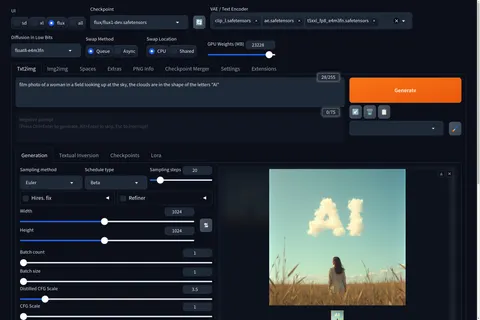
Stable Diffusion WebUI Forge
A faster, more experimental Stable Diffusion WebUI variant focused on improved resource use, quicker inference, and modern model support.
Web UI · API
Image Generation
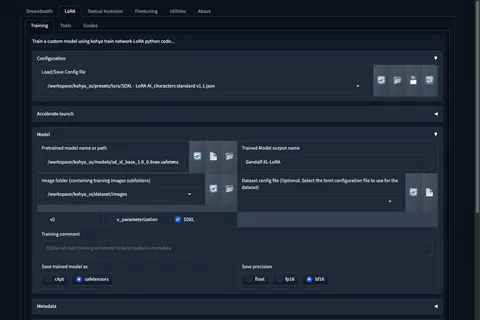
Kohya's GUI
Train LoRAs and fine-tunes for Stable Diffusion and FLUX with a popular GUI for Kohya-based training workflows.
Web UI · API
Fine-Tuning · Image Generation