thibaud
ControlNet SDXL Open Pose
Released
2023-08-29
Family
Stable Diffusion XL
Type
ControlNet Model
Downloads
Model Report
Overview
ControlNet SDXL OpenPose is a generative AI model that augments the capabilities of latent diffusion models by constraining image generation to match human poses inferred by the OpenPose framework. As part of the ControlNet 1.1 family of models, OpenPose maintains architectural compatibility with previous ControlNet releases while introducing improvements in pose conditioning, dataset curation, and multimodal input support. This empowers researchers and practitioners to synthesize images with precise pose control, supporting applications in creative media and computer vision research.

Figure 1. Generated image showing prompt-driven, pose-controlled output for 'man in suit' using ControlNet 1.1 OpenPose. The output image follows the pose derived from the input pose skeleton.
Model Architecture and Design
ControlNet OpenPose operates as a conditional branch on top of the Stable Diffusion architecture, fusing external guidance based on detected pose keypoints into the generative process. The OpenPose variant specifically utilizes body, hand, and facial keypoint maps produced by the OpenPose preprocessor to regulate coherency and alignment in the generated outputs.
While the underlying neural network architecture in ControlNet 1.1 remains unchanged compared to earlier versions, realized improvements in training methodology include enhancements to input diversity, removal of erroneously labeled training pairs, and an upgraded approach to preprocessing—particularly for hand detection accuracy. As a result, ControlNet 1.1 OpenPose demonstrates improved robustness and fidelity when translating pose information into visual content, as documented in the ControlNet-v1-1-nightly release notes.
Pose Control with OpenPose Conditioning
The defining feature of ControlNet SDXL OpenPose is its ability to guide image generation to reproduce complex human poses as defined by OpenPose keypoints, including nuanced articulations of limbs, hands, and faces. The model accepts a variety of conditioning inputs, ranging from body-only to full-body with hand and face keypoints, depending on the user's requirements. Recommended usage typically involves selecting either "OpenPose" for body pose or "OpenPose Full" for full body, hand, and face conditioning, as implemented in the official annotator tools.
Through these constraints, ControlNet OpenPose enables applications such as pose-to-image translation, multi-subject composition, and animation keyframe generation. Empirical tests demonstrate the model's capacity to generate naturalistic and prompt-appropriate images while precisely following the pose skeleton provided, as shown in evaluation samples.

Figure 2. Batch output showing multi-person pose generation with ControlNet 1.1 OpenPose Full, where the model generates images for 'handsome boys in the party' according to the extracted OpenPose keypoints.
Training Enhancements and Dataset Refinement
ControlNet 1.1 OpenPose addresses limitations of earlier versions by implementing comprehensive dataset cleaning and augmentation. Issues such as duplicated grayscale figures, low-quality images, and mismatched prompt-image pairs were resolved through targeted dataset repairs, resulting in more diverse and reliable training data. This process is described in detail in the official ControlNet repository documentation.
A key technical advancement lies in the harmonization of the OpenPose annotation pipeline. The training now leverages improved hand and face detection by reconciling differences between PyTorch and C++ implementations of OpenPose. The upgraded preprocessor produces more consistent and richly annotated pose maps, which in turn lead to improved conditioning and generation fidelity for hands, faces, and complex body movements.
Applications and Use Cases
ControlNet SDXL OpenPose has broad applicability across research and creative disciplines. In digital art pipelines, the model facilitates the rendering of character illustrations or scenes where specific body postures are required. In the domain of computer vision, OpenPose-guided generation can be leveraged for synthetic data augmentation, enhancing pose-estimation datasets with photorealistic, pose-accurate visuals.
The model accommodates arbitrary prompt and pose combinations, allowing for synthesis of images with multiple subjects or complex physical interactions. It also supports integration into modular workflows, where additional ControlNet variants or community LoRA models can be composited to further refine image properties, as discussed in the ControlNet project documentation.
Model Family and Related Variants
While the OpenPose branch is specialized for pose conditioning, ControlNet 1.1 encompasses a suite of targeted models including depth, normal map, edge, segmentation, lineart, scribble, and inpainting variants. Each model leverages modality-specific annotations to direct the diffusion process. For comprehensive information on the full model suite and technical differences between variants, consult the ControlNet-v1-1 HuggingFace model hub.
Within this context, ControlNet OpenPose is distinguished by its approach to synthesizing human subjects conditioned on precise pose keypoints, supporting challenging scenes such as multi-person interactions or detailed hand movements.
Resources and Further Reading
For users and researchers interested in utilizing or extending ControlNet SDXL OpenPose, the following resources provide technical documentation, model downloads, and additional context on preprocessing pipelines:
- ControlNet GitHub Repository
- ControlNet-v1-1 HuggingFace Model Page
- Official Annotator Tools
- Stable Diffusion XL (SDXL) model checkpoints
- OpenPose Project Homepage
These resources collectively support both practical deployment and further research into conditional generative modeling architectures compatible with advanced pose guidance.
More in the Stable Diffusion XL Family
Stable Diffusion XL
SDXL Turbo
SDXL Lightning
OpenDalle
Yamer's Realistic
AlbedoBase XL
Juggernaut XL
Realistic Vision XL
New Reality XL
Realism Engine SDXL
Animagine XL
Nightvision XL
Dreamshaper XL
Pony Diffusion V6 XL
ControlNet SDXL Diffusers Canny
ControlNet SDXL Canny
ControlNet SDXL Diffusers Depth
ControlNet SDXL Depth
ControlNet SDXL Recolor
ControlNet SDXL IP Adapter
Compatible Apps
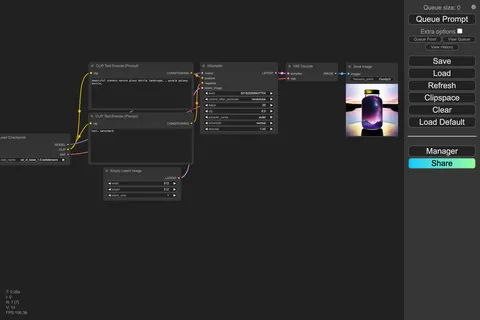
ComfyUI
A node-based workflow builder for advanced image and video generation, ideal for custom pipelines, fine control, and power users.
Web UI · API
Image Generation · Video Generation
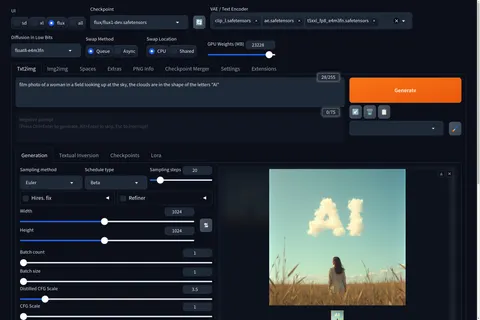
Stable Diffusion WebUI Forge
A faster, more experimental Stable Diffusion WebUI variant focused on improved resource use, quicker inference, and modern model support.
Web UI · API
Image Generation
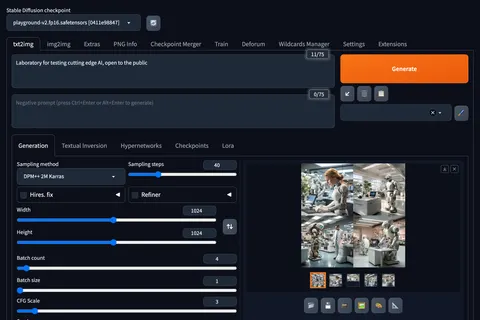
Stable Diffusion Web UI
A full-featured Stable Diffusion interface with deep controls for prompting, inpainting, extensions, and advanced image workflows.
Web UI · API
Image Generation · Video Generation
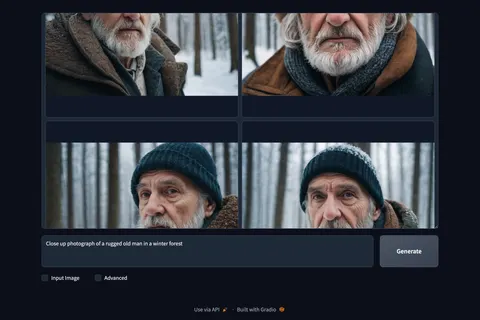
Fooocus
A beginner-friendly image generator focused on strong defaults, with built-in inpainting, outpainting, upscaling, and image prompting.
Web UI · API
Image Generation · Beginner Friendly
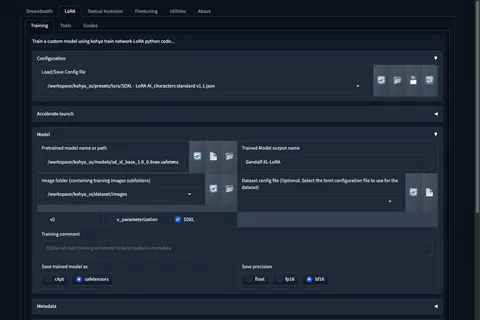
Kohya's GUI
Train LoRAs and fine-tunes for Stable Diffusion and FLUX with a popular GUI for Kohya-based training workflows.
Web UI · API
Fine-Tuning · Image Generation