Yamer
Yamer's Realistic
Released
2024-01-19
Family
Stable Diffusion XL
Type
Fine-Tuned Model
Downloads
Model Report
Overview
Yamer's Realistic is a generative AI model designed to produce highly realistic images, with an emphasis on versatility across portraiture, full-body renderings, and imaginative sceneries. Built upon the SDXL architecture, the model has evolved through several versions, culminating in Version 5, which introduces three distinct variants: TX, SX, and RX. These models serve as checkpoint merges, integrating features and learning from multiple base models to achieve robust, flexible image generation.

Figure 1. Comparative outputs from Yamer's Realistic 5 TX, SX, and RunDiffusion variants across various CFG scales, illustrating the effect of both model choice and generation parameters.
Technical Architecture and Features
Yamer's Realistic builds upon the SDXL base model, utilizing a checkpoint merge technique that combines learned representations from several independently trained models. The Version 5 update introduced three branches—TX, SX, and RX—each offering nuanced differences in color rendering, saturation, and generation characteristics. Notably, the RX model was developed through a collaboration with RunDiffusion, integrating the Realistic 5 and RunDiffusion photo checkpoints.
The model leverages the SafeTensor format for secure storage and distribution, with the full fp16 model occupying approximately 6.46 GB. Most recent versions incorporate the SDXL VAE (Variational AutoEncoder) directly into the checkpoint, streamlining the generation pipeline. The model demonstrates flexibility; while the core output style targets realism, users can achieve alternative aesthetics, such as an anime-inspired appearance, through tailored prompting.
Output Quality and Performance
Yamer's Realistic is recognized for producing "realistic enough" results across a range of subjects and environments. It is particularly effective at generating full-body images, close-up portraits, and complex scenes such as futuristic cities and home interiors. The model demonstrates strong generalization, requiring neither a refiner nor additional detailing tools for quality results.
According to user reviews, the model has received an "Overwhelmingly Positive" reception, accumulating over 1,900 ratings as of January 2024. Guidance higher than a CFG (Classifier-Free Guidance) scale of 15 can negatively affect image integrity.
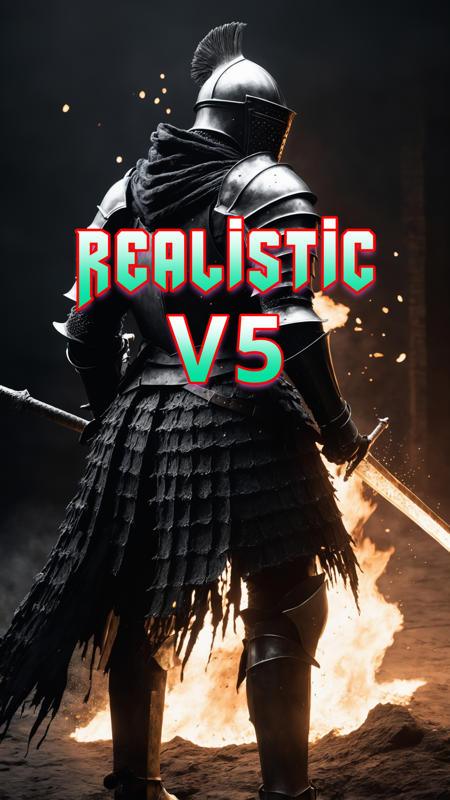
Figure 2. A dramatic, high-detail model output featuring a knight in a molten landscape, exemplifying the model's ability to blend realism with stylized fantasy elements.
Users are encouraged to use prompt keywords such as “realistic,” “photo,” “raw photo,” and “photography” to further reinforce the desired level of realism. The model performs well at the SDXL standard resolution of 1024x1024, with optimal generation steps ranging from 30 to 150; using fewer steps may result in artifacts.
Training Methodology and Merging Process
Unlike traditional models trained from scratch on curated datasets, Yamer's Realistic was constructed as a Checkpoint Merge. This process involves fusing parameters from separately trained models, enabling the integration of distinct strengths and characteristics without direct reference to a single, consolidated dataset. The Version 5 RX, in particular, was the result of a merge between the Realistic 5 and RunDiffusion photo checkpoints in partnership with RunDiffusion, enhancing its rendering of photographic details.
Details regarding the specific datasets employed in the training of the base models are not disclosed, but the merging technique allows for rapid iteration and adaptation by blending high-performing checkpoints. The inclusion of a baked-in SDXL VAE in most recent variants ensures smooth color transitions and high-fidelity outputs without requiring external refinement steps.
Applications and Use Cases
Yamer's Realistic is primarily employed for generating lifelike imagery suited to a range of creative, illustrative, and design contexts. Its versatility allows for the production of full-body and close-up human figures, architectural interiors, futuristic environments, and surrealistic compositions. The model’s ability to adapt styles via prompt conditioning enables both straightforward realism and more imaginative aesthetic outcomes.
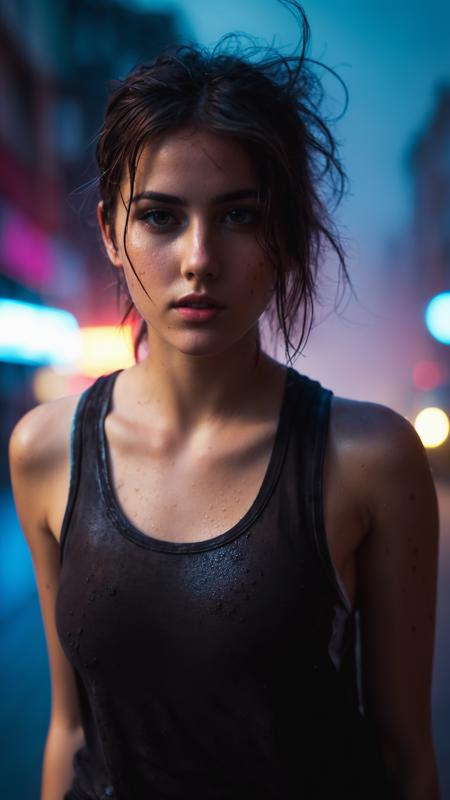
Figure 3. A realistic portrait of a young woman at night, demonstrating the model’s finesse with texture, lighting, and urban atmosphere. Prompt: not provided.

Figure 4. Surreal concept artwork generated by the model: a suited figure with planets as a head, illustrating flexibility in blending realism with imaginative themes.
The model has been utilized for digital illustration, conceptual art, and content generation for visual storytelling. While it is capable of producing a range of image themes, guidance via prompt engineering enables tailoring the outcome to specific aesthetic or narrative requirements.
Versions, Limitations, and Related Models
Since its initial release in January 2024, Yamer's Realistic has undergone several updates, with Version 5 launched in October 2024. Variants TX, SX, and RX were introduced, each displaying distinct responses to prompt cues, colors, and saturation settings. Previous generations (V1 through V4) remain available for historical comparison, and the creator has developed other related models, such as Yamer's Style, a LoRA for abstract, ethereal artwork, and Pixel Art Diffusion XL for pixel-art style generation.
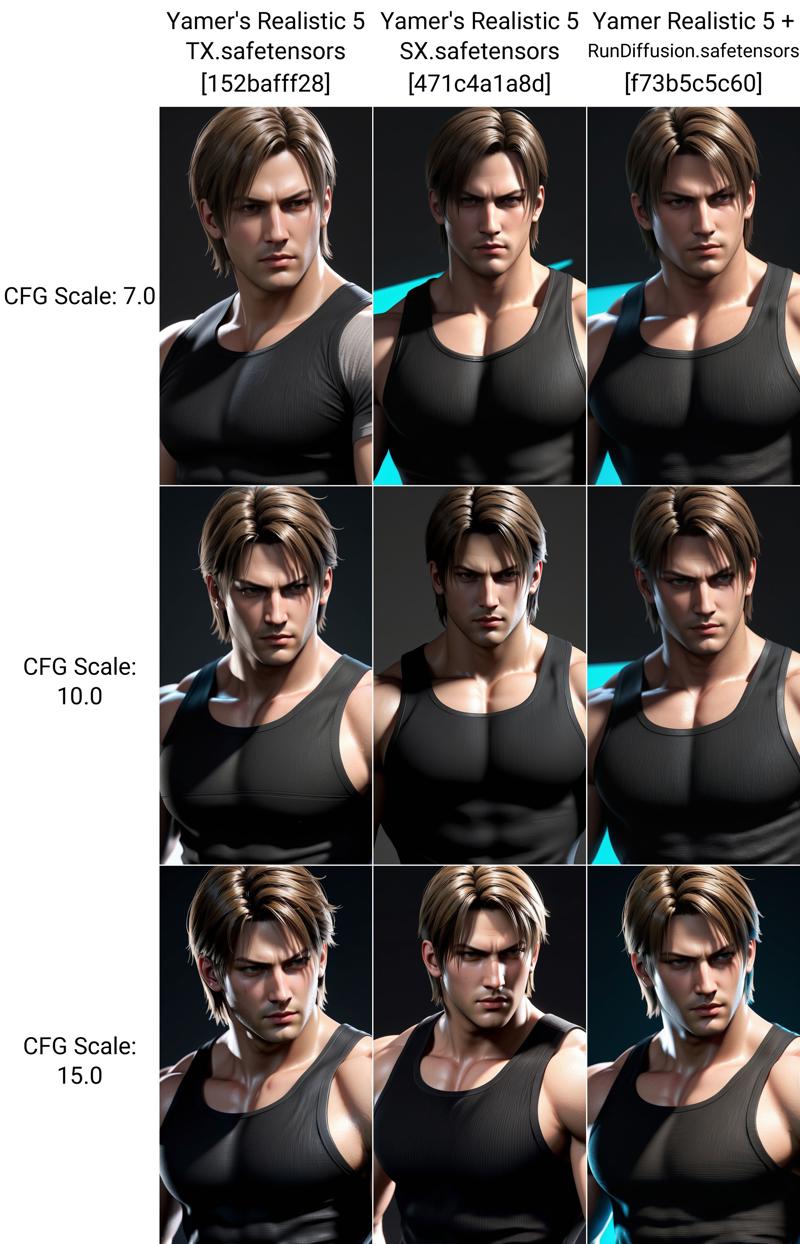
Figure 5. Comparison of Yamer's Realistic 5 outputs showing a 3x3 grid of male figure renderings, varying by model version and CFG scale to illustrate subtleties in output fidelity and color.
Despite its flexibility, the model is not intended to achieve precise photorealism; rather, it focuses on a balance between artistic realism and functional utility. Users have noted limitations when exceeding a CFG scale of 15, as well as the emergence of artifacts at step counts below 30. Some integration challenges have also been reported with Instant ID systems and other deployment platforms.
The model is distributed under the CreativeML Open RAIL++-M license, with an associated license addendum, allowing for responsible and transparent use. The checkpoint merge process and license selection align with practices for accessibility within the AI art generation community.
Helpful Resources
More in the Stable Diffusion XL Family
Stable Diffusion XL
SDXL Turbo
SDXL Lightning
OpenDalle
AlbedoBase XL
Juggernaut XL
Realistic Vision XL
New Reality XL
Realism Engine SDXL
Animagine XL
Nightvision XL
Dreamshaper XL
Pony Diffusion V6 XL
ControlNet SDXL Diffusers Canny
ControlNet SDXL Canny
ControlNet SDXL Diffusers Depth
ControlNet SDXL Depth
ControlNet SDXL Recolor
ControlNet SDXL IP Adapter
ControlNet SDXL Open Pose
Compatible Apps
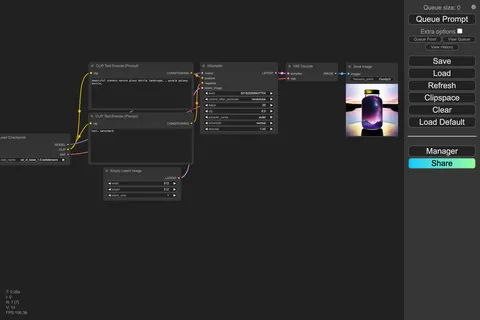
ComfyUI
A node-based workflow builder for advanced image and video generation, ideal for custom pipelines, fine control, and power users.
Web UI · API
Image Generation · Video Generation
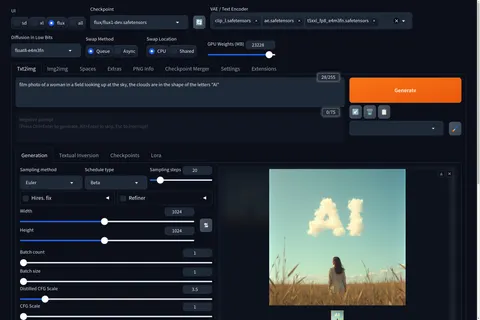
Stable Diffusion WebUI Forge
A faster, more experimental Stable Diffusion WebUI variant focused on improved resource use, quicker inference, and modern model support.
Web UI · API
Image Generation
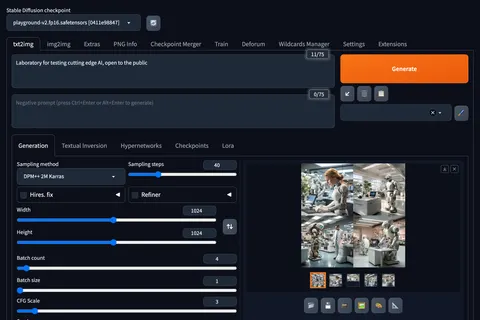
Stable Diffusion Web UI
A full-featured Stable Diffusion interface with deep controls for prompting, inpainting, extensions, and advanced image workflows.
Web UI · API
Image Generation · Video Generation
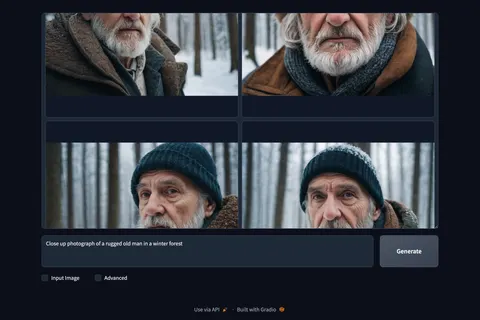
Fooocus
A beginner-friendly image generator focused on strong defaults, with built-in inpainting, outpainting, upscaling, and image prompting.
Web UI · API
Image Generation · Beginner Friendly
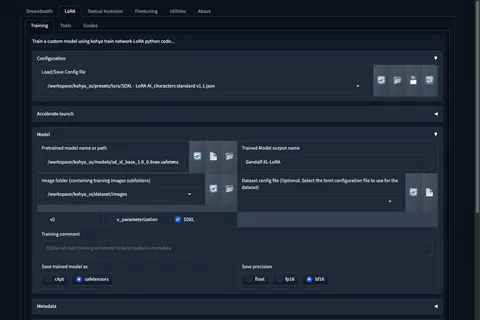
Kohya's GUI
Train LoRAs and fine-tunes for Stable Diffusion and FLUX with a popular GUI for Kohya-based training workflows.
Web UI · API
Fine-Tuning · Image Generation