diffusers
ControlNet SDXL Diffusers Depth
Released
2023-08-29
Family
Stable Diffusion XL
Type
ControlNet Model
Downloads
Model Report
Overview
ControlNet SDXL Diffusers Depth is a deep learning model within the ControlNet 1.1 suite, specializing in guided image synthesis through the use of depth maps. As an evolution of the original ControlNet 1.0 framework, this model is designed to enable fine-grained control over image generation using structural cues contained in depth information. Its robust architecture is closely aligned with its predecessor, but it features improved dataset quality, compatibility with various depth estimation methods, and advancements in performance. The model is applicable to tasks where the preservation of spatial relationships and three-dimensional structure is critical, as it translates depth cues directly into photorealistic or stylized images guided by textual prompts, while leveraging the capabilities of Stable Diffusion.
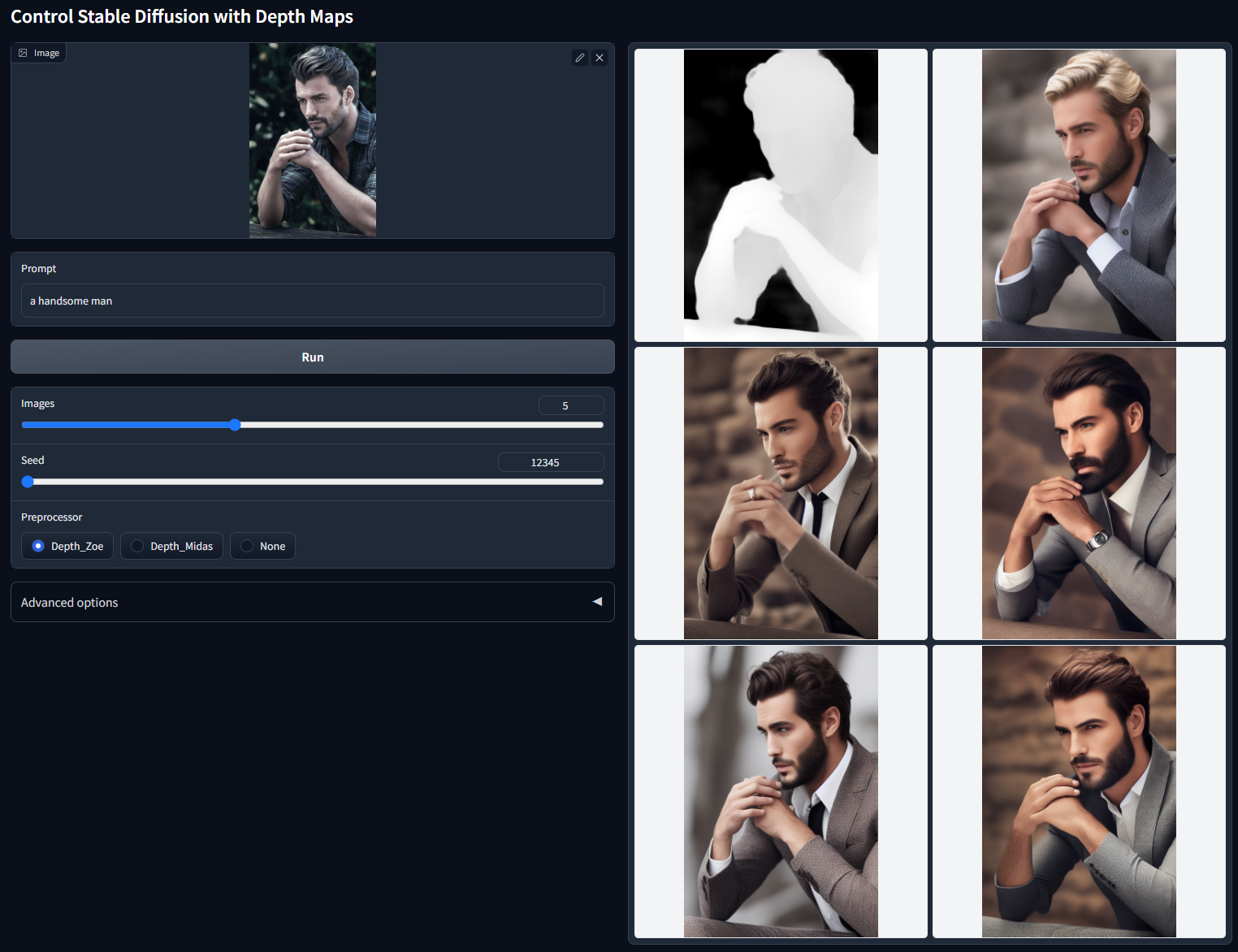
Figure 1. A demonstration of ControlNet SDXL Diffusers Depth: the interface displays an input photograph, its derived depth map, and multiple generated outputs (‘a handsome man’ prompt, seed 12345), illustrating depth-guided image variation.
Model Architecture and Key Features
Sharing its underlying neural network structure with ControlNet 1.0, ControlNet SDXL Diffusers Depth is engineered for stability and extensibility, as the architecture remains unchanged up to the planned release of version 1.5 ControlNet GitHub. The hallmark of this model is its depth map guidance: grayscale depth maps—produced either from monocular depth estimation methods or rendered by 3D engines—are used as control signals to steer the generative process.
Depth estimation involves assigning distance values to each pixel of an input image, resulting in a grayscale map where lighter values indicate objects closer to the camera Control-LoRA on Hugging Face. These depth maps provide essential geometric structure that guides the diffusion model to maintain scene layout and object pose in the synthesized output.
A key feature is the integration of parameter-efficient fine-tuning techniques, notably the Control-LoRA system. By embedding low-rank adaptation layers, Control-LoRA substantially reduces the size of the base model: for example, a rank-256 LoRA file decreases the original ControlNet model size from approximately 4.7 GB to 738 MB, with further compression possible at lower ranks Hugging Face Control-LoRA. This enables application on resource-constrained devices while supporting a specified output fidelity.
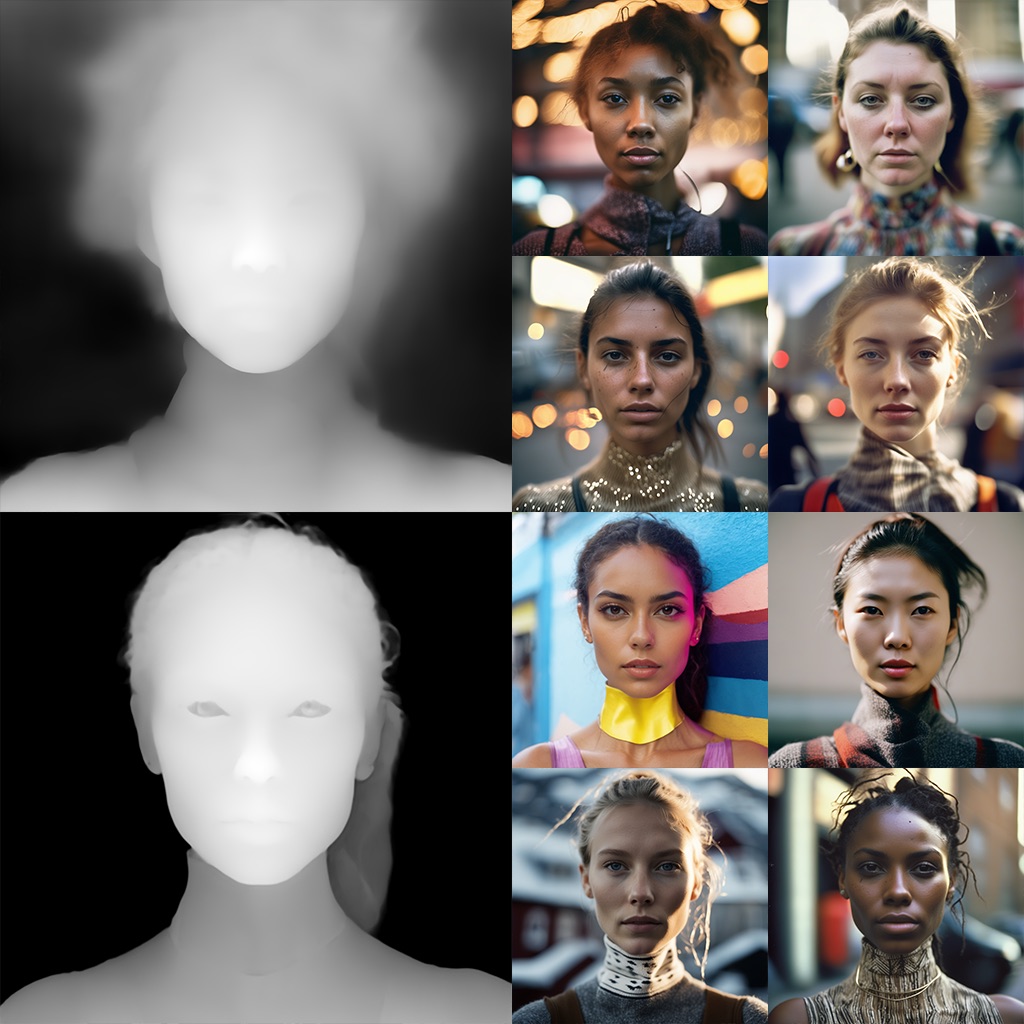
Figure 2. A depth map (left) used to guide portrait generation with Control-LoRA, showing clear transfer of geometry into diverse faces (right).
Training Data and Improvements Over Previous Versions
ControlNet SDXL Diffusers Depth was trained using a combination of multiple established monocular depth estimation methods, specifically integrating Midas Depth, Leres Depth, and Zoe Depth ControlNet GitHub. These diverse inputs and the use of various image resolutions (256, 384, and 512 pixels) contributed to a broader training corpus, further enhanced by data augmentations such as random left-right flipping.
The training regimen of version 1.1 addressed several shortcomings identified in earlier iterations. ControlNet 1.0's dataset contained duplicated subjects, low-quality or blurry samples, and inaccuracies in the pairing of prompts with images. These issues were addressed in version 1.1, resulting in improved training data with better correspondence between control maps and prompts. This strengthening of the dataset not only improved model robustness but also mitigated overfitting to any particular depth estimation technique, affording greater flexibility across diverse preprocessing sources, including real-world 3D engine-generated depth maps.
Control-LoRA, a variant aimed at efficient deployment, was further finetuned with data from the Portrait Depth Estimation model, as documented by ClipDrop, enhancing its performance for close-up portrait applications.
Operational Considerations and Integration
The ControlNet SDXL Diffusers Depth model is distributed as the file control_v11f1p_sd15_depth.pth, accompanied by its configuration YAML. While architectural parameters remain constant with ControlNet 1.0, a notable update is the addition of a global average pooling operation between encoder outputs and the Stable Diffusion UNet as specified by the global_average_pooling directive within the YAML configuration. This supports propagation of depth information during generation ControlNet GitHub. The model is compatible with a variety of processing pipelines and interfaces, including graphical environments such as Gradio, for demonstration and exploration purposes.
For those employing parameter-efficient variants, Control-LoRAs are implementable in user interfaces like ComfyUI and StableSwarmUI, where users can experiment with various workflows and custom nodes provided by Stability AI.
ControlNet SDXL Diffusers Depth also supports flexible integration with community plugins and toolchains. Within the ecosystem of Stable Diffusion 1.5 user extensions and workflows, such as the Mikubill sd-webui-controlnet plugin, users can leverage arbitrary combinations of ControlNets, community models, LoRAs, and advanced sampling schemes.
Comparison to Related Models in the ControlNet Family
Compared to ControlNet 1.0 Depth, this version brings improvements in data quality and adaptability. The version 1.1 model’s training corpus exhibits improved cleanliness, with the removal of duplicated grayscale images and improved alignment between images and textual prompts ControlNet GitHub. This yields a model that is less biased towards specific depth estimation methods, performing consistently across a variety of input resolutions and preprocessing approaches.
In practical terms, for users employing Midas depth preprocessing at a resolution of 384, the distinction in performance between versions may be modest. However, for other resolutions or alternative preprocessors—such as Leres or Zoe Depth—the 1.1 model demonstrates improved generalization and result quality.
The Control-LoRA adaptation offers a compressed alternative for running depth-guided generation, supporting a specified performance level while significantly reducing storage and computational costs. This makes depth-guided generative workflows feasible on a broader range of hardware.
Limitations and Ongoing Development
The ControlNet 1.1 codebase and associated repositories are subject to active development and periodic updates. Model versions marked with suffixes like "f1" (e.g., control_v11f1p_sd15_depth for Stable Diffusion 1.5) indicate post-release bug fixes, whereas marks like "e" denote experimental models, which may yield variable or less predictable results ControlNet GitHub. Certain features, such as multi-ControlNet integration or tiled image upscaling, are currently provided only through specific community extensions.
Some variants, such as ControlNet's Instruct Pix2Pix adaptation, remain experimental and may require selective post-processing or "cherry-picking" to achieve satisfactory results.
Licensing and Research Use
While the model itself does not explicitly declare a license within the provided documentation, it is distributed for research and academic experimentation, according to statements in the ControlNet-v1-1 Nightly GitHub repository. The Control-LoRA model and its derivatives are hosted openly, but users should consult the associated repositories and model cards for up-to-date licensing terms.
Further Resources
- ControlNet 1.1 GitHub Repository — Project source code, documentation, and updates.
- ControlNet 1.1 Models on Hugging Face — Download page for all official model weights.
- Control-LoRA on Hugging Face — Original repository for Control-LoRA parameter-efficient variants.
- ClipDrop API: Portrait Depth Estimation — Reference for the model used in Control-LoRA fine-tuning.
- ComfyUI and StableSwarmUI — User interfaces supporting Control-LoRA workflows.
- Stability-AI ComfyUI Nodes — Custom integration nodes for advanced workflows.
- sd-webui-controlnet Plugin — A popular community plugin for utilizing ControlNet and related models.
- Hugging Face Annotator Models — Depth and pose annotator models used in preprocessing.
- ControlNet Inpaint Usage Guide — Documentation for inpainting with ControlNet models.
- Discussion on Multi-ControlNet Tiling — Community discussion about multi-model workflows and upscaling.
More in the Stable Diffusion XL Family
Stable Diffusion XL
SDXL Turbo
SDXL Lightning
OpenDalle
Yamer's Realistic
AlbedoBase XL
Juggernaut XL
Realistic Vision XL
New Reality XL
Realism Engine SDXL
Animagine XL
Nightvision XL
Dreamshaper XL
Pony Diffusion V6 XL
ControlNet SDXL Diffusers Canny
ControlNet SDXL Canny
ControlNet SDXL Depth
ControlNet SDXL Recolor
ControlNet SDXL IP Adapter
ControlNet SDXL Open Pose
Compatible Apps
ComfyUI
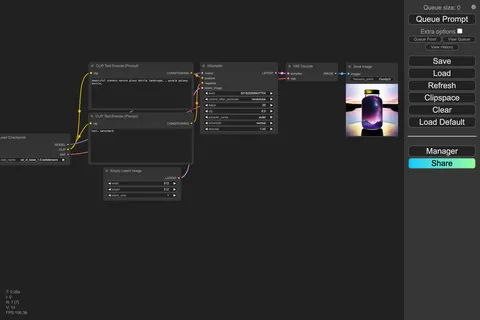
A node-based workflow builder for advanced image and video generation, ideal for custom pipelines, fine control, and power users.
Web UI · API
Image Generation · Video Generation
Stable Diffusion WebUI Forge
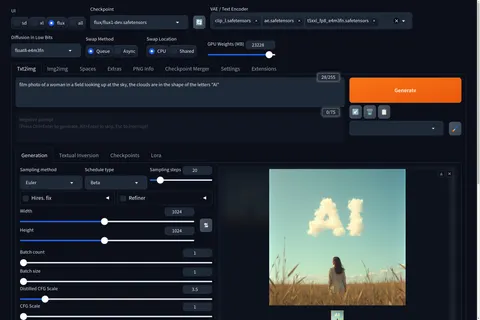
A faster, more experimental Stable Diffusion WebUI variant focused on improved resource use, quicker inference, and modern model support.
Web UI · API
Image Generation
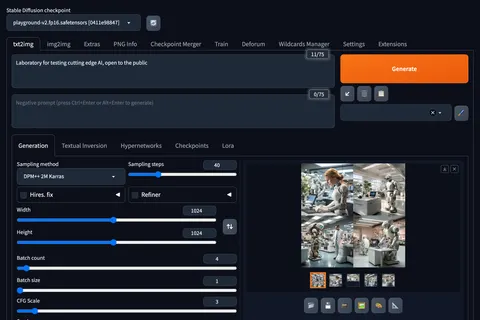
Stable Diffusion Web UI
A full-featured Stable Diffusion interface with deep controls for prompting, inpainting, extensions, and advanced image workflows.
Web UI · API
Image Generation · Video Generation
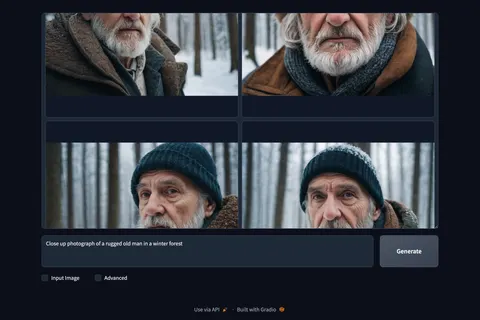
Fooocus
A beginner-friendly image generator focused on strong defaults, with built-in inpainting, outpainting, upscaling, and image prompting.
Web UI · API
Image Generation · Beginner Friendly
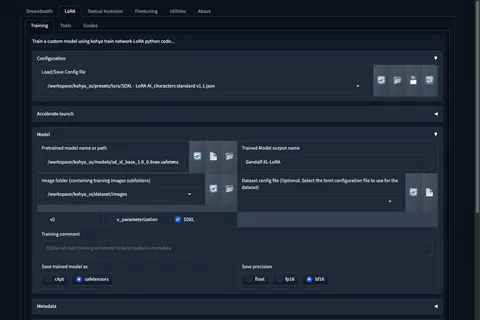
Kohya's GUI
Train LoRAs and fine-tunes for Stable Diffusion and FLUX with a popular GUI for Kohya-based training workflows.
Web UI · API
Fine-Tuning · Image Generation