stabilityai
Stable Diffusion 2
Downloads
Model Report
Overview
Stable Diffusion 2 is an open-source, text-to-image generative model developed by Stability AI and released on November 23, 2022. Building upon prior work in latent diffusion by researchers including Robin Rombach and Patrick Esser in collaboration with the CompVis Group at LMU Munich, Stable Diffusion 2 advances the capabilities of text-to-image synthesis through architectural improvements and new features. The model introduces higher image resolutions, new guidance mechanisms, enhanced inpainting, and novel depth-aware generation, broadening the scope of image synthesis and research applications. It relies on latent diffusion techniques, leveraging a pretrained text encoder, and has been trained on large, filtered datasets to facilitate both performance and responsible use.

Figure 1
Model Architecture and Key Features
Stable Diffusion 2 employs the latent diffusion model framework, which encodes images into lower-dimensional latent representations to improve data efficiency and computational performance, as outlined in the CVPR 2022 paper on High-Resolution Image Synthesis with Latent Diffusion Models. Images are compressed during training, allowing the model to focus on the most salient features for image generation.
A central component is the OpenCLIP-ViT/H text encoder, developed by LAION and integrated with Stability AI's support. This encoder translates user prompts into vector representations, which are then utilized by the U-Net backbone within the latent diffusion process through cross-attention mechanisms.
Significant improvements over Stable Diffusion 1.5 include expanded resolution options (512×512 and 768×768 pixels), offering enhanced output quality and detail. The model suite also introduces specialized variants, such as a 4x upscaling diffusion model for generating high-resolution images, and a depth-to-image diffusion model that conditions outputs on inferred image depth maps. These advances facilitate novel applications while preserving coherence, especially in tasks involving significant image transformations.
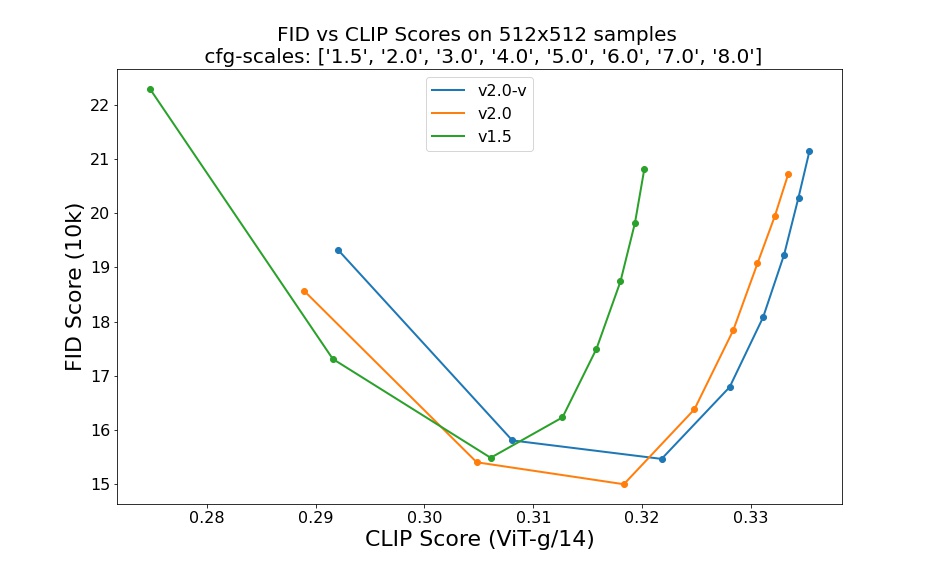
Figure 2. Performance metrics for Stable Diffusion v2.0 variants and v1.5, visualizing FID and CLIP evaluation scores on 512x512 samples across various guidance scales.
Training Data and Procedures
Stable Diffusion 2 models are trained on the LAION-5B dataset and curated subsets, filtered for safety and aesthetics. Data preprocessing includes the application of the LAION NSFW classifier (with a conservative threshold) to minimize harmful or inappropriate content, and the Improved Aesthetic Predictor for aesthetic quality.
Training follows a multi-stage regimen. For instance, the 512-base model undergoes hundreds of thousands of steps on LAION-5B, first at lower resolution and then at 512×512. The 768-v variant extends training at higher resolution, employing a v-objective to further improve sample fidelity. Specialized models, such as depth-to-image, are fine-tuned with additional input channels for depth information, based on estimates from MiDaS. Inpainting models are refined using strategies from LAMA with masked latent representations, while the upscaler uses high-resolution image crops and introduces a controllable noise level for guided upsampling.
These model checkpoints are publicly released to promote transparency and reproducibility in research, as detailed in the Stable Diffusion v2 Model Card.
Capabilities and Applications
Stable Diffusion 2 provides robust text-to-image generation, supporting intricate synthesis from textual prompts. The new models yield outputs with default resolutions up to 768×768 pixels and can upscale to 2048×2048 or higher using latent upscaling. The integration of depth-based conditioning enables transformations that preserve structural coherence and realism.
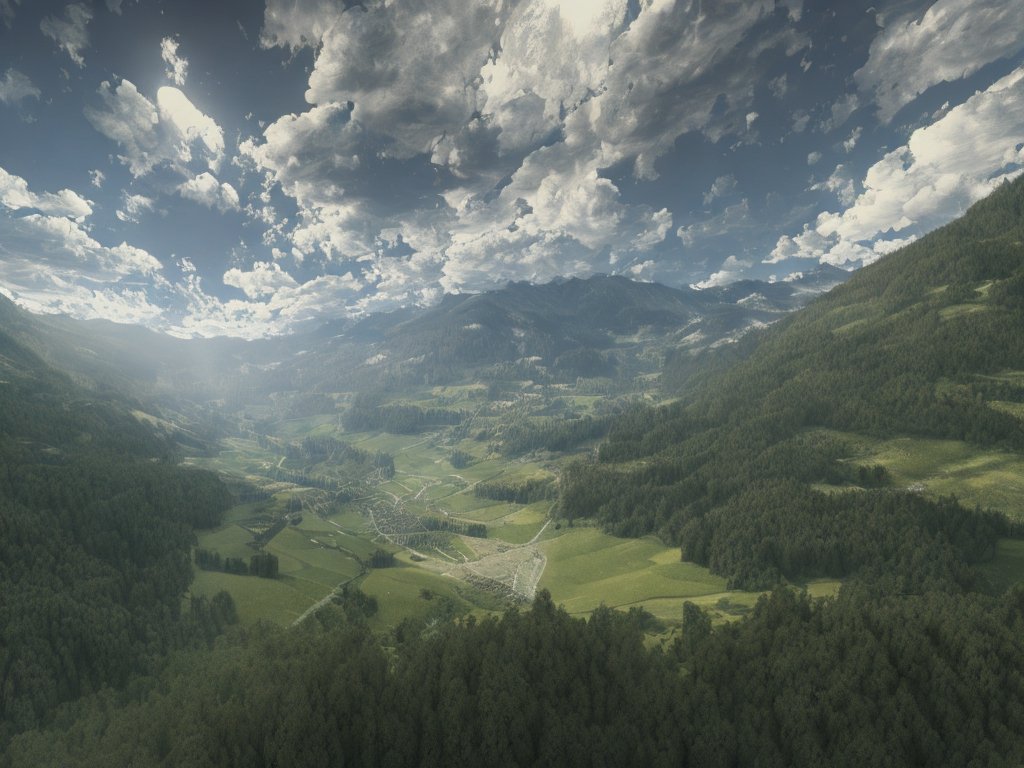
Figure 3
For image editing, the inpainting diffusion model enables rapid and seamless alteration of specific image regions under textual guidance. This allows targeted modifications, such as changing clothing or objects, while maintaining surrounding coherence.

Figure 4
Typical research uses encompass generative model benchmarking, art and design experimentation, educational tool development, and studies of model biases and limitations. The system supports classifier-free guidance, with common inference settings using a guidance scale of 7.5 and 50 DDIM sampling steps as referenced in the Stable Diffusion Model Card.
Limitations and Considerations
Despite its advancements, Stable Diffusion 2 exhibits several notable limitations. The model does not achieve perfect photorealism, and its ability to handle text rendering and fine compositional tasks remains limited. Generation of human faces and figures is imperfect, and the model is primarily proficient with English-language prompts due to its training data.
Biases present in the data can manifest in outputs, particularly in the representation of non-western cultures or non-English prompts. Although safety classifiers and aesthetic filters are integrated, absolute filtering is not guaranteed, and outputs may reflect societal biases embedded in the source data, as documented in the model's technical report.
The underlying autoencoding process is lossy, which can affect image fidelity, especially after repeated transformations. The developers recommend using the model for research and creative exploration rather than for applications requiring error-free or sensitive outputs.
Environmental and Licensing Information
The resource demands for training large diffusion models are considerable. For earlier versions, emissions of approximately 15,000 kg CO₂-equivalent were estimated using an A100 PCIe 40GB cluster over 200,000 hours, as discussed in Lacoste et al. (2019).
Stable Diffusion 2 is distributed under the CreativeML Open RAIL++-M License, an open-source framework adapted from the RAIL Initiative and BigScience project. This license allows commercial and research applications, but it cautions users to implement additional safeguards in light of potential biases and limitations. The model weights are released as research artifacts.
Impact and Model Lineage
Stable Diffusion 2 is part of a broader family of latent diffusion models. The initial Stable Diffusion 1.5 set foundational standards for accessible, high-performance image generation by providing openly available, large-scale models. Both Stable Diffusion 1.5 and Stable Diffusion 2 share the latent diffusion backbone but differ in text encoder architecture, training procedures, and support for higher resolutions.
The release and open distribution of Stable Diffusion contributed to rapid community adoption, sparking significant interest in generative AI. This trend is exemplified by the sharp initial rise in developer engagement, noted in Stable Diffusion GitHub metrics.
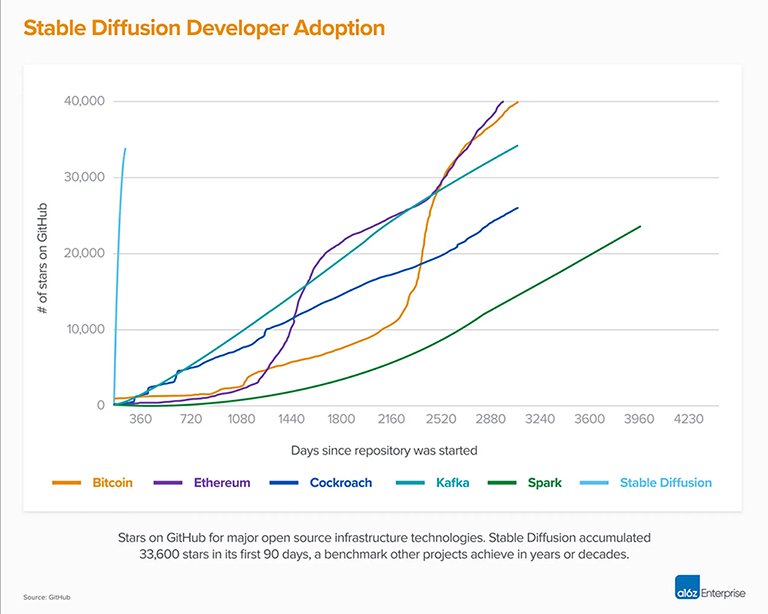
Figure 5. Stable Diffusion's rapid accumulation of GitHub stars within its first 90 days, compared to other major open-source projects.
More from stabilityai
Stable Video Diffusion
Stable Video Diffusion XT
Stable Video Diffusion XT 1.1
Stable Video 3D
Stable Video 4D
Stable Fast 3D
Stable Diffusion 1.1
Stable Diffusion 1.5
Stable Diffusion XL
SDXL Turbo
ControlNet SDXL Canny
ControlNet SDXL Depth
ControlNet SDXL Recolor
Stable Diffusion 3.5 Large
Stable Diffusion 3.5 Turbo
Stable Cascade Stage A
Stable Cascade Stage B
Stable Cascade Stage C
Stable Audio Open 1.0
Compatible Apps
ComfyUI
A node-based workflow builder for advanced image and video generation, ideal for custom pipelines, fine control, and power users.
Web UI · API
Image Generation · Video Generation
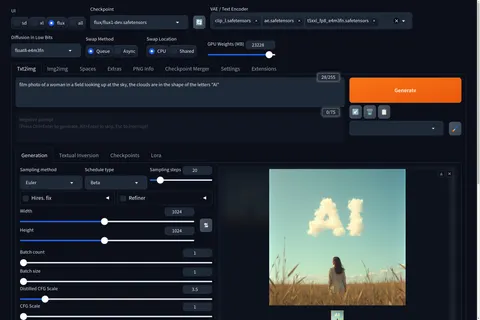
Stable Diffusion WebUI Forge
A faster, more experimental Stable Diffusion WebUI variant focused on improved resource use, quicker inference, and modern model support.
Web UI · API
Image Generation
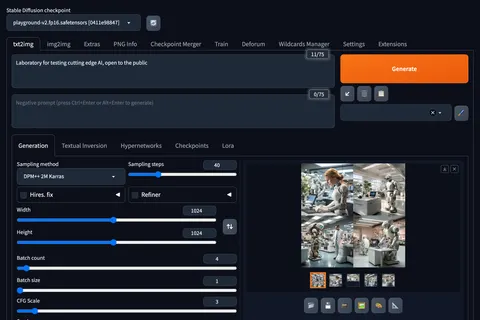
Stable Diffusion Web UI
A full-featured Stable Diffusion interface with deep controls for prompting, inpainting, extensions, and advanced image workflows.
Web UI · API
Image Generation · Video Generation