Deep Cogito
Cogito V1 Preview 32B
Downloads
Model Report
Overview
Cogito V1 Preview 32B is a large language model (LLM) developed by Deep Cogito, representing the 32-billion-parameter variant in a series of generative models designed for advanced language understanding and reasoning. The model was released on April 8, 2025, as part of the broader Cogito family, which encompasses models ranging from 3B up to 70B parameters. Cogito V1 Preview 32B is positioned as a research-driven system that integrates new approaches to alignment and self-improvement within contemporary transformer-based neural architectures.
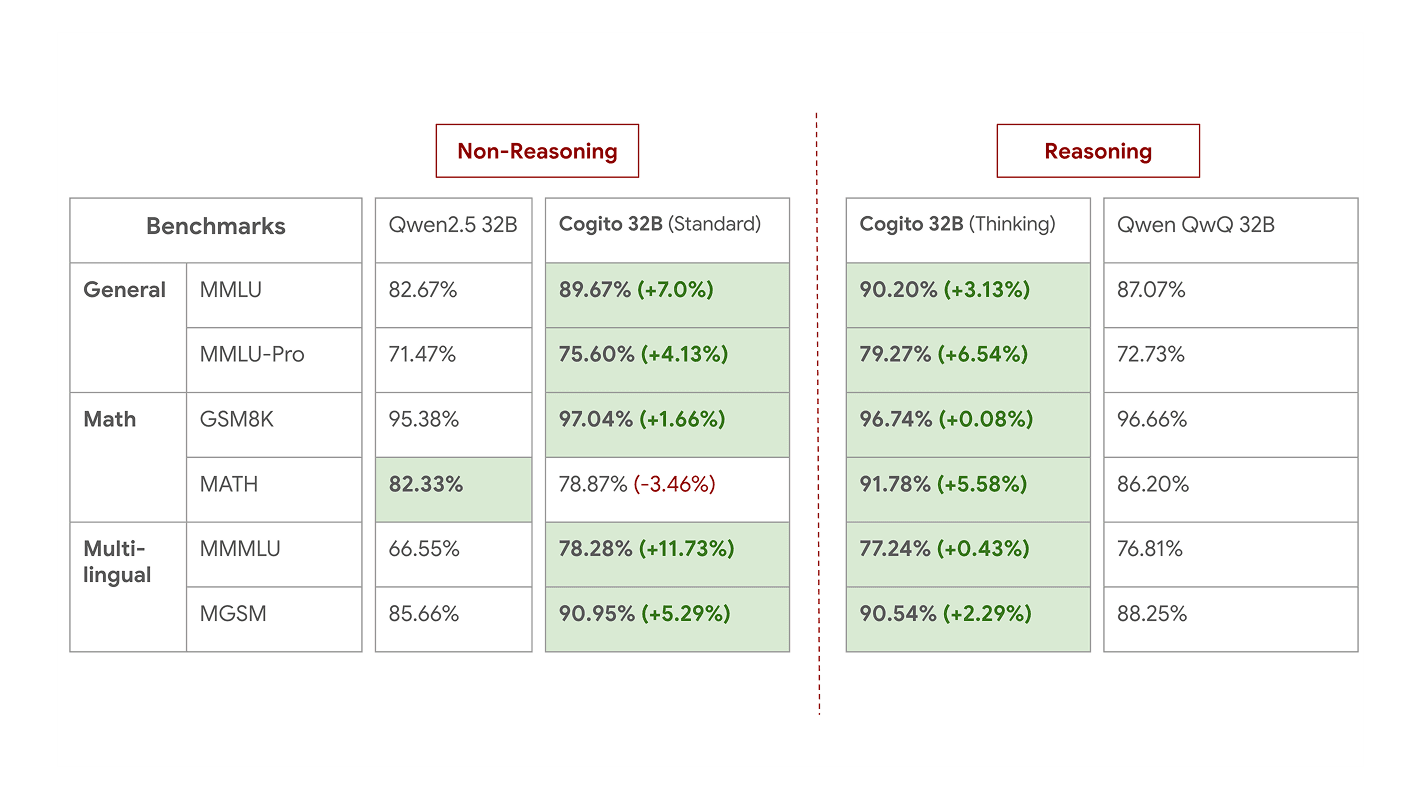
Figure 1. Benchmark comparison of Cogito 32B (in standard and thinking modes) against Qwen2.5 32B and Qwen QwQ 32B across general, math, and multilingual tasks.
Model Architecture and Alignment Strategy
Cogito V1 Preview 32B is built upon the Qwen2.5 32B architecture, employing a transformer-based neural network with 32.8 billion parameters. The model extends the capabilities of its Qwen lineage by introducing a unique alignment strategy known as Iterated Distillation and Amplification (IDA). IDA aims to systematically improve the reasoning capacities of the model through alternating cycles of "amplification"—where more complex subroutines are executed to achieve higher-level reasoning—and "distillation," which transfers these improved reasoning strategies into the model's own weights.
This approach contrasts with more conventional alignment techniques such as reinforcement learning from human feedback (RLHF) and model distillation from larger systems. IDA emphasizes scalable self-improvement while reducing dependency on expensive human or computational oversight, supporting efficient refinement of the model's internal thought processes.
Technical Features and Modes of Operation
Cogito V1 Preview 32B is an instruction-tuned, text-in/text-out model optimized for a variety of advanced applications, including code generation, function calling, and autonomous agentic behaviors. Notably, the model offers two distinct operational modes: the standard mode, which provides direct responses, and a specialized "reasoning mode" (or "thinking mode") that engages in explicit self-reflection before generating output. Reasoning mode can be invoked by appending a directive such as "Enable deep thinking subroutine." to the system prompt or by enabling a flag in the tokenizer's chat template method.
Multilingual proficiency is integral to the design, as the model is trained on data across more than 30 languages. Additionally, Cogito 32B supports a long context window of up to 128,000 tokens, enhancing its ability to manage lengthy documents and complex conversational states.
A distinguishing feature is the model's native support for tool calling across both its standard and extended reasoning modes. This allows for seamless integration of external tools via single, parallel, or multiple calls, and enables flexible composition of outputs with tool results—beyond what is typically present in other models of comparable size.
Training Procedures and Data Management
Training for Cogito V1 Preview 32B commences with existing base checkpoints from Qwen2.5 32B and, in some cases, Llama models, upon which the IDA methodology is applied. Throughout this iterative process, expensive cognitive subroutines are learned and consolidated, improving each successive checkpoint's ability to handle complex reasoning. Evaluation benchmarks used in development are rigorously excluded from training material by using string-matching methods to prevent data contamination and maintain the validity of performance assessments.
The distillation phase internalizes external reasoning subroutines, leading to a feedback loop of iterative improvement. This contrasts with more static pretraining and fine-tuning paradigms and is designed to make the model's "thinking process" more efficient and scalable over time.
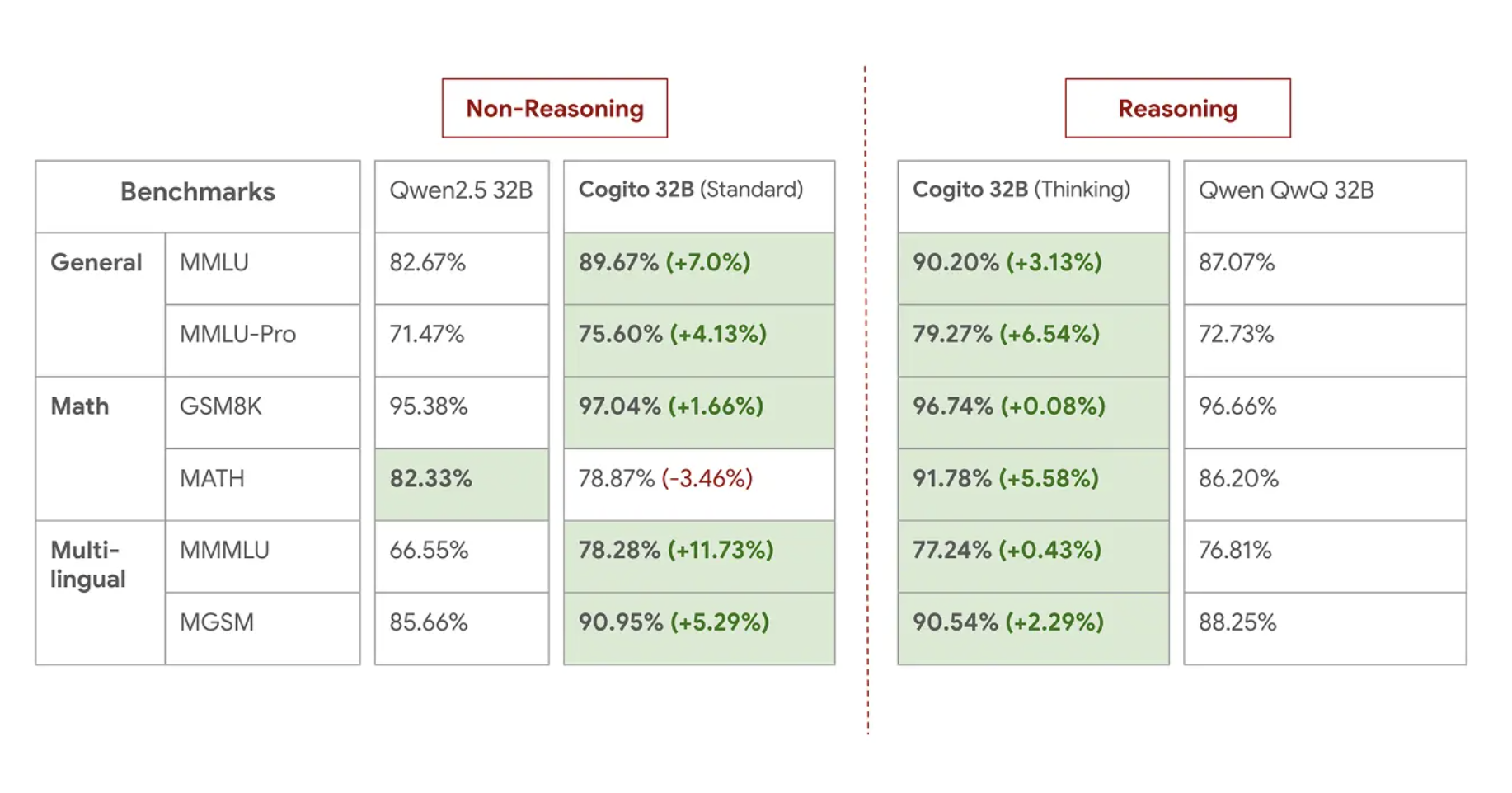
Figure 2. Performance data comparing Cogito 32B (standard and thinking) to Qwen2.5 32B and Qwen QwQ 32B across non-reasoning and reasoning benchmarks (including MMLU, Math, and multilingual tasks).
Performance Benchmarks and Model Evaluation
Cogito V1 Preview 32B demonstrates competitive results on standard language model benchmarks, including MMLU, MMLU-Pro, GSM8K, MATH, MMMLU, and MGSM. In published comparisons against other major open-source models—such as Qwen2.5 32B, Qwen QwQ 32B, as well as Llama3 and DeepSeek models—the Cogito 32B model typically matches or outperforms alternatives in tasks spanning general language understanding, mathematics, and multilingual reasoning.
The model's reasoning mode ("Cogito 32B Thinking") further enhances its ability to solve tasks that require more complex sequential deduction, a feature illustrated in side-by-side benchmark tables. For example, relative improvements over Qwen2.5 32B are observed across several key evaluation metrics, including global averages computed from diverse test sets. Native tool calling capabilities are cited as a factor contributing to gains over models like Llama, where such features are less comprehensively integrated.
It is noted by Deep Cogito that while benchmark metrics provide a useful reference, their correspondence with end-user experience is inherently limited. Real-world utility, especially in dynamic or multi-turn dialogues, may diverge from results indicated by static benchmarks.
Use Cases and Model Applications
Cogito V1 Preview 32B is engineered for a broad spectrum of practical applications. Coding and code comprehension are primary targets, supported by robust capabilities in natural language instruction following, general agentic behavior, and complex function or tool invocation. The model finds utility in STEM disciplines as well, benefiting from its extensive multilingual training and its long-context capacity.
Typical interaction scenarios include multi-step reasoning tasks, data analysis pipelines incorporating tool calls, and high-fidelity language generation in multilingual environments. The reasoning mode is especially suitable for tasks where explicit self-reflection enhances output quality or traceability.
Limitations and Model License
Despite its advancements, Cogito V1 Preview 32B is not tailored for extremely long or deeply recursive reasoning chains, a tradeoff intended to balance model efficiency with practical wait times and to streamline the distillation process. Benchmark accuracy is acknowledged as an imperfect proxy for real-world performance, and results may vary based on deployment context.
The model is distributed under the Apache 2.0 License, permitting wide commercial and research use.
Related Models and Future Directions
The Cogito V1 Preview 32B is part of a scalable family with available checkpoints at 3B, 8B, 14B, 32B, and 70B parameters. According to development roadmaps, larger model variants—such as those in the 109B to over 600B parameter range—are under active development. Each release leverages the IDA framework to incrementally improve intelligence and alignment.
Helpful Links
More in the Qwen 2 Family
Qwen2.5 VL 3B
Qwen2.5 VL 7B
Qwen2.5 VL 72B
QwQ 32B Preview
QwQ 32B
Qwen 2.5 Math 1.5B
DeepSeek R1 Distill Qwen 1.5B
DeepCoder 1.5B Preview
Qwen 2.5 Math 7B
Qwen 2.5 Math PRM 7B
DeepSeek R1 Distill Qwen 7B
Qwen 2.5 Math 72B
Qwen 2.5 Math PRM 72B
Qwen 2.5 Coder 7B
Qwen 2.5 Coder 32B
Qwen 2.5 7B
Qwen2.5 7B 1M
Qwen 2.5 14B
Qwen2.5 14B 1M
DeepSeek R1 Distill Qwen 14B
DeepCoder 14B Preview
Cogito V1 Preview 14B
Qwen 2.5 32B
DeepSeek R1 Distill Qwen 32B
Qwen 2.5 72B
Qwen 2 7B
Qwen 2 72B
More from Deep Cogito
Cogito V1 Preview 8B
Cogito V1 Preview 70B
Cogito V1 Preview 3B
Compatible Apps
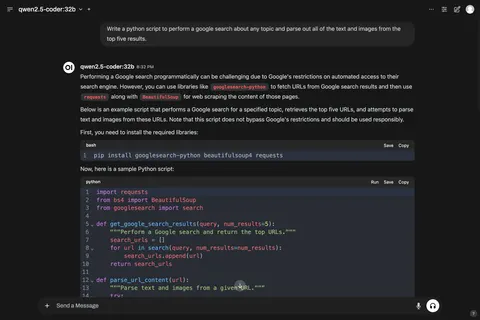
Open WebUI
A polished, self-hosted chat interface for LLMs with Ollama integration, multimodal prompts, and extensive workspace customization.
Web UI
Chat UIs · Beginner Friendly
llama.cpp
GGUF model inference with a polished web UI and OpenAI-format API. CPU-only build — high hardware compatibility, works on any machine without a GPU.
Web UI · API · CLI
LLM Inference · Chat UIs
llama.cpp (CUDA)
GGUF model inference with a polished web UI and OpenAI-format API. CUDA build — GPU-accelerated for NVIDIA GPUs.
Web UI · API · CLI
LLM Inference · Chat UIs
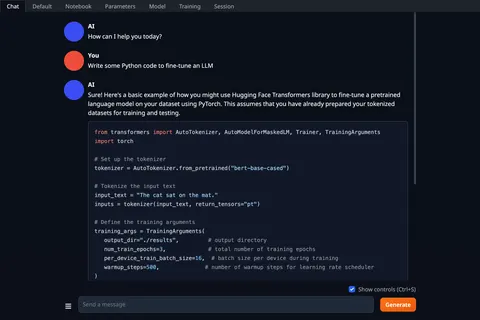
Text Generation Web UI
A feature-rich interface for running and experimenting with open-weight LLMs, including multiple inference backends, plugins, and tuning controls.
Web UI · API
Chat UIs · LLM Inference