Alibaba Cloud
Qwen2.5 7B 1M
Downloads
Model Report
Overview
Qwen2.5-7B-Instruct-1M is a large language model developed by the Qwen Team at Alibaba Group, belonging to the Qwen2.5-1M series. It is designed to handle extremely long contexts, offering support for up to 1,010,000 input tokens. This capability enables processing and reasoning over large volumes of text, positioning the model for tasks that require comprehensive long-range dependency modeling. Qwen2.5-7B-Instruct-1M is released as open-source under the Apache 2.0 License and builds on efficient transformer architectures and novel long-context inference optimizations, as documented in the official Hugging Face model card and arXiv technical report.
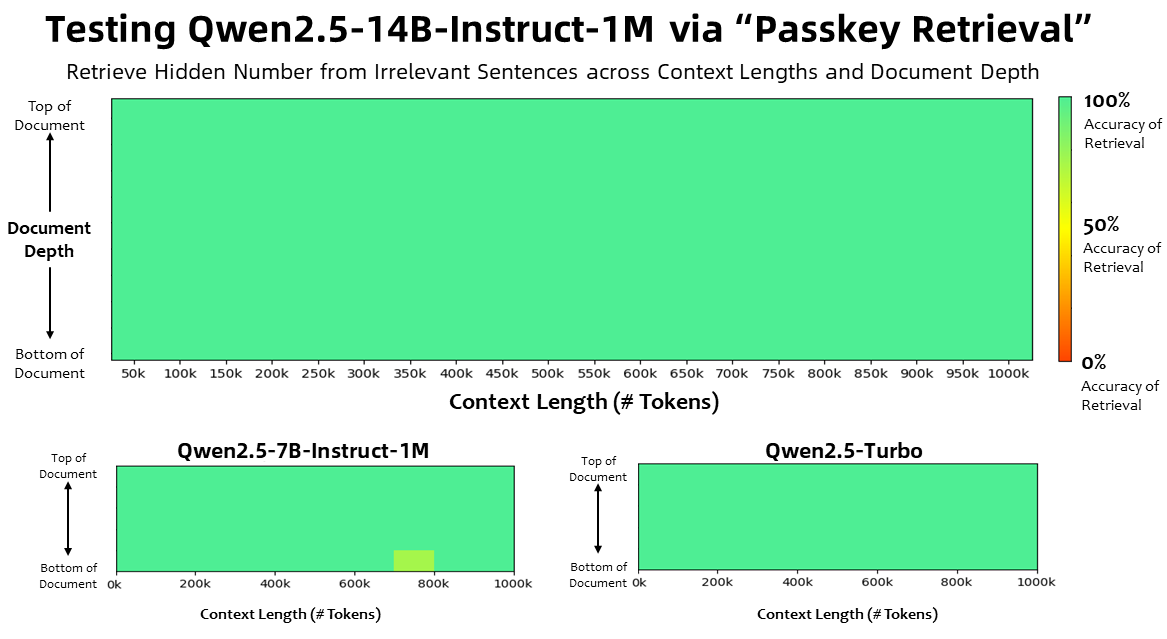
Figure 1. Heatmaps visualizing passkey retrieval accuracy for Qwen2.5-7B-Instruct-1M and related models across context lengths up to 1 million tokens. Green indicates high retrieval accuracy even at extended sequence lengths.
Model Architecture and Long-Context Techniques
Qwen2.5-7B-Instruct-1M builds upon a transformer-based causal language modeling framework with architectural innovations aimed at enabling ultra-long context processing. The model incorporates advanced Rotary Positional Embeddings (RoPE) to encode positional information effectively. Additionally, SwiGLU is used as the activation function to enhance non-linear transformation capacity, while RMSNorm is implemented for improved training stability.
A key feature is the integration of Grouped Query Attention (GQA), which allows more efficient use of key-value caches during extended sequences. Attention mechanisms are further optimized by introducing attention QKV bias and leveraging a custom inference framework based on vLLM that implements sparse attention and advanced length extrapolation.
To optimize performance in handling lengthy contexts, Qwen2.5-7B-Instruct-1M employs the Dual Chunk Attention (DCA) method and YaRN (Yet Another RoPE Extrapolation), allowing reliable extrapolation to 1M tokens—even beyond the contexts observed in training. DCA remaps relative positions into manageable ranges during attention computation, which reduces degradation of attention quality at extreme lengths, as detailed in an arXiv technical overview.
For enhanced inference efficiency, sparse attention—particularly based on MInference methodology—is utilized to focus computation on critical tokens, yielding reductions in time-to-first-token latencies during long input processing.
Training Strategy and Data
The model is trained in a two-phase process involving both pretraining and post-training strategies optimized for long-context learning. Pretraining leverages a vast dataset that includes sources such as Common Crawl, arXiv, books, and public code repositories, supplemented with synthetic data designed to foster the model's ability to understand and reason over extended textual spans. Synthetic tasks include fill-in-the-middle, keyword-based and position-based retrieval, as well as paragraph reordering, targeting enhanced modeling of logical structure and contextual dependencies, as described in the technical report section 4.
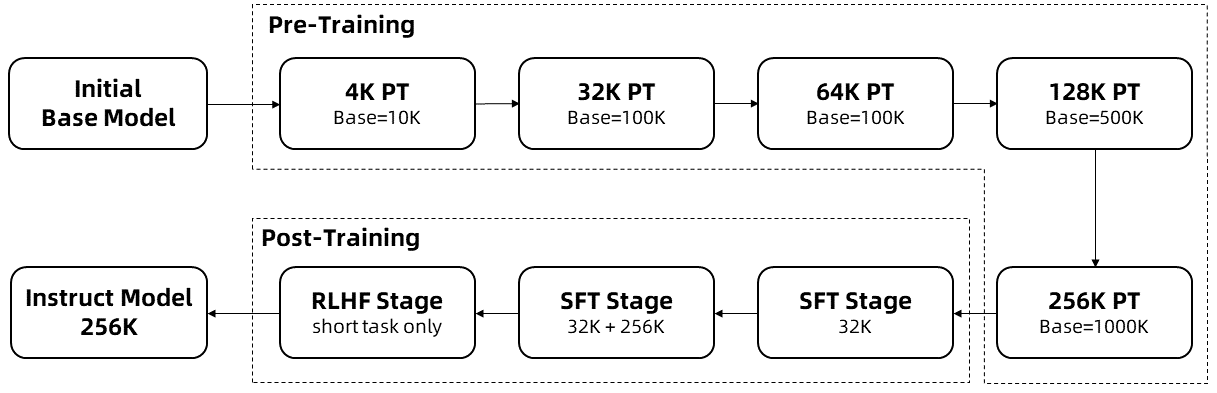
Figure 2. Flowchart illustrating the staged progression of context length during pretraining and post-training, including reinforcement learning and multi-stage supervised fine-tuning.
The context window is progressively expanded throughout training using a five-stage curriculum, beginning at 4,096 tokens and eventually accommodating sequences up to 262,144 tokens. Adaptive Base Frequency (ABF) for RoPE is adopted to manage this transition. Subsequent post-training involves supervised fine-tuning first on short instructions (up to 32,768 tokens), followed by a mixed regimen encompassing both short and very long instructions (up to 262,144 tokens). The model is finally aligned via offline reinforcement learning, similar to Direct Preference Optimization (DPO), to ensure output consistency and user-aligned behavior in both short and long-context applications.
Performance and Benchmarks
Qwen2.5-7B-Instruct-1M demonstrates robust performance on a wide spectrum of evaluation tasks, maintaining high accuracy in both short- and long-context settings. On long-range retrieval assessments such as the Passkey Retrieval and RULER tasks, the model achieves near-perfect accuracy in extracting hidden information across contexts up to 1M tokens, with only marginal accuracy decline noted in extreme-length scenarios.
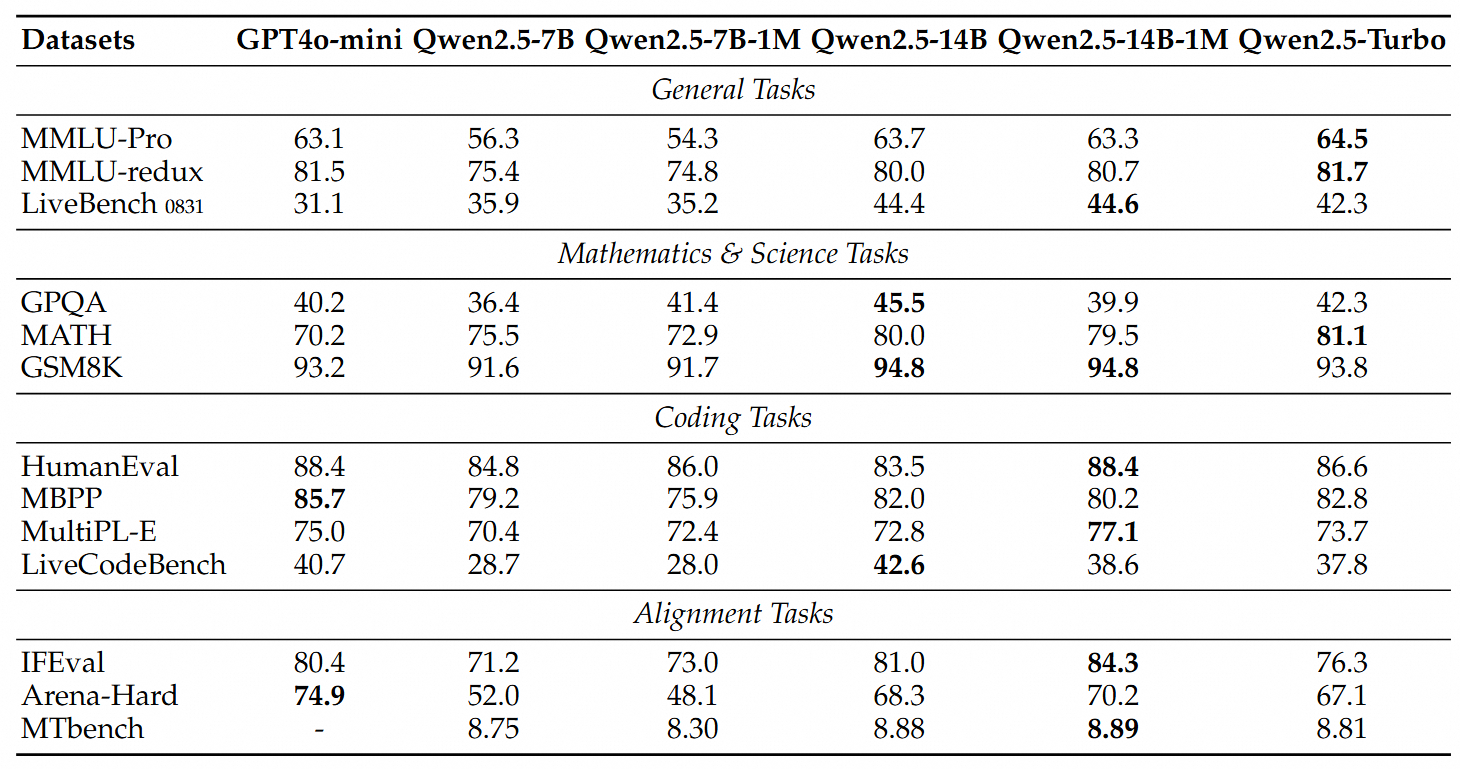
Figure 3. Ablation analysis indicating that Dual Chunk Attention (DCA) enables Qwen2.5-7B-Instruct-1M to maintain high passkey retrieval accuracy at 1M-token contexts.
In head-to-head benchmark comparisons, such as LV-Eval, LongBench-Chat, and the RULER dataset, Qwen2.5-7B-Instruct-1M outperforms earlier 128K-token variants and remains competitive with other long-context models, as shown in benchmark results. For short-context tasks (e.g., MMLU, GPQA, MATH, GSM8K, HumanEval, MBPP), the model retains nearly the same proficiency as its short-context counterparts.
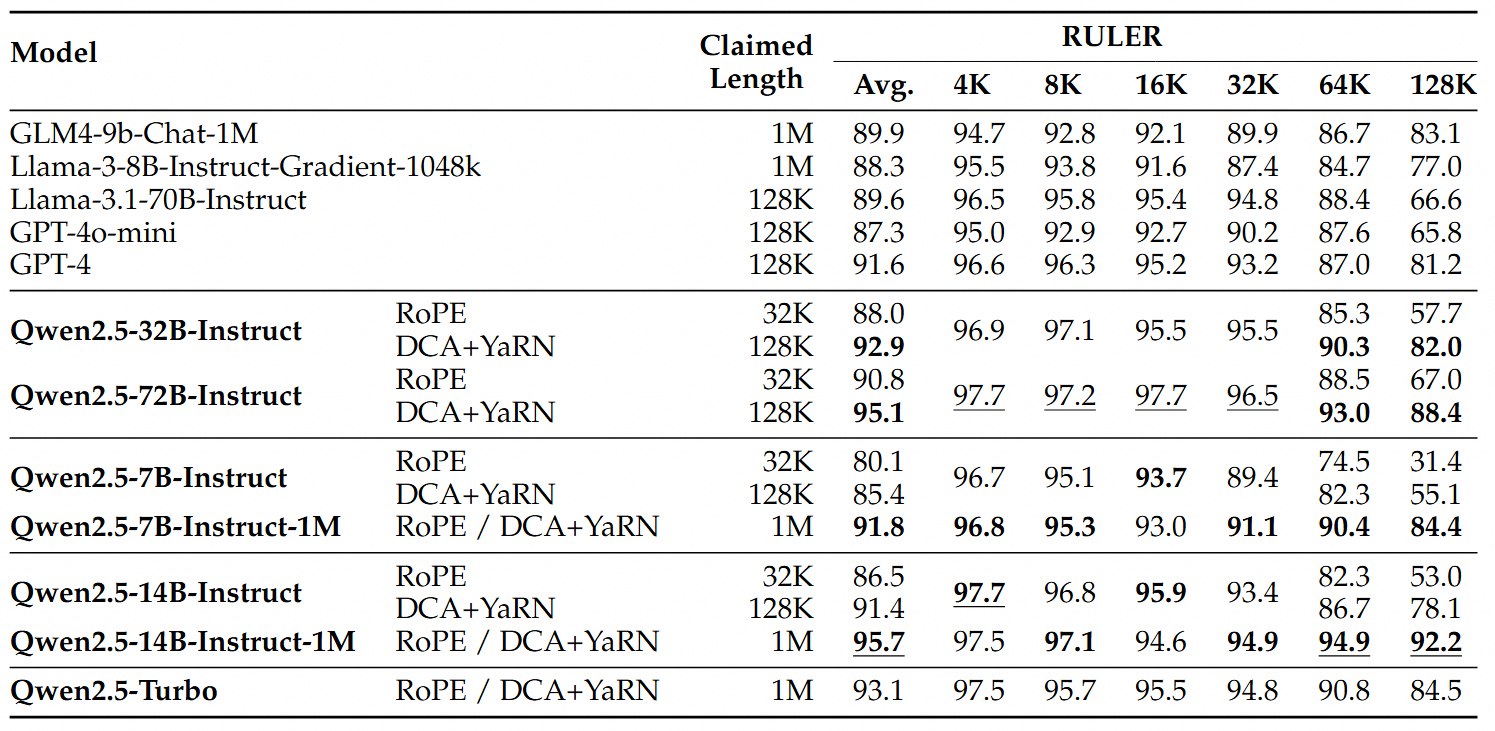
Figure 4. RULER benchmark results for long-context understanding, comparing Qwen2.5-1M models to other contemporary language models at varying context lengths.
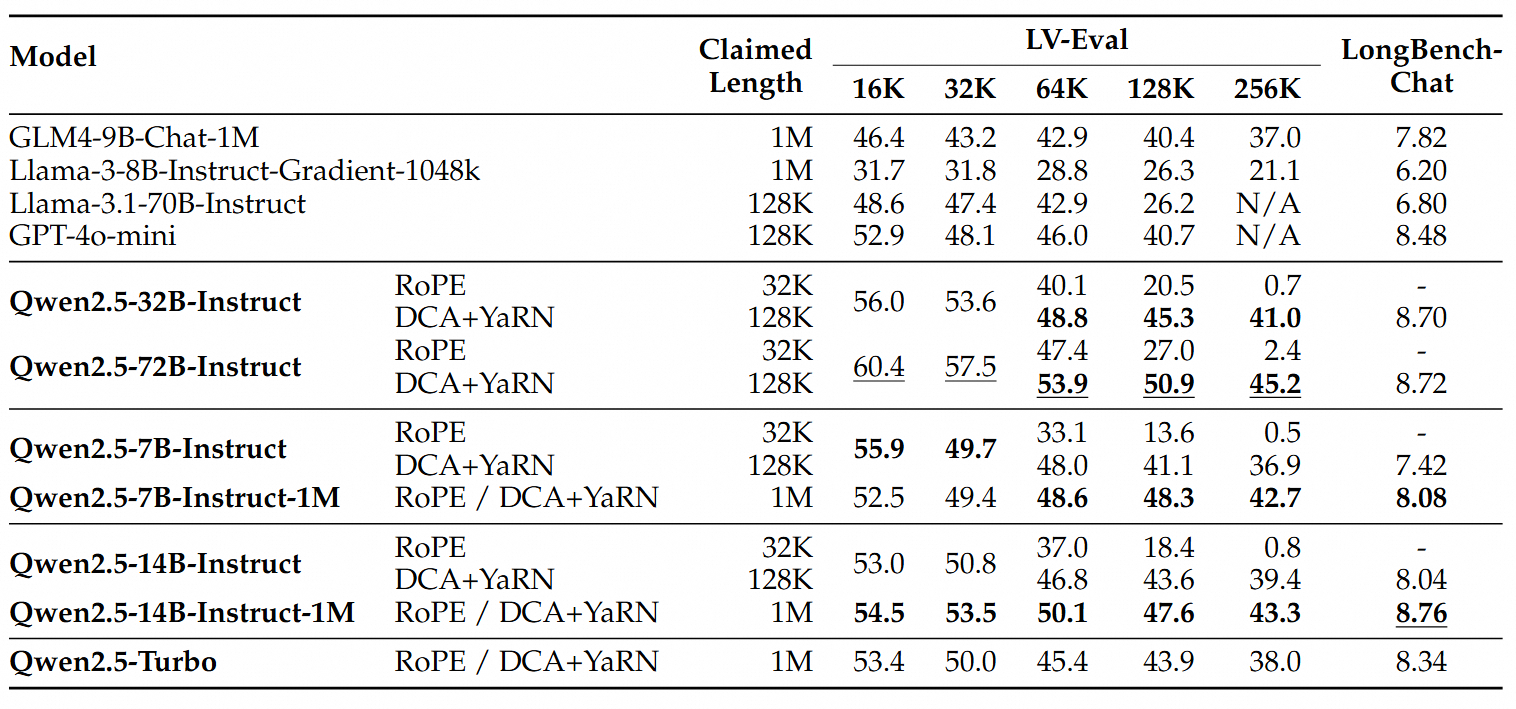
Figure 5. Comprehensive results on LV-Eval and LongBench-Chat benchmarks, documenting long-context task performance across model variants including Qwen2.5-7B-Instruct-1M.
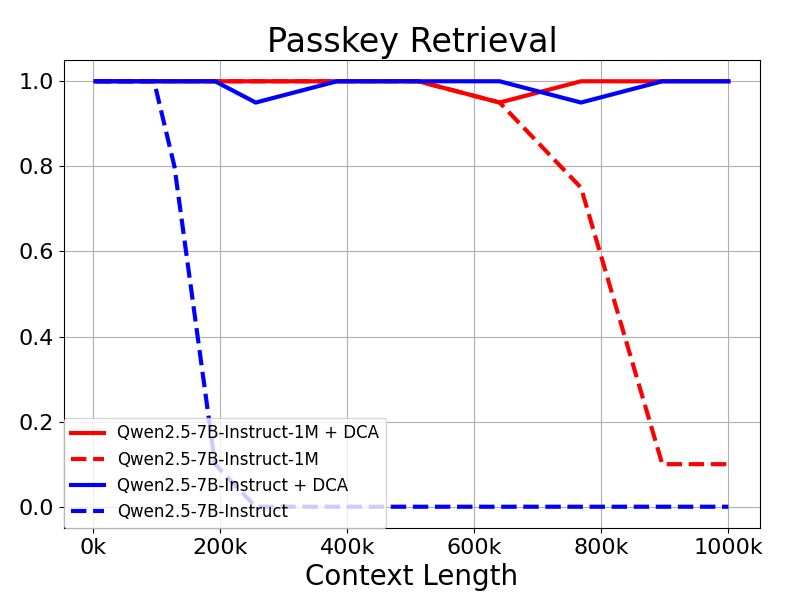
Figure 6. Acceleration factors of the custom inference method over standard full attention for 1M-token inference, for Qwen2.5-7B-Instruct-1M and related models on H20 and A100 GPUs.
The model's inference efficiency is further improved through custom engine optimizations, such as chunked prefill, kernel-level sparse attention, and asynchronous scheduling. Empirically, this results in 3–7x acceleration in input processing for million-token sequences, enabling feasible real-time long-context applications, as noted in blog documentation.
Limitations and Considerations
Despite its strengths, Qwen2.5-7B-Instruct-1M relies on substantial computational resources, with information regarding resource allocation available in its deployment details. Some accuracy degradation may appear at the highest context lengths or when using inference frameworks lacking DCA and related optimizations. For optimal results, users must deploy the custom vLLM branch that implements all engine-level enhancements.
Minor inaccuracies can occur in edge-case retrieval tasks near the 1M-token limit for the 7B model size, as documented in passkey retrieval evaluations. Furthermore, as with many transformer-based large language models, downstream performance may depend on the structure and quality of the input data.
Comparison to Related Models
Qwen2.5-7B-Instruct-1M is a member of the broader Qwen2.5-1M family, which includes larger models such as Qwen2.5-14B-Instruct-1M and Qwen2.5-Turbo. The 14B and Turbo variants exhibit further improvements in long-context accuracy and throughput, with Turbo utilizing a Mixture of Experts (MoE) design. Compared to previous 128K-token Qwen2.5 models, the 1M series provides gains in retrieval, summarization, and code understanding tasks at extended sequence lengths, as suggested by official benchmarks.
When measured against models like GPT-4o-mini and Llama variants, Qwen2.5-7B-Instruct-1M achieves competitive results on both long- and short-context workloads while supporting up to eight times longer contexts than some contemporaries.
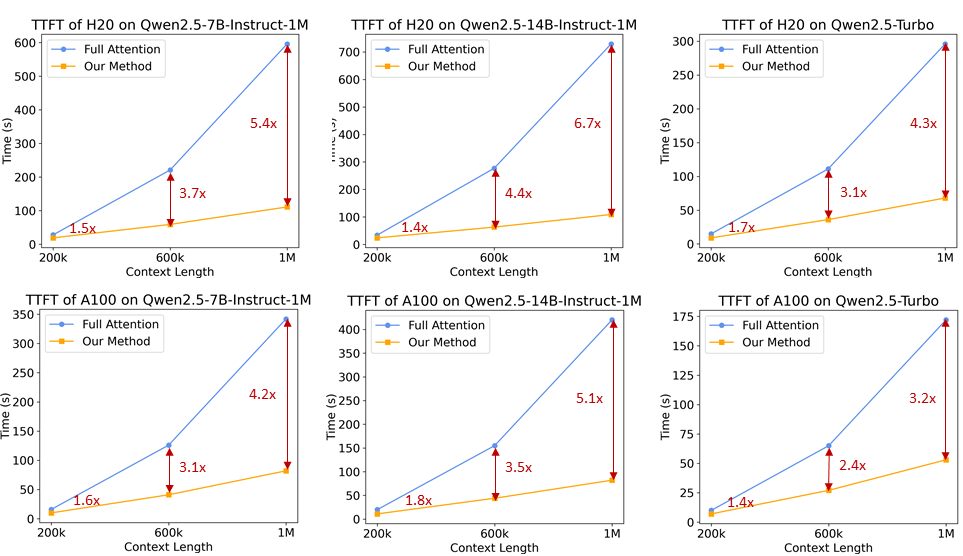
Figure 7. Benchmarks summarize Qwen2.5-7B-Instruct-1M short-context and multi-domain task performance against previous Qwen2.5 releases and GPT-4o-mini.
Applications
With its million-token context capacity, Qwen2.5-7B-Instruct-1M enables advanced applications in domains that require large-scale textual analysis and aggregation. Use cases include repository-level code generation and debugging, comprehensive document analysis for research, large-scale summarization, retrieval from extensive transcripts, and multi-hop reasoning. The model serves both as a foundation for natural language understanding and as a component in specialized agents capable of tasks such as reading entire PDF files or supporting complex conversational interactions, as outlined in Qwen-Agent documentation.
Release Timeline and Licensing
The technical report describing Qwen2.5-7B-Instruct-1M's innovations was published in January 2025. This release marks the introduction of 1M-token context handling within open-source Qwen models, as detailed in an arXiv preprint. The model and code are distributed under the Apache 2.0 License, facilitating broad research and development use.
Helpful Links
More in the Qwen 2 Family
Qwen2.5 VL 3B
Qwen2.5 VL 7B
Qwen2.5 VL 72B
QwQ 32B Preview
QwQ 32B
Qwen 2.5 Math 1.5B
DeepSeek R1 Distill Qwen 1.5B
DeepCoder 1.5B Preview
Qwen 2.5 Math 7B
Qwen 2.5 Math PRM 7B
DeepSeek R1 Distill Qwen 7B
Qwen 2.5 Math 72B
Qwen 2.5 Math PRM 72B
Qwen 2.5 Coder 7B
Qwen 2.5 Coder 32B
Qwen 2.5 7B
Qwen 2.5 14B
Qwen2.5 14B 1M
DeepSeek R1 Distill Qwen 14B
DeepCoder 14B Preview
Cogito V1 Preview 14B
Qwen 2.5 32B
DeepSeek R1 Distill Qwen 32B
Cogito V1 Preview 32B
Qwen 2.5 72B
Qwen 2 7B
Qwen 2 72B
More from Alibaba Cloud
Qwen3 0.6B
Qwen3 1.7B
Qwen3 4B
Qwen3 8B
Qwen3 14B
Qwen3 32B
Qwen3 30B A3B
Qwen3 235B A22B
Qwen 1.5 32B
Qwen 1.5 72B
Compatible Apps
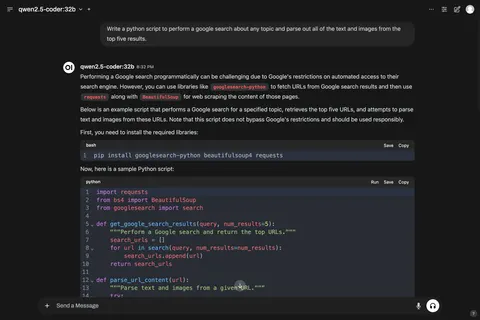
Open WebUI
A polished, self-hosted chat interface for LLMs with Ollama integration, multimodal prompts, and extensive workspace customization.
Web UI
Chat UIs · Beginner Friendly
llama.cpp
GGUF model inference with a polished web UI and OpenAI-format API. CPU-only build — high hardware compatibility, works on any machine without a GPU.
Web UI · API · CLI
LLM Inference · Chat UIs
llama.cpp (CUDA)
GGUF model inference with a polished web UI and OpenAI-format API. CUDA build — GPU-accelerated for NVIDIA GPUs.
Web UI · API · CLI
LLM Inference · Chat UIs
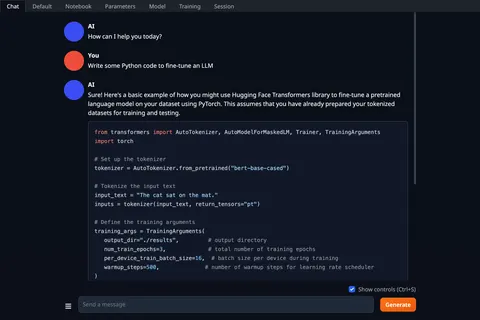
Text Generation Web UI
A feature-rich interface for running and experimenting with open-weight LLMs, including multiple inference backends, plugins, and tuning controls.
Web UI · API
Chat UIs · LLM Inference