Deep Cogito
Cogito V1 Preview 8B
Downloads
Model Report
Overview
Cogito V1 Preview 8B is an open large language model (LLM) developed by Deep Cogito, released on April 8, 2025, as part of the Cogito V1 Preview series. Designed for general-purpose reasoning, coding, and agentic applications, it is distributed under the Llama 3.1 Community License Agreement, allowing for commercial use. The 8B model, based on the Llama-3.1-8B checkpoint, introduces a hybrid reasoning mechanism and supports extended context, tool calling, and multilingual capabilities.
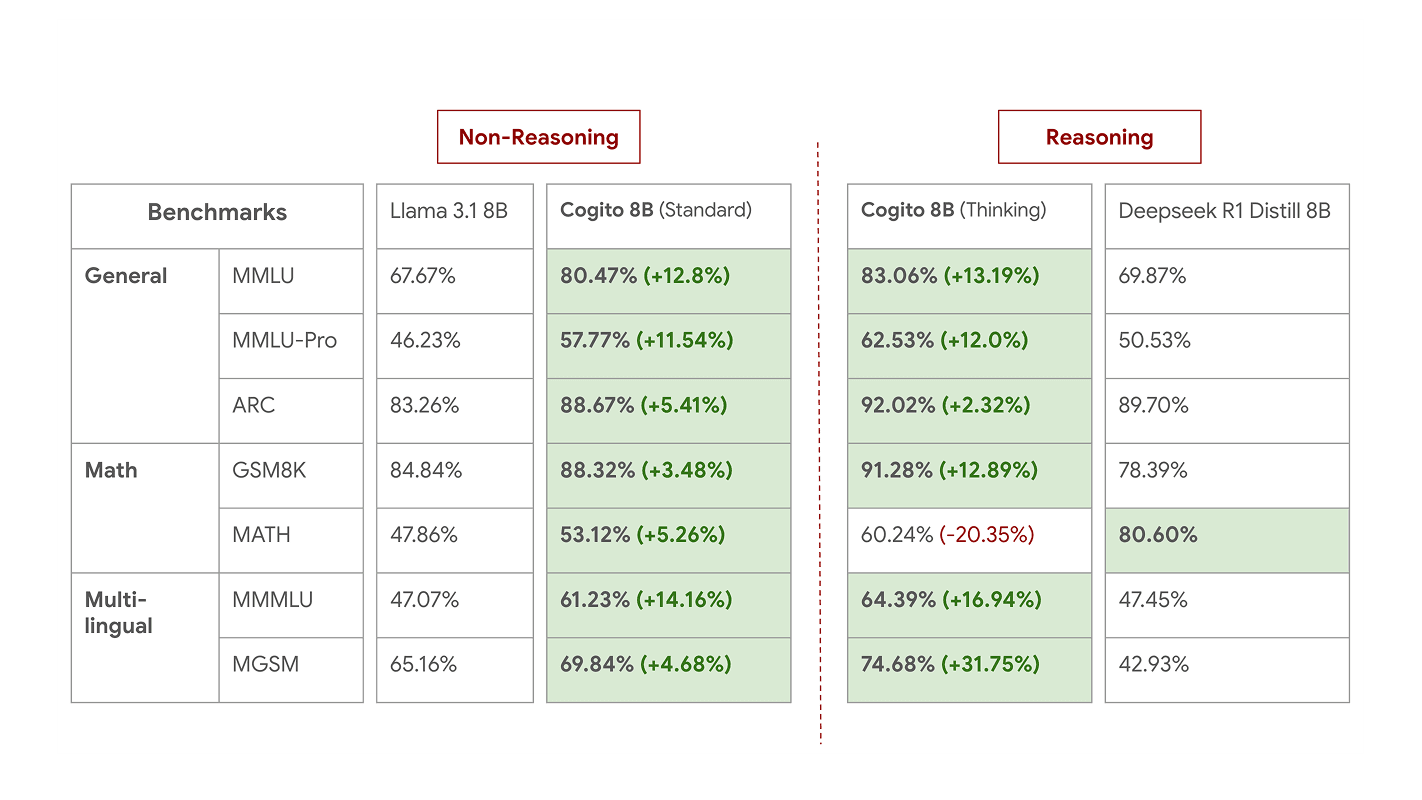
Figure 1. Benchmark results: Cogito 8B (Standard and Thinking) compared to Llama 3.1 8B and Deepseek R1 Distill 8B on General, Math, and Multilingual tasks.
Technical Features
Cogito V1 Preview 8B supports flexible reasoning operations. By default, it operates in standard LLM inference mode, quickly answering queries directly. Alternatively, it offers a "reasoning mode" that prompts the model to self-reflect and generate answers with explicit intermediate reasoning—an approach conceptually similar to chain-of-thought frameworks. This mode can be triggered by introducing the system prompt Enable deep thinking subroutine. or, when using tokenizers in Hugging Face, by setting the enable_thinking argument.
Despite adopting an explicit thought process, the model is not optimized for extremely long reasoning chains; instead, it focuses on achieving strong performance with efficient, shorter reasoning sequences. This design enables swifter responses and improved parameter distillation during training. Cogito V1 Preview 8B features a context window of 128,000 tokens, is proficient in over 30 languages, and natively supports tool calling—including single, parallel, multiple, and parallel_multiple scenarios. Tool calling is tightly integrated into both standard and extended thinking modes, enabling the model to define tools, generate calls, and incorporate tool outputs in follow-up responses.
The model is further optimized for coding, function calling, agent-oriented applications, science and engineering (STEM), and complex instruction following.
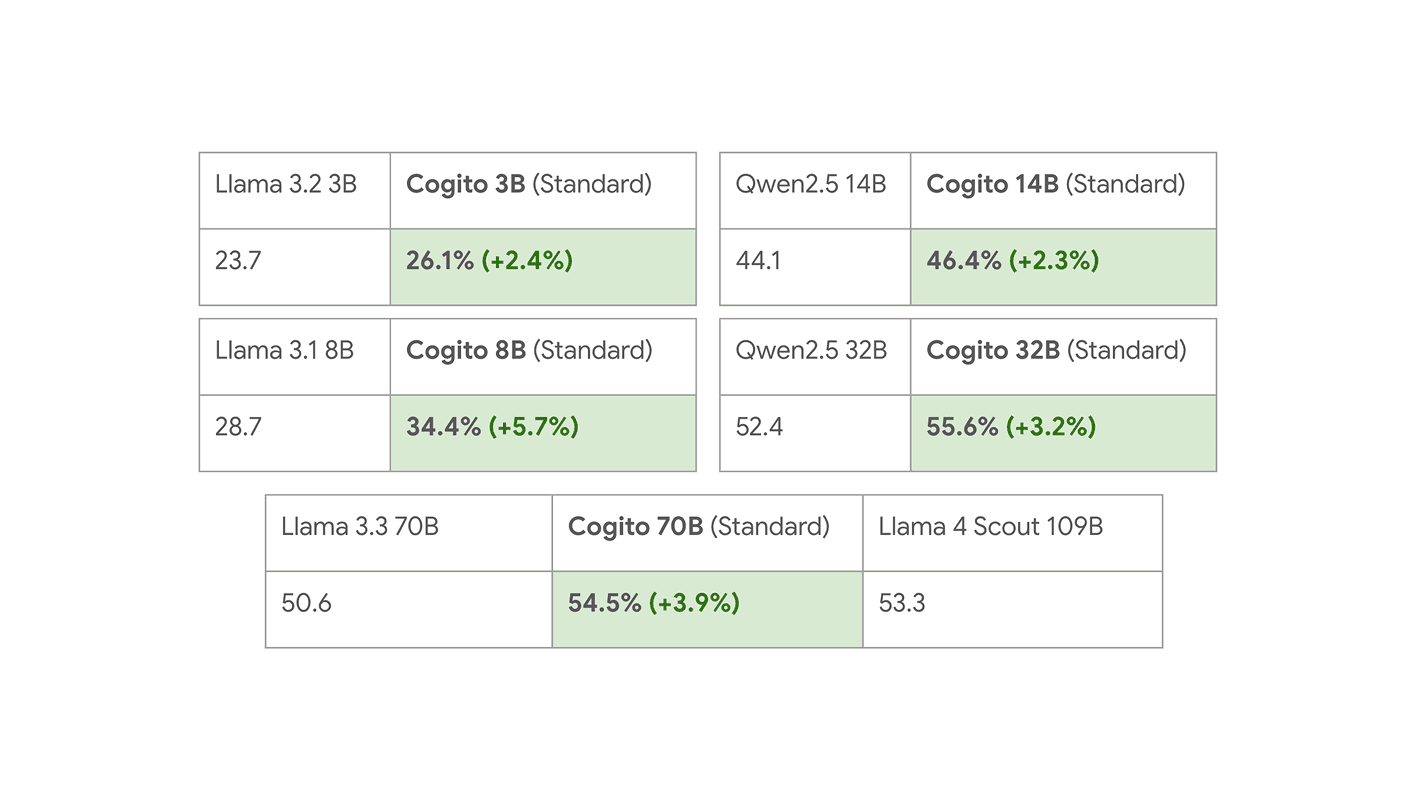
Figure 2. Performance comparison: Cogito models exhibit numerical performance increases versus Llama and Qwen baselines, highlighted in green.
Architecture and Training Methodology
Cogito V1 Preview 8B is built atop Llama 3.1-8B, leveraging a mix of Llama and Qwen pretraining checkpoints common to the Cogito V1 family. Its defining innovation lies in the application of Iterated Distillation and Amplification (IDA), an alignment and performance bootstrapping technique inspired by theoretical frameworks for scalable AI oversight and self-improvement.
IDA operates via alternating cycles of amplification—using additional computation for enhanced reasoning (e.g., chain-of-thought, answer sampling, solution verification)—and distillation, whereby superior cognitive routines are encoded into the model's parameters. Unlike conventional supervised finetuning or RLHF-based alignment, IDA enables a feedback loop in which the model can gradually surpass the bounded competence of its initial overseers. Deep Cogito reports that this iterative setup enables efficient and scalable training, such that the entire V1 Preview series was developed within approximately 75 days.
To ensure rigorous evaluation, benchmark test sets were explicitly excluded from the training corpus using string-matching filters.
Performance and Benchmarks
Cogito V1 Preview 8B has undergone extensive benchmarking against open-source models of comparable size, including Llama 3.1 8B, Qwen2 7B Instruct, and Deepseek R1 Distill 8B. Evaluation categories span general knowledge (e.g., MMLU, ARC), math (GSM8K, MATH), and multilingual tasks (MMMLU, MGSM), in both direct answering and reasoning modes.
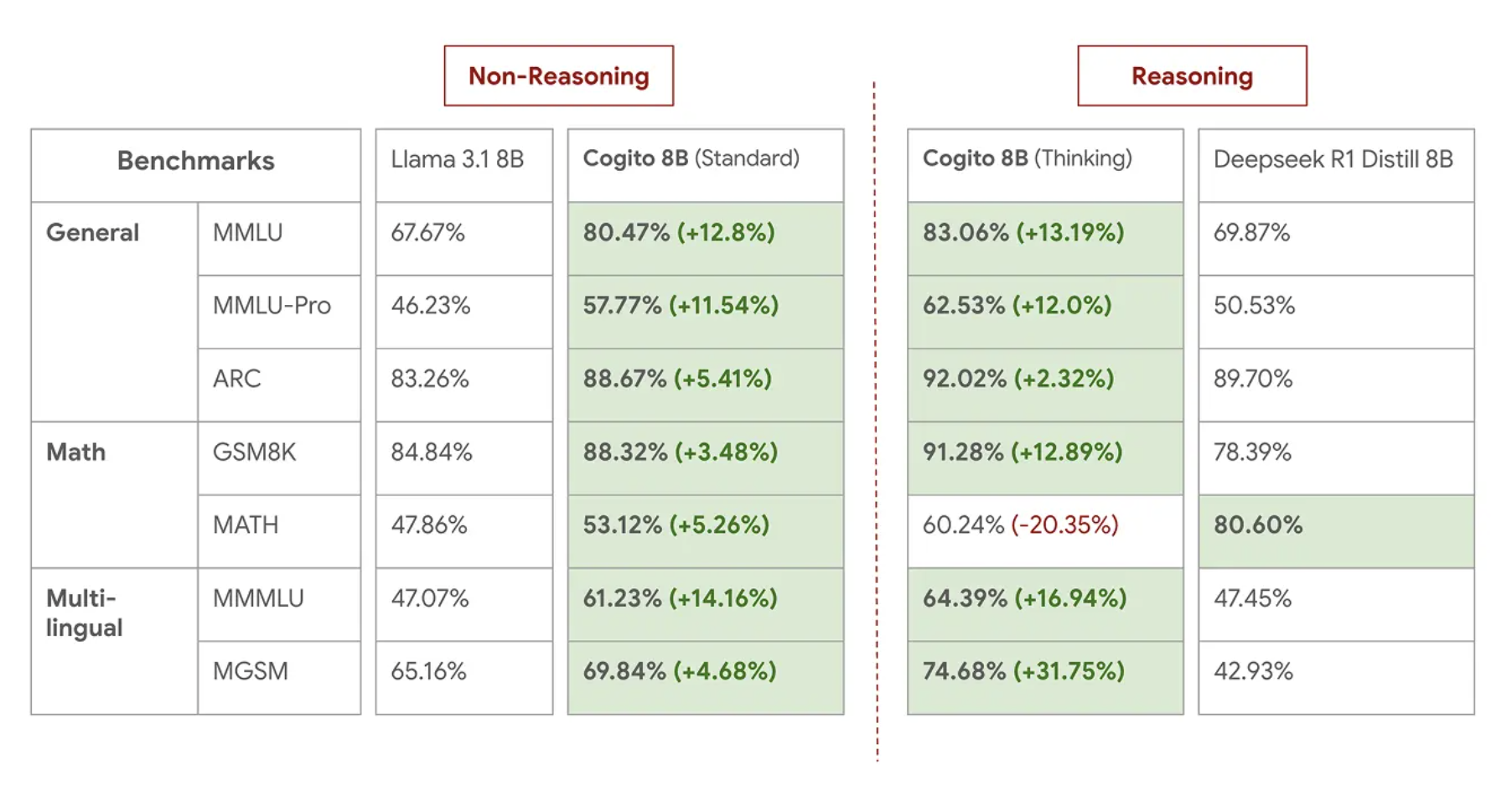
Figure 3. Cogito 8B (Standard and Thinking) benchmarked against Llama 3.1 8B and Deepseek R1 Distill 8B across General, Math, and Multilingual tasks for both Non-Reasoning and Reasoning evaluation.
In direct mode, the model demonstrates performance gains over both Llama and Qwen instruct models, while in reasoning mode it is measured against models specifically optimized for chain-of-thought and iterative distillation, such as Deepseek R1 and Qwen QwQ. Across most benchmarks, Cogito 8B maintains competitive or superior results, particularly notable in reasoning tasks and tool calling support.
The model also reports favorable results on Livebench, a composite benchmark summarizing broad task coverage.
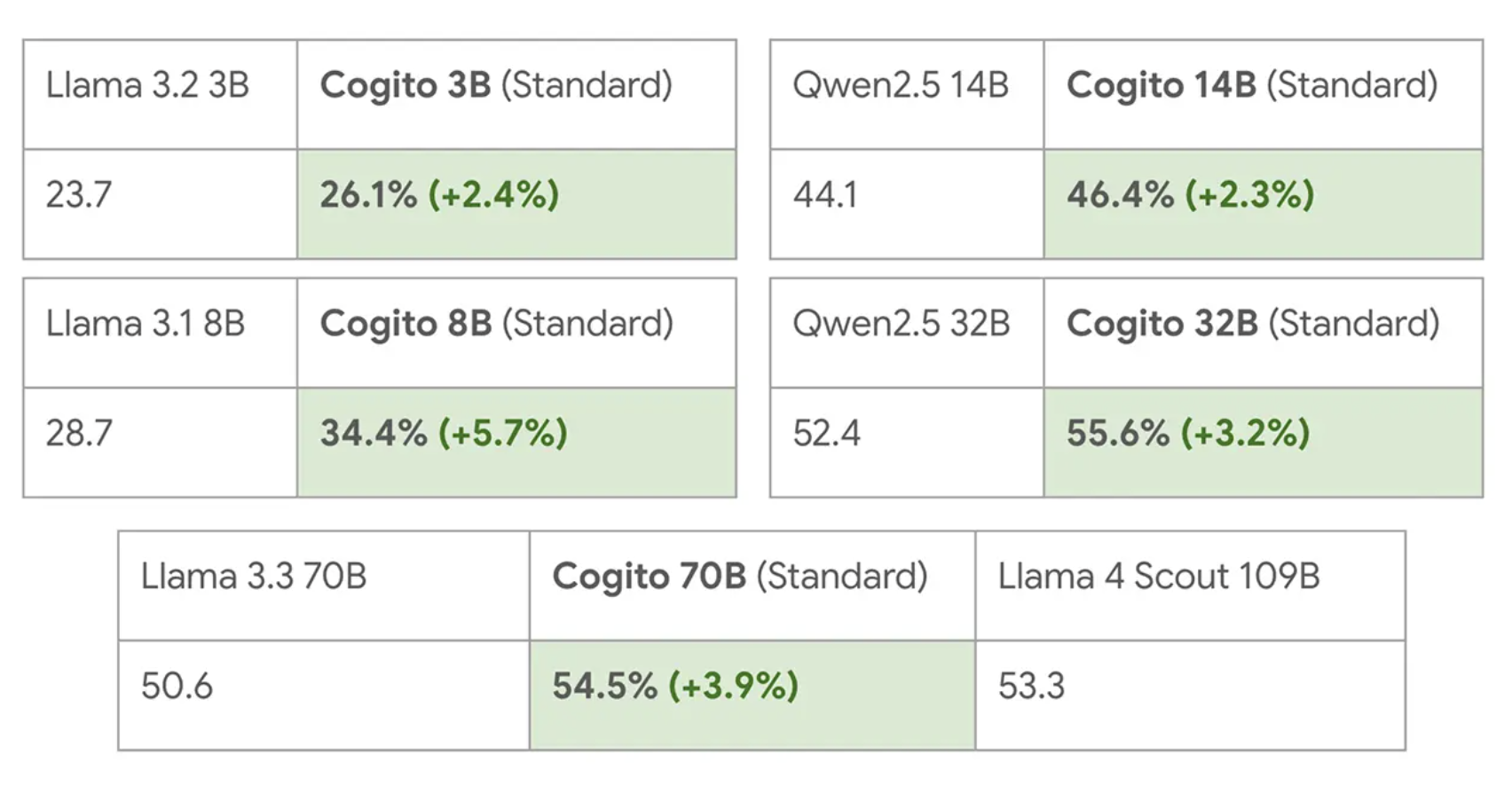
Figure 4. Livebench Global Average: Cogito models demonstrate performance gains over baseline Llama and Qwen models.
Cogito V1 Preview 8B stands out for its robust tool calling capability, significantly outperforming 8B-class baseline models that either lack or minimally implement this feature.
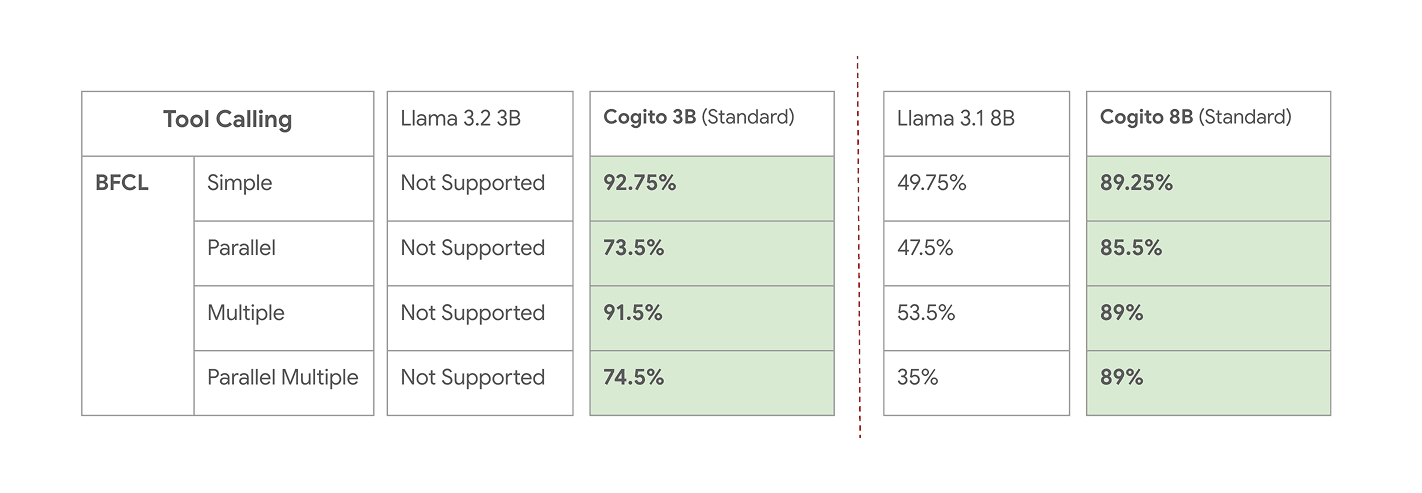
Figure 5. Tool calling evaluation: Cogito models demonstrate successful execution across single and parallel tool scenarios, while Llama baselines do not support these tasks natively.
Use Cases and Model Family
Cogito V1 Preview 8B is intended for a broad spectrum of tasks, including software development, function and tool invocation, autonomous agent frameworks, STEM problem solving, multilingual communication, and general instructional assistance.
It belongs to the wider Cogito V1 Preview series, spanning model sizes from 3B through 70B, all trained with the IDA methodology. According to Deep Cogito, the 70B variant demonstrates further performance improvements, with ongoing plans for even larger models (109B, 400B, 671B MoEs) and incremental checkpoint updates for all sizes. All iterations are intended to remain open under the same license.
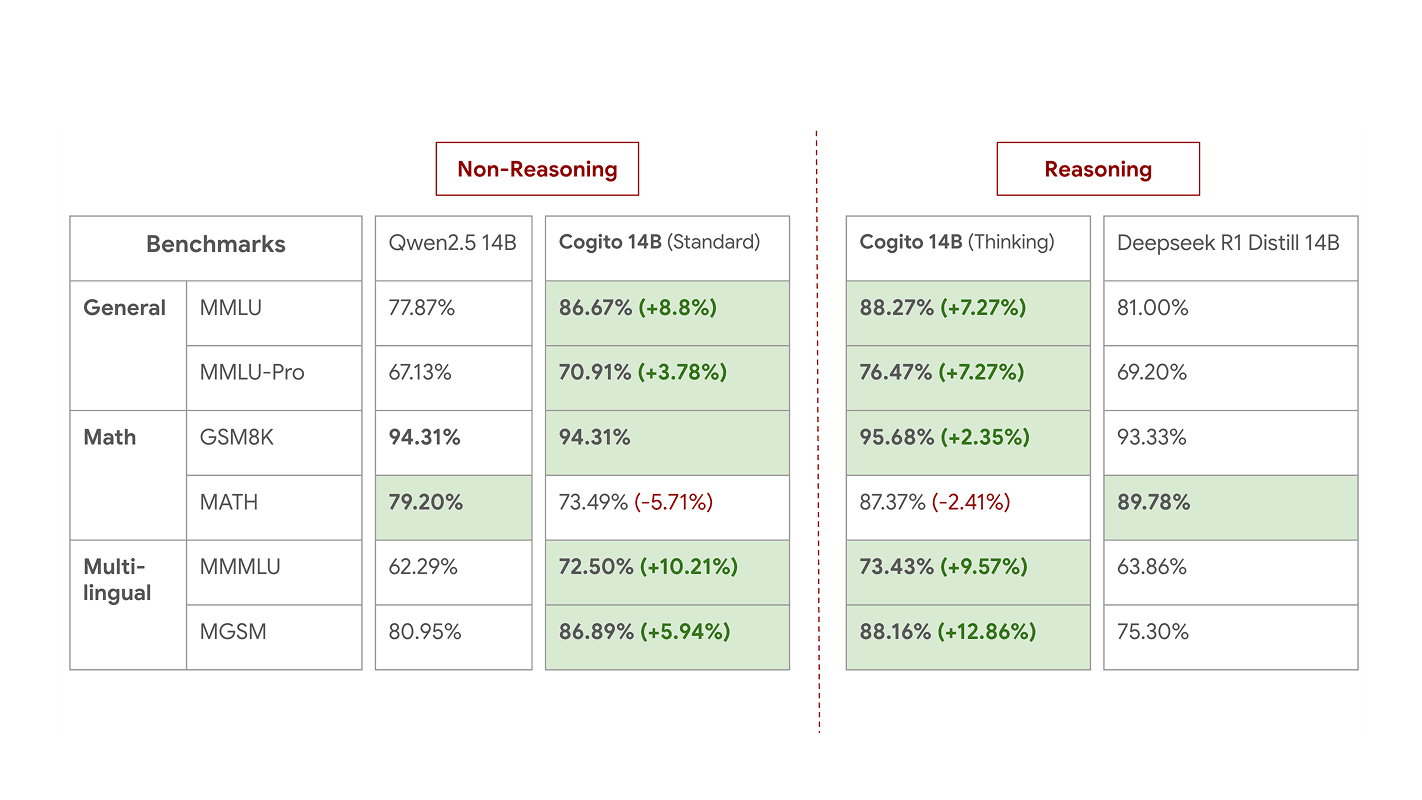
Figure 6. Performance evaluation for Cogito 14B (Standard and Thinking) versus Qwen2.5 14B and Deepseek R1 Distill 14B across benchmark categories.
Limitations and License
Cogito V1 Preview 8B is not specifically tuned for lengthy, multi-step reasoning chains, prioritizing more practical response speed and parameter efficiency. While benchmarks indicate notable gains, Deep Cogito recognizes that benchmark scores may not perfectly predict real-world user satisfaction or model utility across all deployment contexts.
The model and its repository are distributed under the Llama 3.1 Community License Agreement, making it freely available for both research and commercial projects.
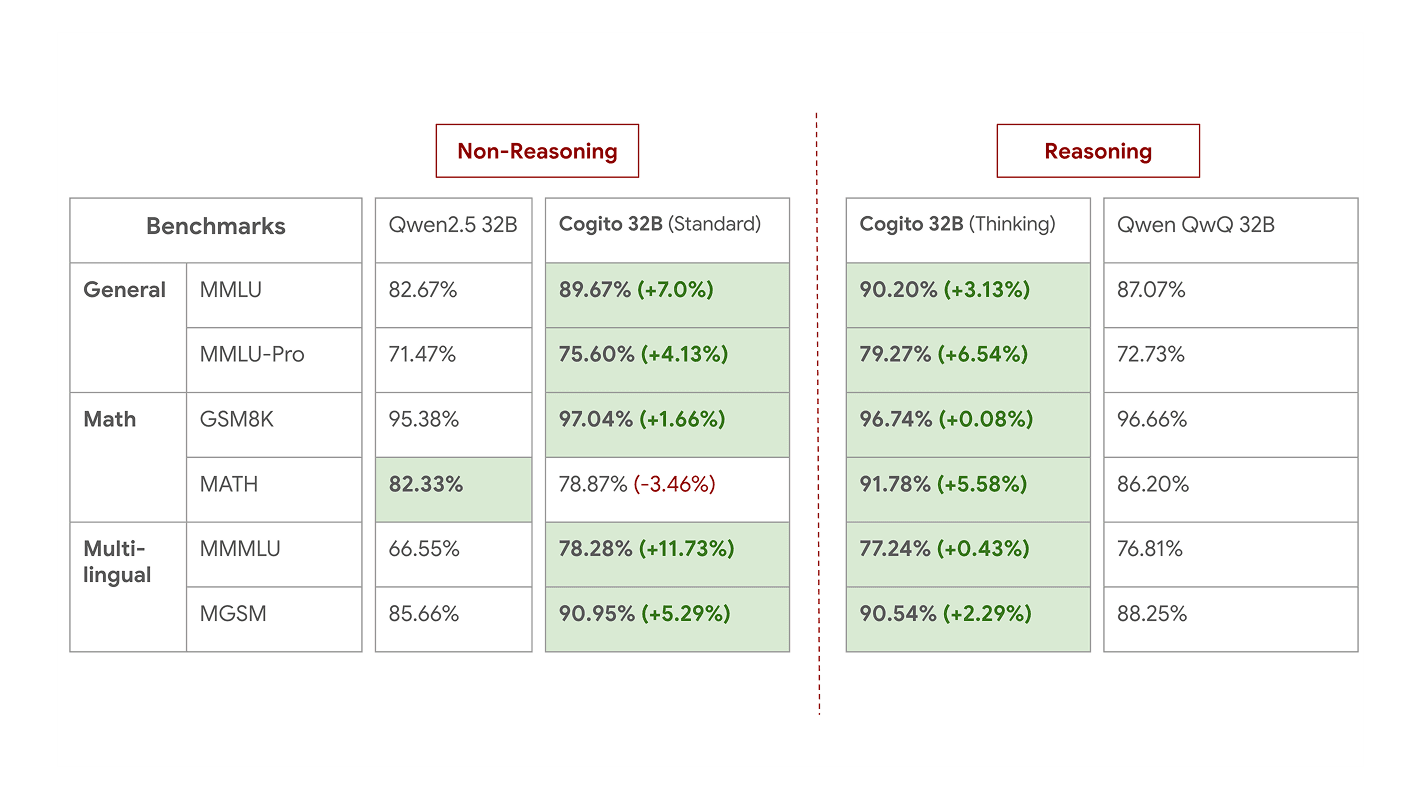
Figure 7. Cogito 32B (Standard and Thinking) versus Qwen2.5 32B and Qwen QwQ 32B: performance across benchmark tasks for Non-Reasoning and Reasoning evaluations.
External Resources
- Cogito V1 Preview collection on Hugging Face
- Cogito V1 Preview Llama 8B model card
- Iterated Distillation and Amplification: AI Alignment blog post
- Iterated Amplification: original research paper (2018)
- Deep Cogito – official website
- Deep Cogito on X
- List of models finetuned from Llama-3.1-8B
- Documentation: Model base specification
More in the Llama 3 Family
Llama 3 8B
Llama 3 70B
Llama 3.1 8B
Llama 3.1 8B Stheno v3.4
DeepSeek R1 Distill Llama 8B
Llama 3.1 70B
Cogito V1 Preview 70B
Llama 3.2 3B
Dolphin 3.0 Llama3.2 3B
Cogito V1 Preview 3B
Llama 3.3 70B
L3.3 70B Euryale v2.3
70B L3.3 Cirrus x1
Anubis 70B v1
Anubis 70B v1.1
Wayfarer Large 70B Llama 3.3
DeepSeek R1 Distill Llama 70B
More from Deep Cogito
Cogito V1 Preview 14B
Cogito V1 Preview 32B
Compatible Apps
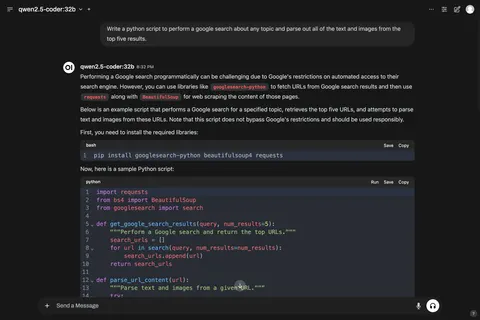
Open WebUI
A polished, self-hosted chat interface for LLMs with Ollama integration, multimodal prompts, and extensive workspace customization.
Web UI
Chat UIs · Beginner Friendly
llama.cpp
GGUF model inference with a polished web UI and OpenAI-format API. CPU-only build — high hardware compatibility, works on any machine without a GPU.
Web UI · API · CLI
LLM Inference · Chat UIs
llama.cpp (CUDA)
GGUF model inference with a polished web UI and OpenAI-format API. CUDA build — GPU-accelerated for NVIDIA GPUs.
Web UI · API · CLI
LLM Inference · Chat UIs
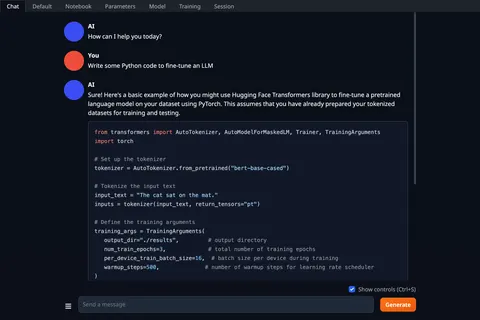
Text Generation Web UI
A feature-rich interface for running and experimenting with open-weight LLMs, including multiple inference backends, plugins, and tuning controls.
Web UI · API
Chat UIs · LLM Inference