Deep Cogito
Cogito V1 Preview 14B
Downloads
Model Report
Overview
Cogito V1 Preview 14B is an instruction-tuned, generative large language model (LLM) developed by Deep Cogito. As part of the Cogito family, this model is designed for advanced text generation tasks in a wide variety of languages and domains. The Cogito series encompasses several model sizes, including 3B, 8B, 14B, 32B, and 70B, with plans for future expansion to larger parameter counts and updated model checkpoints. These models are engineered to deliver robust performance in text-centric applications while incorporating innovative architectural and training strategies.
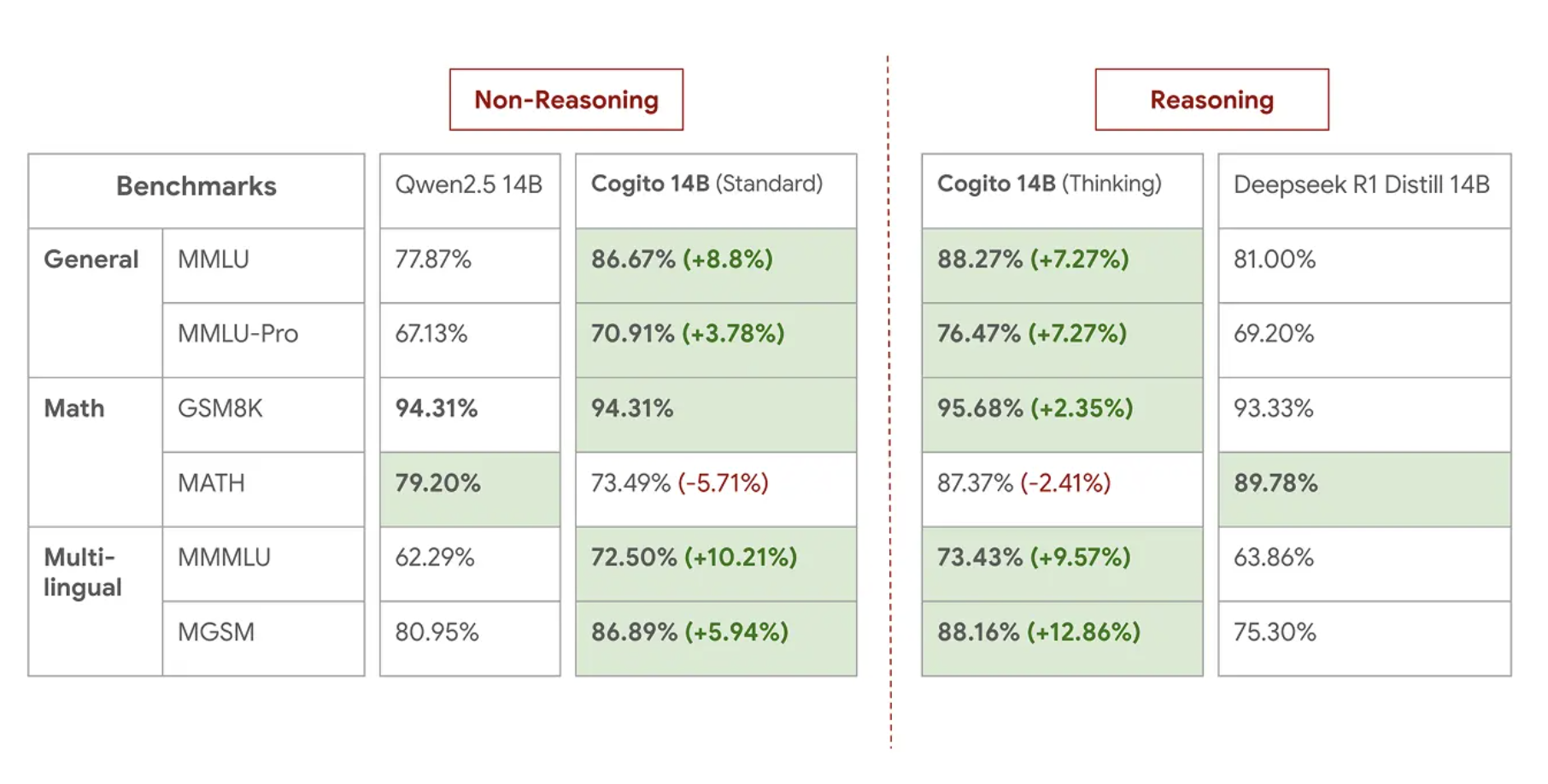
Figure 1. Benchmark table comparing Cogito 14B (Standard and Thinking modes) with Qwen2.5 14B and Deepseek R1 Distill 14B across general, math, and multi-lingual domains. Data includes both non-reasoning and reasoning results.
Model Architecture and Technical Details
Cogito V1 Preview 14B is fundamentally based on the Qwen 2.5 14B architecture, utilizing a parameter count of approximately 14.8 billion and employing BF16 tensor type for efficient computation. The model supports a substantial context window of 128,000 tokens, enabling the handling of lengthy and complex textual inputs. Its multilingual training corpus spans over 30 languages, reflecting a focus on interoperability and global application.
One distinguishing aspect of the Cogito models is their "hybrid reasoning" capability. Unlike standard LLMs, Cogito can directly answer user prompts or, alternatively, engage in a reflective reasoning process before responding. This specialized mode—referred to as the "deep thinking subroutine"—can be activated via a specific system prompt or through configuration parameters in the inference pipeline. Such design choices facilitate the model's flexibility in accommodating both rapid-response and in-depth reasoning tasks.
Training Methodology: Iterated Distillation and Amplification
The most notable innovation in the Cogito V1 Preview 14B training process is its adoption of Iterated Distillation and Amplification (IDA), a strategy developed to achieve scalable and efficient model alignment. IDA training consists of two recurring stages: "amplification," where the model generates more sophisticated solutions by invoking additional computation and auxiliary reasoning subroutines, and "distillation," in which these enhanced behaviors are internalized into the model's core parameters. This paradigm promotes continuous self-improvement and incremental capability gains over successive training cycles.
IDA distinguishes itself from traditional approaches like Reinforcement Learning from Human Feedback (RLHF) by minimizing reliance on direct human oversight and enabling self-supervised advancement. The Cogito models begin with pretrained Llama or Qwen checkpoints and progressively absorb higher-level cognitive patterns through iterative amplification/distillation processes. According to published overviews and research on IDA, this method aims to surpass the limitations inherent to human oversight in training highly capable language models.
Performance Benchmarks and Evaluation
Empirical evaluations indicate that Cogito V1 Preview 14B offers competitive performance relative to other 14B-parameter language models. Benchmarking spans domains including general knowledge, mathematics, and multilingual capability, and encompasses both standard ("non-reasoning") and advanced ("reasoning") modes. For example, when assessed on tasks such as MMLU, GSM8K, and MMMLU, Cogito 14B demonstrates notable improvements in key categories compared to base Qwen 2.5 14B and Deepseek R1 Qwen 14B models.
The provided evaluation framework ensures impartiality by excluding benchmark test sets from the model's training data, using string-matching removal strategies. Detailed performance reports and live benchmark results are disseminated in official technical documentation, revealing that related larger models (such as Cogito 70B) also show strong results in cross-model comparisons, including those involving models like Llama 4 109B MoE and Llama 3.3 70B.
Functional Capabilities and Applications
Cogito V1 Preview 14B is optimized for a range of practical applications, with particular emphasis on coding, STEM-related tasks, complex instruction following, and agentic use cases. The model supports a variety of tool-calling functionalities, allowing for direct, parallel, and multi-tool invocation within both standard and extended "thinking" modes. This flexibility is particularly relevant for tasks requiring programmatic interaction, automated reasoning, and workflow orchestration.
The model's hybrid reasoning and multilingual training allow it to provide helpful responses across a wide array of user prompts, from day-to-day query answering to more sophisticated reasoning or computational tasks. While Cogito 14B supports advanced reasoning subroutines, the design intentionally avoids optimization for very long reasoning chains, reflecting an emphasis on practical performance and minimal latency in real-world deployment contexts.
Limitations and License
Despite robust capabilities, Cogito V1 Preview 14B does present certain limitations. The model is not specifically optimized for extremely deep or extended reasoning sequences, favoring instead scenarios that require concise and efficient responses. Additionally, while benchmark scores are indicative of relative technical merit, real-world performance can diverge from standardized evaluation metrics due to the nuance of user queries and application-specific requirements.
The model and its associated weights are distributed under the Apache 2.0 License, granting broad rights for commercial use and encouraging further research and development within the community. All released models in the Cogito V1 Preview family are available under this permissive open license.
Further Reading and Resources
- Official Blog Post: Overview of Cogito v1 Preview models and the IDA training methodology.
- Cogito V1 Preview on Hugging Face: Access to the model family and associated documentation.
- Iterated Distillation and Amplification Research Paper: Academic resource detailing the foundations of IDA.
- IDA Concept Introduction Article: Additional background on IDA theory and implications.
More in the Qwen 2 Family
Qwen2.5 VL 3B
Qwen2.5 VL 7B
Qwen2.5 VL 72B
QwQ 32B Preview
QwQ 32B
Qwen 2.5 Math 1.5B
DeepSeek R1 Distill Qwen 1.5B
DeepCoder 1.5B Preview
Qwen 2.5 Math 7B
Qwen 2.5 Math PRM 7B
DeepSeek R1 Distill Qwen 7B
Qwen 2.5 Math 72B
Qwen 2.5 Math PRM 72B
Qwen 2.5 Coder 7B
Qwen 2.5 Coder 32B
Qwen 2.5 7B
Qwen2.5 7B 1M
Qwen 2.5 14B
Qwen2.5 14B 1M
DeepSeek R1 Distill Qwen 14B
DeepCoder 14B Preview
Qwen 2.5 32B
DeepSeek R1 Distill Qwen 32B
Cogito V1 Preview 32B
Qwen 2.5 72B
Qwen 2 7B
Qwen 2 72B
More from Deep Cogito
Cogito V1 Preview 8B
Cogito V1 Preview 70B
Cogito V1 Preview 3B
Compatible Apps
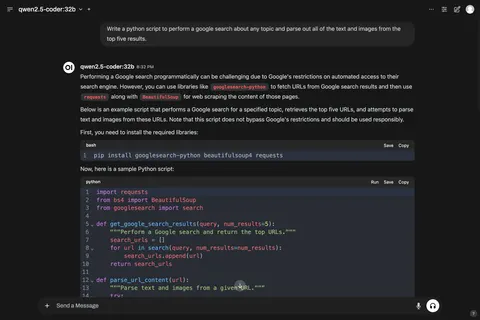
Open WebUI
A polished, self-hosted chat interface for LLMs with Ollama integration, multimodal prompts, and extensive workspace customization.
Web UI
Chat UIs · Beginner Friendly
llama.cpp
GGUF model inference with a polished web UI and OpenAI-format API. CPU-only build — high hardware compatibility, works on any machine without a GPU.
Web UI · API · CLI
LLM Inference · Chat UIs
llama.cpp (CUDA)
GGUF model inference with a polished web UI and OpenAI-format API. CUDA build — GPU-accelerated for NVIDIA GPUs.
Web UI · API · CLI
LLM Inference · Chat UIs
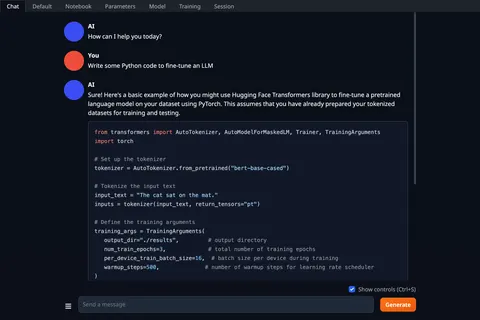
Text Generation Web UI
A feature-rich interface for running and experimenting with open-weight LLMs, including multiple inference backends, plugins, and tuning controls.
Web UI · API
Chat UIs · LLM Inference