Alibaba Cloud
Qwen 2.5 Coder 7B
Downloads
Model Report
Overview
Qwen2.5-Coder-7B is a large language model (LLM) developed by the Qwen Team at Alibaba Group, designed to address complex code generation, reasoning, and repair across a wide spectrum of programming languages. It is a member of the Qwen2.5-Coder model family, which serves as a successor to the CodeQwen1.5 series, and specifically targets high-performance coding tasks, while also retaining advanced mathematical and general reasoning abilities. As an open-source model, Qwen2.5-Coder-7B incorporates architectural innovations and demonstrates notable performance in coding benchmarks, providing a foundation for automated code understanding and generation.
Figure 1. Official logo representing the Qwen3 and Qwen2.5-Coder model family from Alibaba.
Architecture and Technical Features
Qwen2.5-Coder-7B employs a transformer-based architecture enhanced with several advanced features, including Rotary Position Embeddings (RoPE), SwiGLU activation, and Root Mean Square Normalization (RMSNorm). This model uses 28 transformer layers and contains approximately 7.61 billion parameters, with 6.53 billion attributed to non-embedding layers. It utilizes separate attention heads for query and key-value processing, allocating 28 heads for queries and 4 for key-value pairs, a configuration described in the Qwen2.5-Coder Technical Report.
A significant aspect of Qwen2.5-Coder-7B is its extensive context window, supporting up to 128,000 tokens per prompt, made possible by the YaRN position encoding extension. This allows for handling of large documents, repository-wide code completion, and long-range code understanding. The model is trained to interpret and process code in 92 programming languages and includes specialized support for code completion methodologies such as fill-in-the-middle (FIM), using unique prompt tokens to designate task structure.
Training Data and Optimization
Qwen2.5-Coder-7B has been trained on a vast corpus comprising 5.5 trillion tokens, consisting of source code, synthetic data, and grounded text-code datasets. The scale and diversity of the training material are detailed in the Qwen2.5-Coder Technical Report, which emphasizes the inclusion of multi-programming language data and comprehensive mathematical benchmarks. The training regime incorporates post-training strategies such as supervised fine-tuning (SFT) and reinforcement learning from human feedback (RLHF), contributing to instruction-following and generalization.
Instruction-tuned variants, denoted as "Qwen2.5-Coder-Instruct", are further optimized with high-quality instruction data, enhancing capabilities in following detailed prompts and achieving user-aligned responses. This fine-tuning approach aligns with modern practices for instruction adaptation in language models aimed at interactive and assistant-like use cases.
Benchmark Performance
Qwen2.5-Coder-7B demonstrates competitive results on a broad array of code-centric and general reasoning benchmarks. In studies, it achieves high scores in code generation and completion tasks on industry-standard datasets such as HumanEval, EvalPlus, MultiPL-E, and BigCodeBench. The model's instruction-tuned variant exhibits multilingual proficiency in practical coding scenarios, as evaluated by McEval.
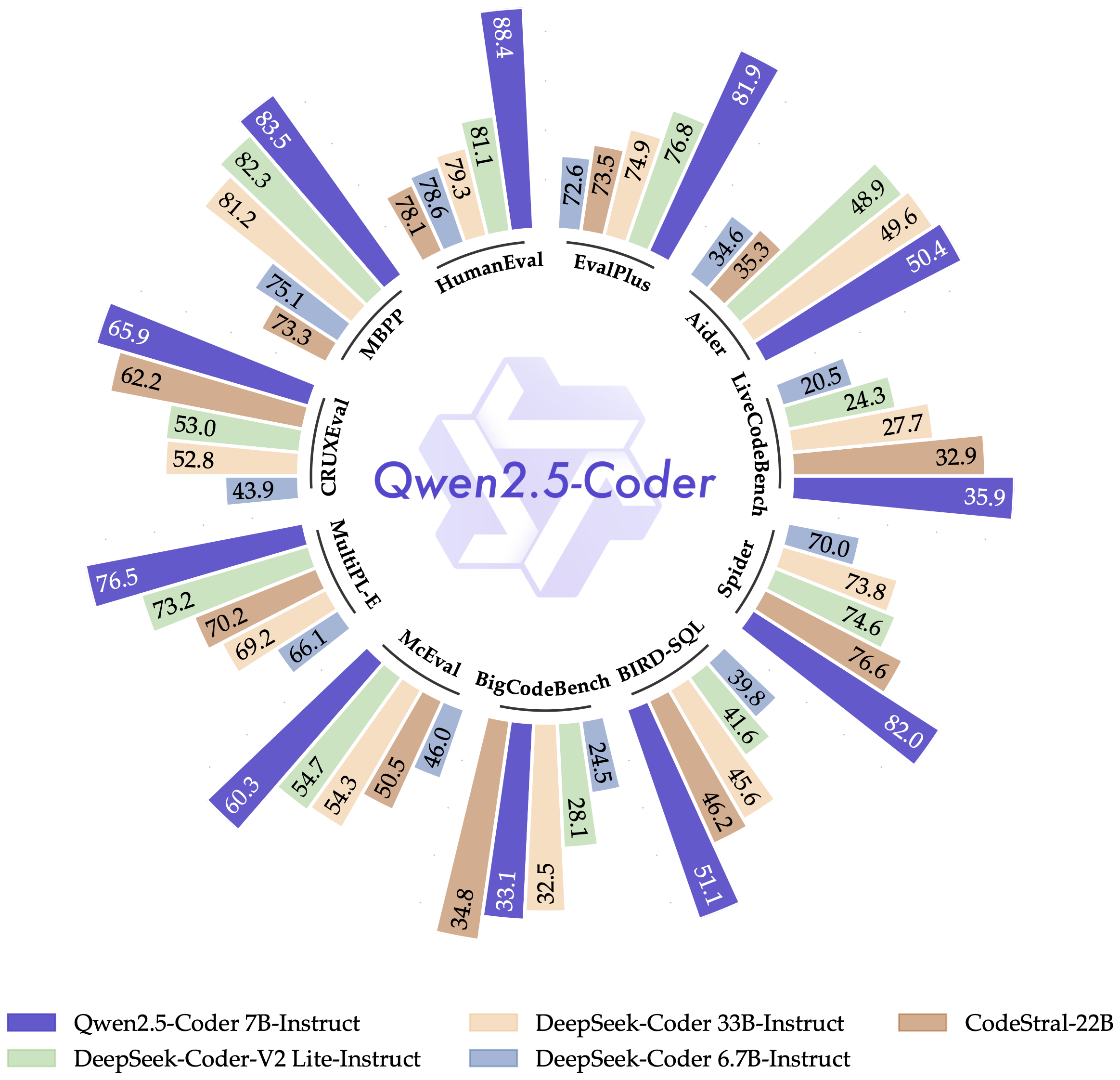
Figure 2. Radial bar chart comparing Qwen2.5-Coder’s performance to other models across multiple coding benchmarks such as HumanEval, EvalPlus, and MultiPL-E.
Quantitative comparisons indicate Qwen2.5-Coder-7B-Base performs strongly in a variety of tasks, including those where it achieves scores comparable to or exceeding some larger open-source models in areas such as code completion, fill-in-the-middle generation, and mathematical problem solving.
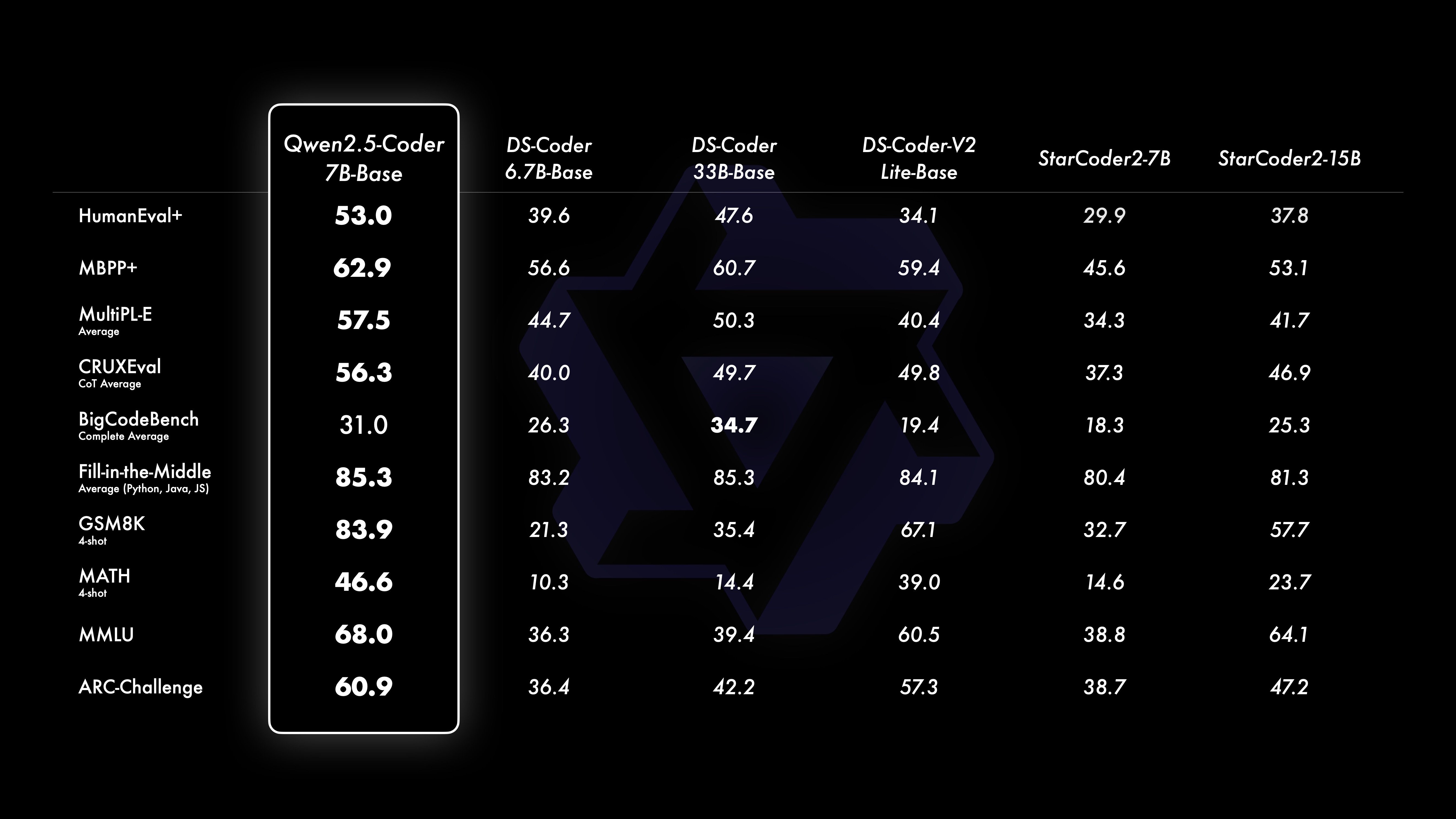
Figure 3. Tabular comparison showing Qwen2.5-Coder 7B-Base’s scores across numerous code evaluation tasks relative to peer models.
Notably, the instruction-tuned version achieves high marks on code reasoning datasets, such as CRUXEval, and performs well in mathematical benchmarks like MATH and AMC23. Its multilingual capabilities extend to more than 40 languages, with sustained strong performance across both common and less frequently encountered programming environments.
In performance scaling, Qwen2.5-Coder models demonstrate a favorable performance-to-size ratio, performing effectively in code reasoning and instruction-following at smaller parameter scales.
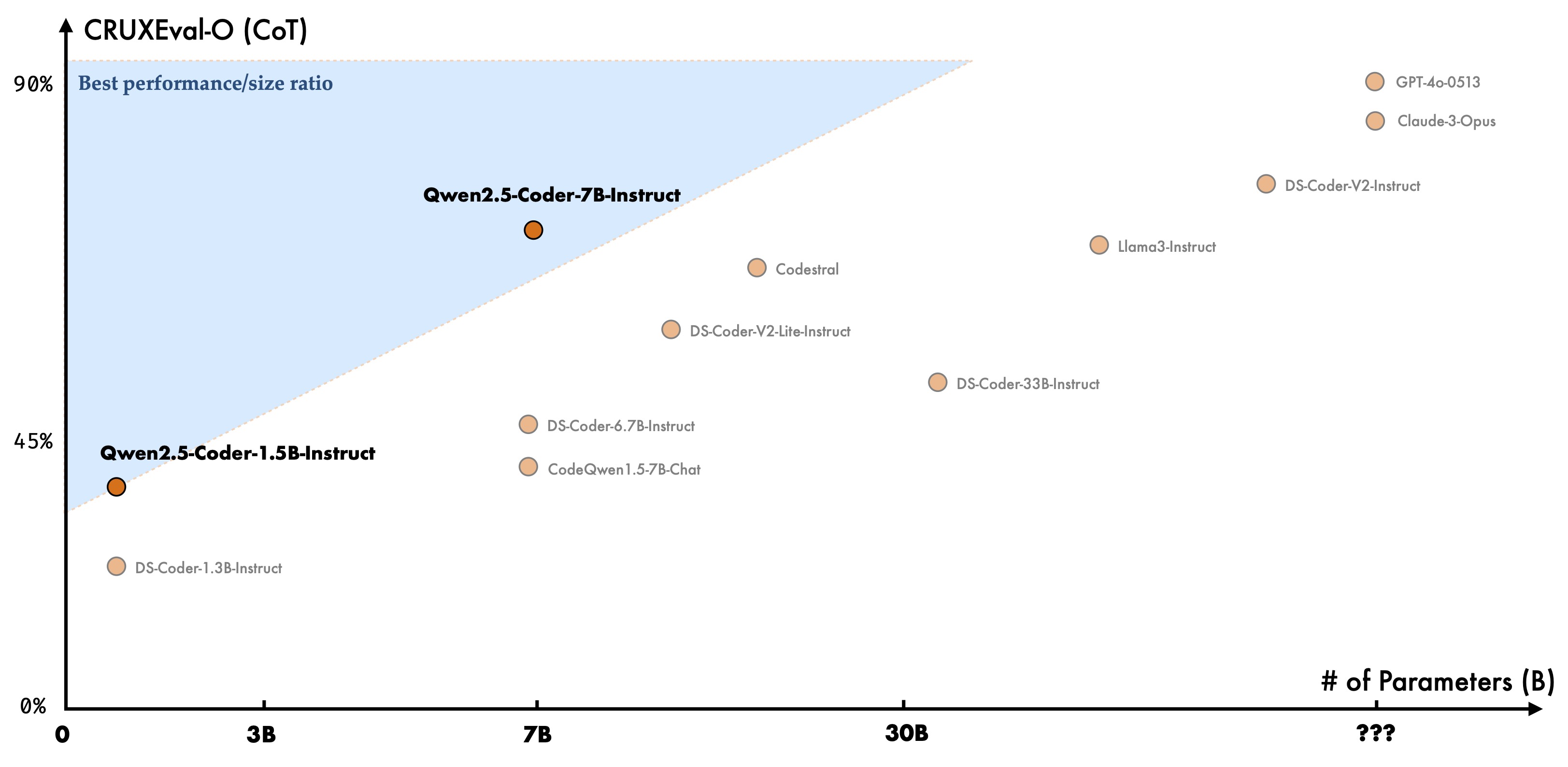
Figure 4. Scatter plot illustrating Qwen2.5-Coder-Instruct’s performance in code reasoning benchmarks in relation to model size.
Applications and Use Cases
The versatility of Qwen2.5-Coder-7B enables its deployment for a wide range of software engineering applications. Its core use cases include automated code completion—at both file and repository granularity—with dedicated support for fill-in-the-middle code generation utilizing specialized FIM tokens. This feature is grounded in the efficient fill-in-the-middle methodology, allowing the insertion of code segments within complex codebases.
Furthermore, the model’s understanding of repository context, assisted by prompt tokens designating repository and file separators, makes it suitable for agent-based code suggestion tools and automated refactoring systems. While the base model is primarily aimed at non-conversational code tasks, the instruction-tuned versions are adapted for chat-based interfaces, enabling use as an interactive code assistant or integrated development environment assistant.
Model Family and Release
Qwen2.5-Coder-7B is part of the broader Qwen2.5-Coder series, which includes models ranging from 0.5 billion to 32 billion parameters. The series succeeded the CodeQwen1.5 line and is positioned within the larger Qwen family of language and multimodal models from Alibaba, which span natural language generation, vision, audio, and agent functionalities. The 7B model was officially released on September 19, 2024, with larger variants, including the 32B parameter class, designed to provide similar capabilities to some proprietary LLMs.
Limitations and License
While Qwen2.5-Coder-7B is effective in code and reasoning tasks, the base model is not recommended for conversational or general dialogue use, except in its instruction-tuned variants. Handling of long-context prompts relies on YaRN-based positional scaling; some interfaces (such as vLLM) currently implement only static scaling, which may affect performance on short inputs if global scaling is enabled.
Qwen2.5-Coder-7B is made available under the open Apache 2.0 license, supporting transparent research, development, and commercial deployment.
Helpful Links
- Qwen Documentation
- Qwen Blog
- Qwen GitHub
- Qwen Hugging Face
- Qwen ModelScope
- Qwen2.5-Coder Technical Report
- Qwen2 Technical Report
- YaRN: Efficient Context Window Extension of Large Language Models
- Efficient Training of Language Models to Fill in the Middle
- Qwen2.5-Coder Series Blog
- Qwen2.5-Coder GitHub
- Qwen2.5-Coder Hugging Face Collection
- Star History Chart for Qwen2.5-Coder GitHub
More in the Qwen 2 Family
Qwen2.5 VL 3B
Qwen2.5 VL 7B
Qwen2.5 VL 72B
QwQ 32B Preview
QwQ 32B
Qwen 2.5 Math 1.5B
DeepSeek R1 Distill Qwen 1.5B
DeepCoder 1.5B Preview
Qwen 2.5 Math 7B
Qwen 2.5 Math PRM 7B
DeepSeek R1 Distill Qwen 7B
Qwen 2.5 Math 72B
Qwen 2.5 Math PRM 72B
Qwen 2.5 Coder 32B
Qwen 2.5 7B
Qwen2.5 7B 1M
Qwen 2.5 14B
Qwen2.5 14B 1M
DeepSeek R1 Distill Qwen 14B
DeepCoder 14B Preview
Cogito V1 Preview 14B
Qwen 2.5 32B
DeepSeek R1 Distill Qwen 32B
Cogito V1 Preview 32B
Qwen 2.5 72B
Qwen 2 7B
Qwen 2 72B
More from Alibaba Cloud
Qwen3 0.6B
Qwen3 1.7B
Qwen3 4B
Qwen3 8B
Qwen3 14B
Qwen3 32B
Qwen3 30B A3B
Qwen3 235B A22B
Qwen 1.5 32B
Qwen 1.5 72B
Compatible Apps
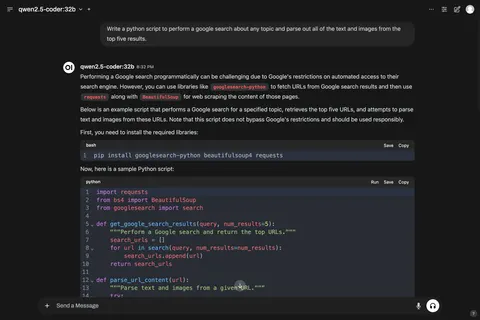
Open WebUI
A polished, self-hosted chat interface for LLMs with Ollama integration, multimodal prompts, and extensive workspace customization.
Web UI
Chat UIs · Beginner Friendly
llama.cpp
GGUF model inference with a polished web UI and OpenAI-format API. CPU-only build — high hardware compatibility, works on any machine without a GPU.
Web UI · API · CLI
LLM Inference · Chat UIs
llama.cpp (CUDA)
GGUF model inference with a polished web UI and OpenAI-format API. CUDA build — GPU-accelerated for NVIDIA GPUs.
Web UI · API · CLI
LLM Inference · Chat UIs
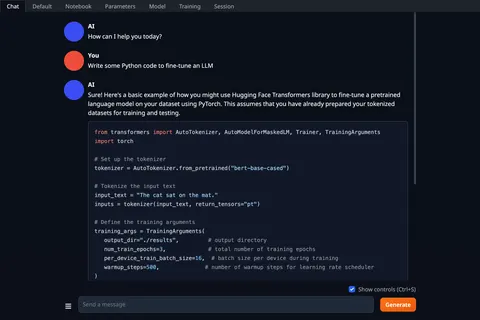
Text Generation Web UI
A feature-rich interface for running and experimenting with open-weight LLMs, including multiple inference backends, plugins, and tuning controls.
Web UI · API
Chat UIs · LLM Inference