Deep Cogito
Cogito V1 Preview 70B
Downloads
Model Report
Overview
Cogito V1 Preview 70B is a large language model (LLM) developed by Deep Cogito and released on April 8, 2025, as part of the Cogito V1 Preview collection. The series spans multiple model sizes, including 3B, 8B, 14B, and 32B parameters, with the 70B version being one of the largest current offerings in the lineup. Cogito models are instruction-tuned and distributed under the Llama 3.3 Community License Agreement, which permits commercial use and a wide range of research or application scenarios, as outlined in Deep Cogito's research announcement.
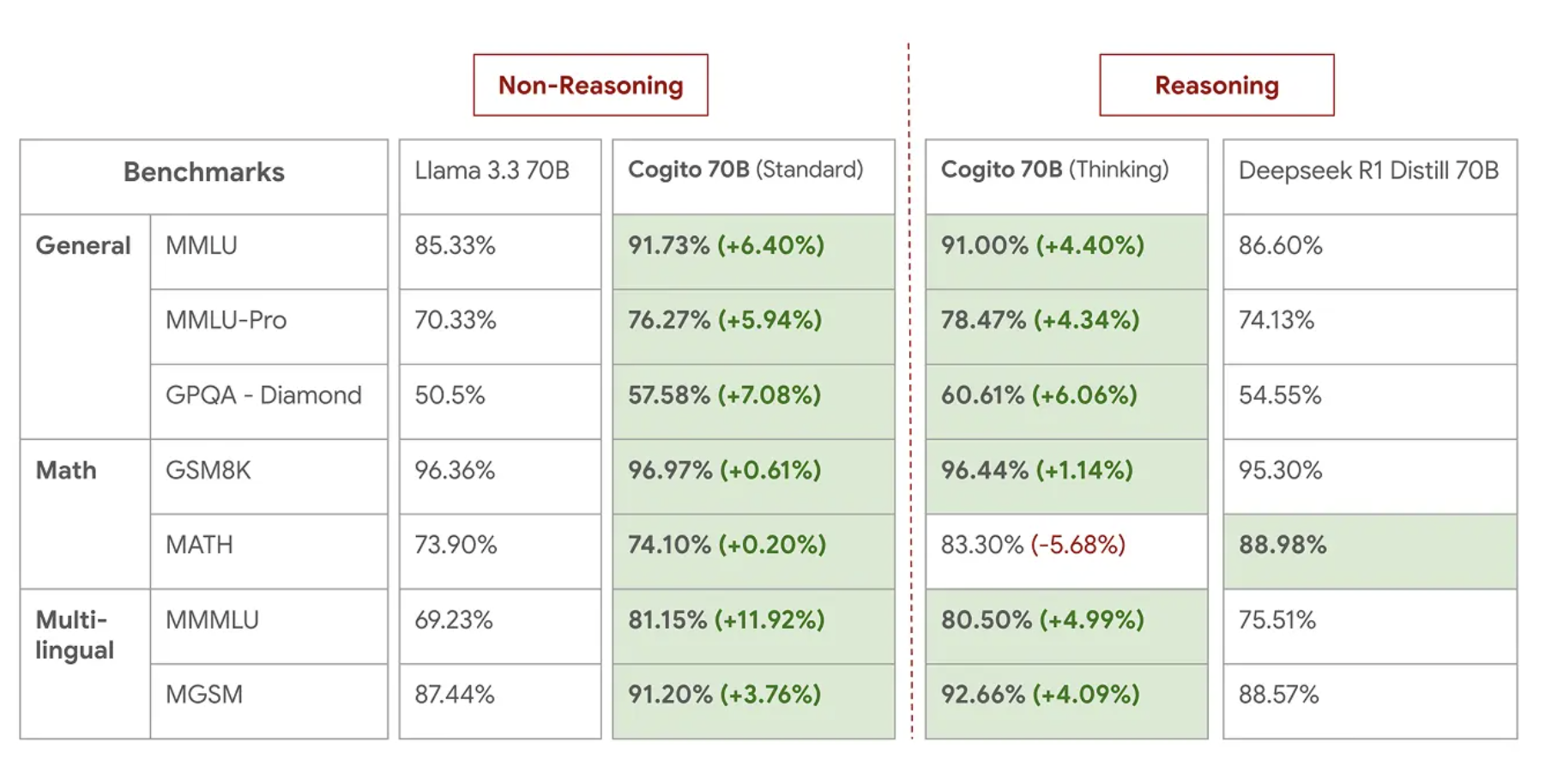
Figure 1. A benchmark comparison showing Cogito 70B Standard and Thinking performance against models like Llama 3.3 70B and Deepseek R1 Distill 70B on Non-Reasoning and Reasoning tasks across General, Math, and Multilingual benchmarks.
Technical Features and Model Architecture
The Cogito V1 Preview 70B model distinguishes itself through hybrid reasoning capabilities, context length, multilingual support, and tool-calling proficiency. It can operate in two principal modes: a standard LLM mode for fast direct answers and a "reasoning mode," where the model applies modular self-reflection for more elaborate solution paths—this extended thinking is triggered with a specific system instruction or configuration, as described in Cogito's technical documentation.
Cogito 70B provides a context window of up to 128,000 tokens, supporting the processing of extensive documents and conversations. Multilingual competence is achieved through training on data in over 30 different languages, enhancing performance in global and cross-lingual use cases. Notably, tool calling is natively supported, enabling both single and parallel tool operations across direct and reasoning tasks—a feature that is expanded and measured extensively in model benchmarks.
Under the hood, Cogito 70B utilizes a transformer architecture based on the meta-llama/Llama-3.1-70B base checkpoint, adapted for its proprietary alignment and optimization procedures.
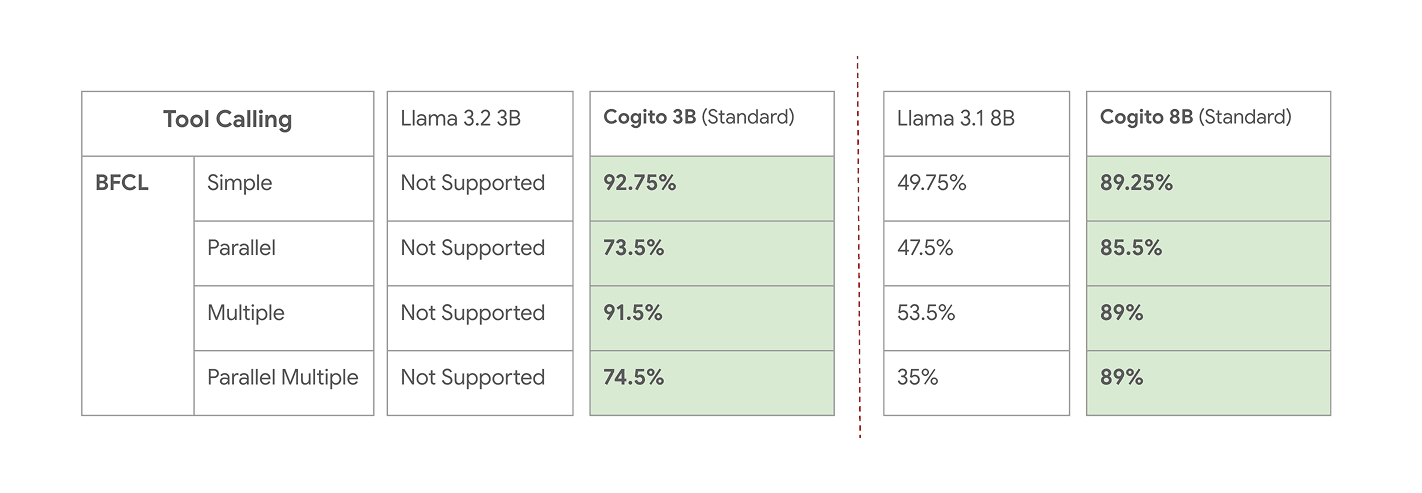
Figure 2. Benchmarks highlighting Cogito models' support for various tool calling scenarios, where Llama models of comparable size show no native support.
Training Methodology and Alignment Process
Cogito V1 Preview 70B is trained using Iterated Distillation and Amplification (IDA), an approach designed to align large models to high-quality reasoning and problem-solving strategies. In every iteration of IDA, the model first amplifies its intelligence through the use of computational subroutines—such as chain-of-thought reasoning and answer verification—and subsequently distills these advanced behaviors into its parameters. This creates a recurrent loop, enabling the model to internalize increasingly complex solution strategies.
The IDA process, according to the Deep Cogito research summary, is positioned as more time-efficient and scalable than traditional methods like reinforcement learning from human feedback (RLHF). The training data is curated to exclude benchmark evaluation sets via string matching, aiming to maintain the integrity of evaluation metrics.
Performance and Benchmark Evaluation
Extensive evaluation demonstrates Cogito 70B's strong performance across general, mathematical, and multilingual benchmarks in both direct and reasoning modes. When compared to peer models—including Llama 3.3 70B, Qwen2.5 14B, and Deepseek R1 Distill 70B—Cogito 70B displays consistently competitive or superior results across multiple categories, as evidenced by benchmark tables from Hugging Face and Deep Cogito research.
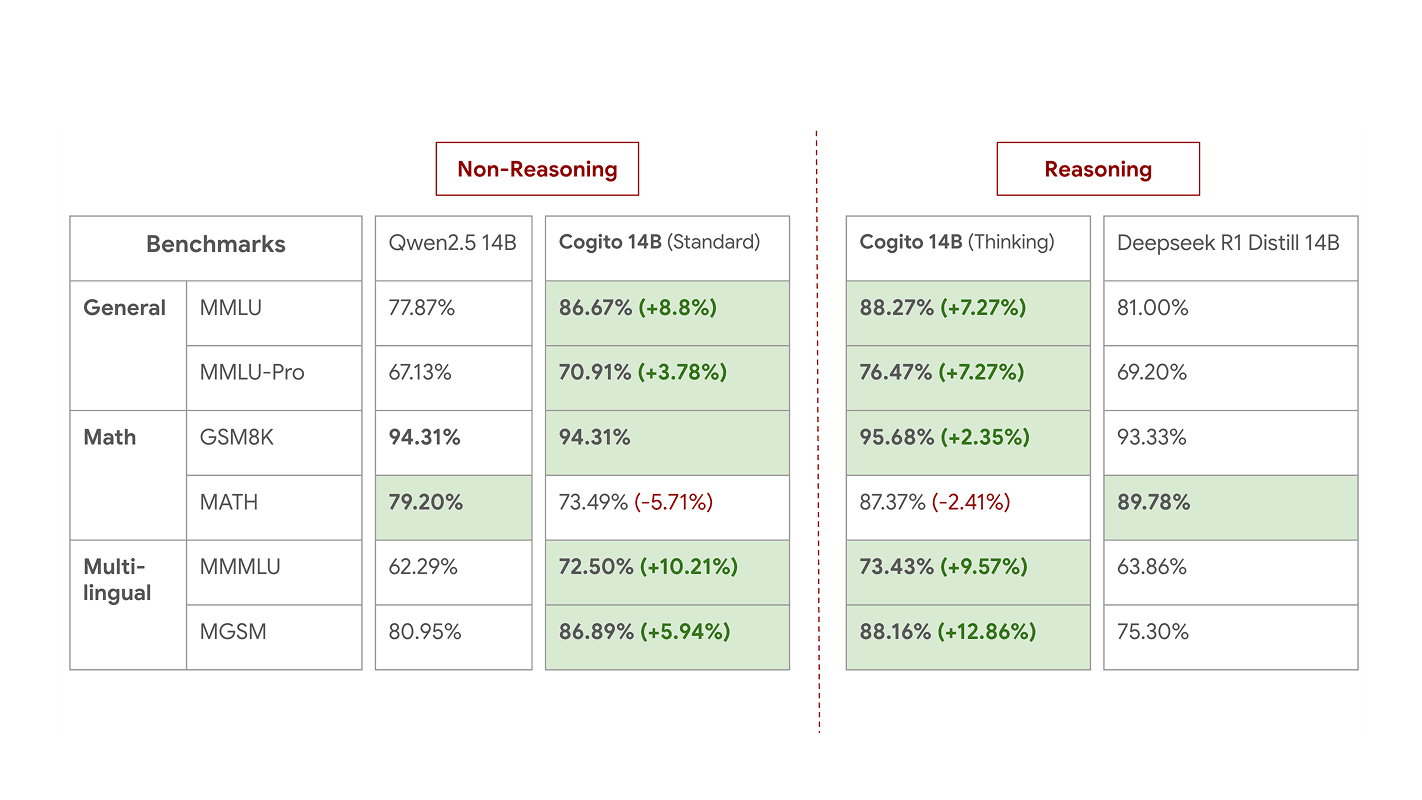
Figure 3. Performance of Cogito 14B models in 'Standard' versus 'Thinking' configurations compared to Qwen2.5 14B and Deepseek R1 Distill 14B across Non-Reasoning and Reasoning tasks.
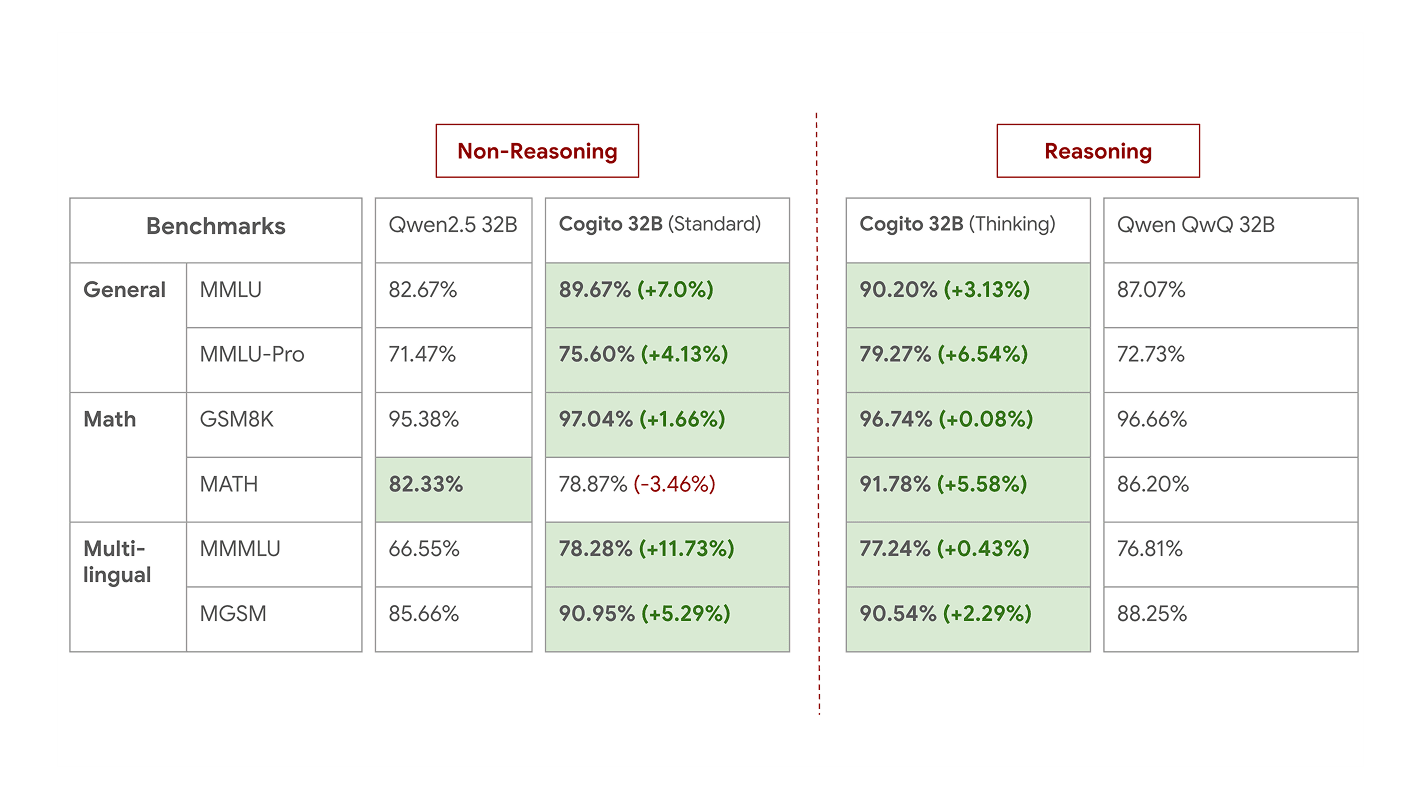
Figure 4. Cogito 32B models compared with [Qwen2.5 32B](https://openlaboratory.ai/models/qwen-2_5-32b) and [Qwen QwQ 32B](https://openlaboratory.ai/models/qwq-32b) on a variety of academic, mathematical, and multilingual evaluation sets.
In tool calling evaluations, Cogito models show marked advantages over contemporaneous open LLMs. This is illustrated by significant support for simple, parallel, and multiple tool invocation scenarios, where other models may lack native support. Benchmark suites also collectively highlight robust generalization in mathematical reasoning (MATH, GSM8K), knowledge tests (MMLU), and multilingual assessments (MMMLU, MGSM).
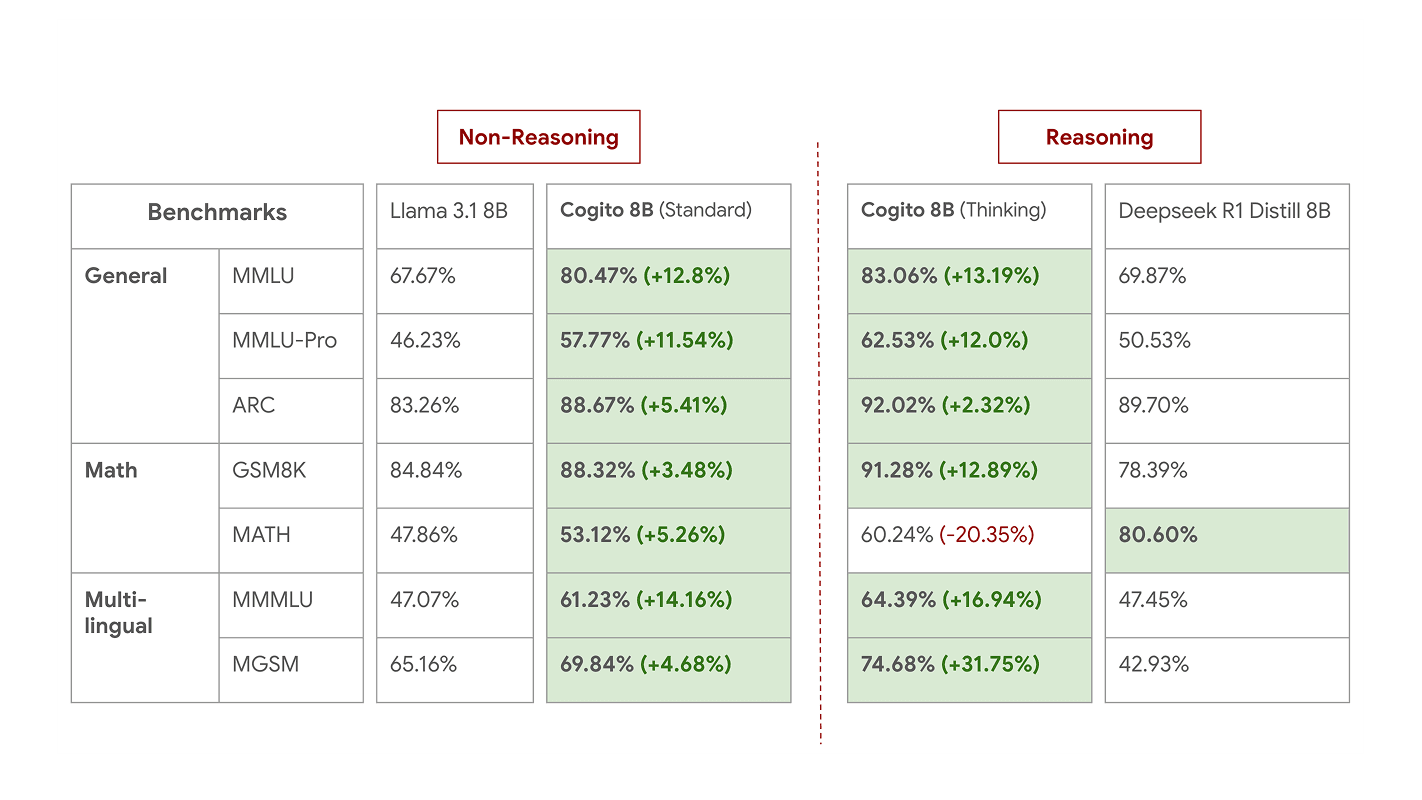
Figure 5. An evaluation of 8B-sized models on Non-Reasoning and Reasoning benchmarks, showcasing the percentage improvements for Cogito 8B over equivalent Llama and Deepseek models.
Use Cases, Applications, and Model Family
The Cogito V1 Preview 70B model is tailored for use in coding, function and tool invocation, agent-based workflows, STEM-related tasks, multilingual communication, and general instruction following. Due to its extended reasoning mode and robust handling of complex contexts, Cogito is especially suitable for scenarios that demand modular problem-solving and iterative logic.
Cogito V1 Preview is a model family comprising multiple parameter sizes, all utilizing the IDA regimen for alignment. Alongside the 70B model, Deep Cogito has released variants at 3B, 8B, 14B, and 32B sizes. All models are released under compatible open licenses, and future expansions—including Mixture-of-Experts systems at even larger scales—are planned as outlined in the Cogito V1 Preview roadmap.
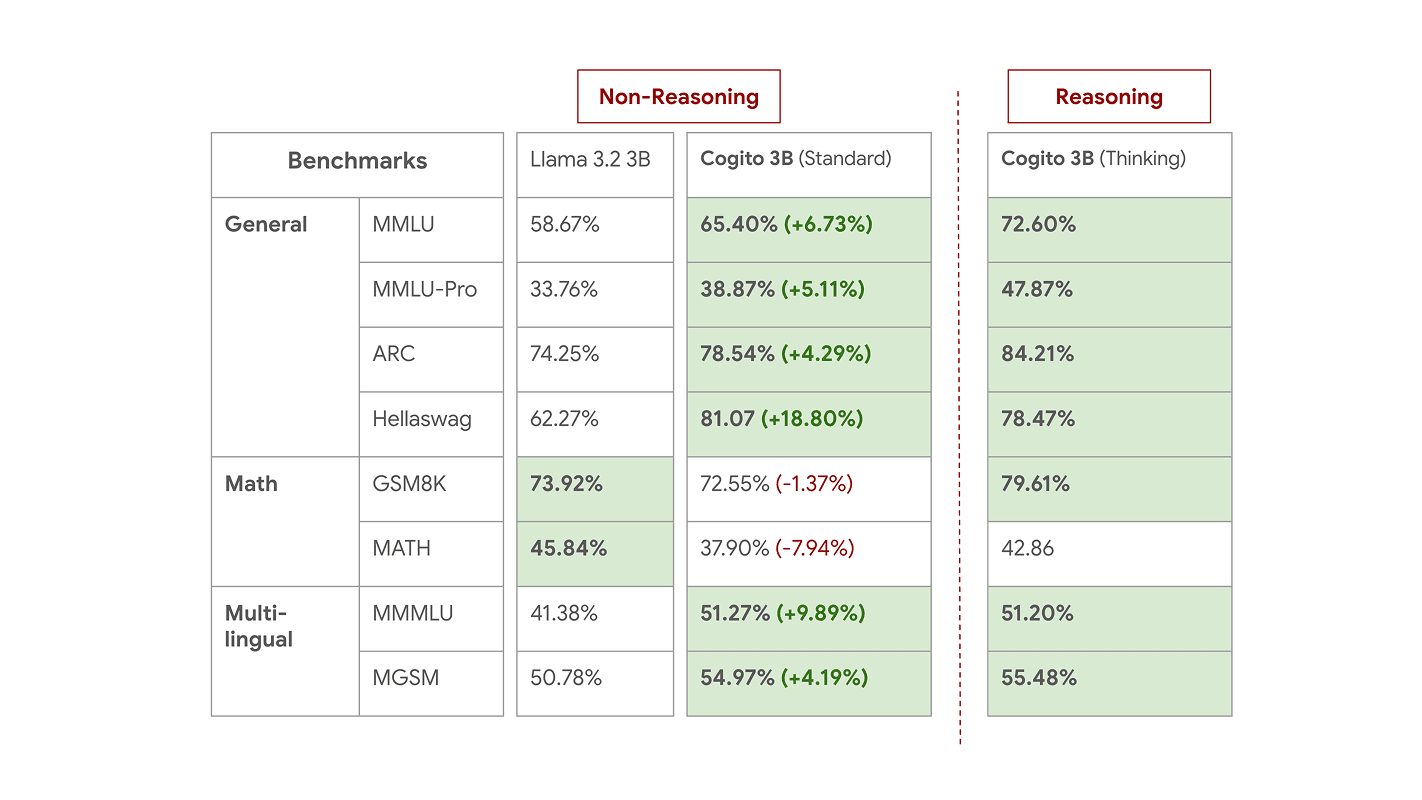
Figure 6. Comparison of Cogito 3B models (Standard and Thinking) with [Llama 3.2 3B](https://openlaboratory.ai/models/llama3_2-3b) across general, math, and multilingual benchmarks.
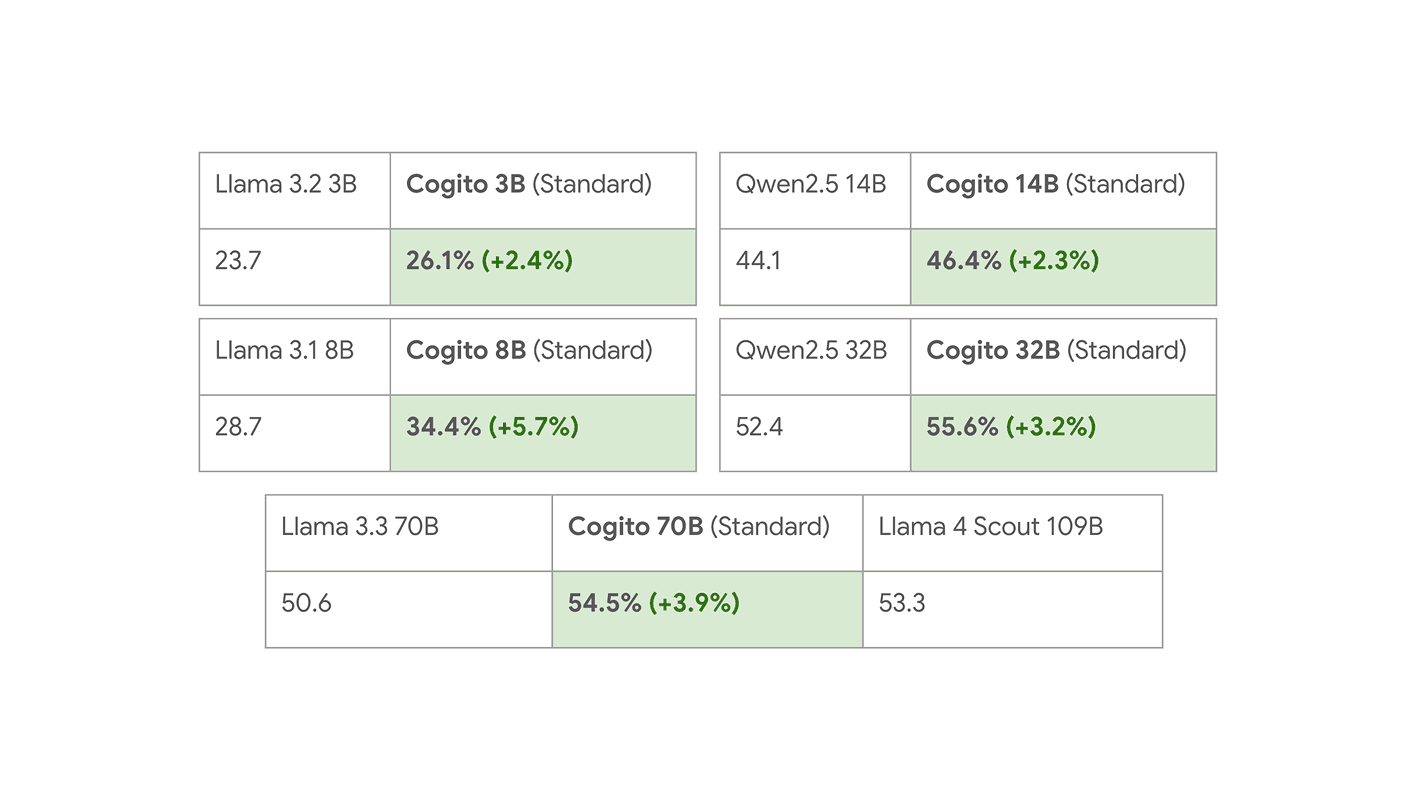
Figure 7. Data visualization summarizing performance improvements of Cogito models over comparable Llama and Qwen baselines across multiple benchmarks.
Limitations and Considerations
While Cogito models offer an extended reasoning mode, they are not specifically tuned for lengthy reasoning chains, by design. The developers note that most real-world applications prioritize shorter, relevant reasoning paths that provide timely responses, and shorter chains are more efficiently distilled into model weights. Additionally, benchmarks serve as orientation metrics and may only partially capture real-world utility, as highlighted on the Cogito research page.
Further Resources
For additional technical information, performance details, and licensing, the following resources are recommended:
- Cogito V1 Preview collection on Hugging Face
- Cogito V1 Preview 70B model card and documentation
- Deep Cogito's official research announcement
- Iterated Distillation and Amplification paper
- IDA description at AI Alignment Forum
- Llama 3.3 Community License Agreement
- Deep Cogito on X (formerly Twitter)
- Deep Cogito LinkedIn profile
More in the Llama 3 Family
Llama 3 8B
Llama 3 70B
Llama 3.1 8B
Llama 3.1 8B Stheno v3.4
DeepSeek R1 Distill Llama 8B
Cogito V1 Preview 8B
Llama 3.1 70B
Llama 3.2 3B
Dolphin 3.0 Llama3.2 3B
Cogito V1 Preview 3B
Llama 3.3 70B
L3.3 70B Euryale v2.3
70B L3.3 Cirrus x1
Anubis 70B v1
Anubis 70B v1.1
Wayfarer Large 70B Llama 3.3
DeepSeek R1 Distill Llama 70B
More from Deep Cogito
Cogito V1 Preview 14B
Cogito V1 Preview 32B
Compatible Apps
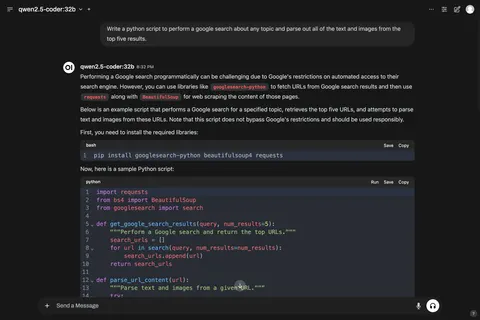
Open WebUI
A polished, self-hosted chat interface for LLMs with Ollama integration, multimodal prompts, and extensive workspace customization.
Web UI
Chat UIs · Beginner Friendly
llama.cpp
GGUF model inference with a polished web UI and OpenAI-format API. CPU-only build — high hardware compatibility, works on any machine without a GPU.
Web UI · API · CLI
LLM Inference · Chat UIs
llama.cpp (CUDA)
GGUF model inference with a polished web UI and OpenAI-format API. CUDA build — GPU-accelerated for NVIDIA GPUs.
Web UI · API · CLI
LLM Inference · Chat UIs
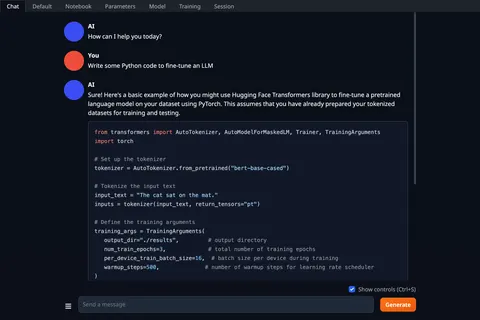
Text Generation Web UI
A feature-rich interface for running and experimenting with open-weight LLMs, including multiple inference backends, plugins, and tuning controls.
Web UI · API
Chat UIs · LLM Inference