Alibaba Cloud
Qwen 2 72B
Downloads
Model Report
Overview
Figure 1. Header image displaying the stylized Qwen2 logo, representing the Qwen2 series of large language models.
Qwen2-72B is a large-scale language model introduced as part of the Qwen2 series, released on June 7, 2024, as an evolution of the earlier Qwen1.5 models. Developed by the Qwen team, Qwen2-72B is designed as a foundational language model positioned for further post-training, including supervised fine-tuning and reinforcement learning from human feedback. The Qwen2 series encompasses models of varying sizes, with both base and instruction-tuned variants. Qwen2-72B, the largest dense model in the lineup, demonstrates strong performance across a diverse range of benchmarks, multilingual tasks, and extended context scenarios, reflecting ongoing advancements in large language model research and engineering. For further details, refer to the official Qwen2 release announcement.
Architecture and Model Design
Qwen2-72B is built upon the Transformer architecture, incorporating several enhancements such as SwiGLU activation, attention QKV bias, and Group Query Attention (GQA). The use of GQA contributes to improved inference speed and reduced memory consumption. This dense model comprises approximately 72.71 billion parameters, of which 70.21 billion are non-embedding weights. Unlike some smaller Qwen2 variants, Qwen2-72B does not employ embedding tying. An updated tokenizer is integrated to support multiple natural languages and programming code, reflecting efforts to enhance multilingual and code understanding.
The Qwen2 model family includes both base and instruction-tuned models. Qwen2-72B itself is a dense, decoder-only language model, differentiating it from Mixture-of-Experts (MoE) architectures found in related models like Qwen2-57B-A14B. All models in the series utilize GQA, but only the smallest models (Qwen2-0.5B and Qwen2-1.5B) integrate tied embeddings.
Training Data and Methods
Qwen2-72B and its instruction-tuned derivative, Qwen2-72B-Instruct, were trained on large, diverse datasets covering 27 languages beyond English and Chinese. Considerable emphasis was placed on increasing both the quality and volume of multilingual and instructional training data. The training regimen addressed linguistic challenges such as code-switching, leading to significant improvements in multilingual evaluation metrics.
For instruction tuning, models such as Qwen2-72B-Instruct underwent post-training to enhance human alignment and task-following capabilities. Alignment techniques included scalable supervised fine-tuning, reward modeling, and online Direct Preference Optimization (DPO). Automated strategies such as rejection sampling for mathematics, execution feedback for coding, back-translation for creative writing, and scalable oversight for role-play were employed to generate high-quality instructional data. An Online Merging Optimizer was implemented to reduce the so-called "alignment tax" during post-training.
Benchmark Performance
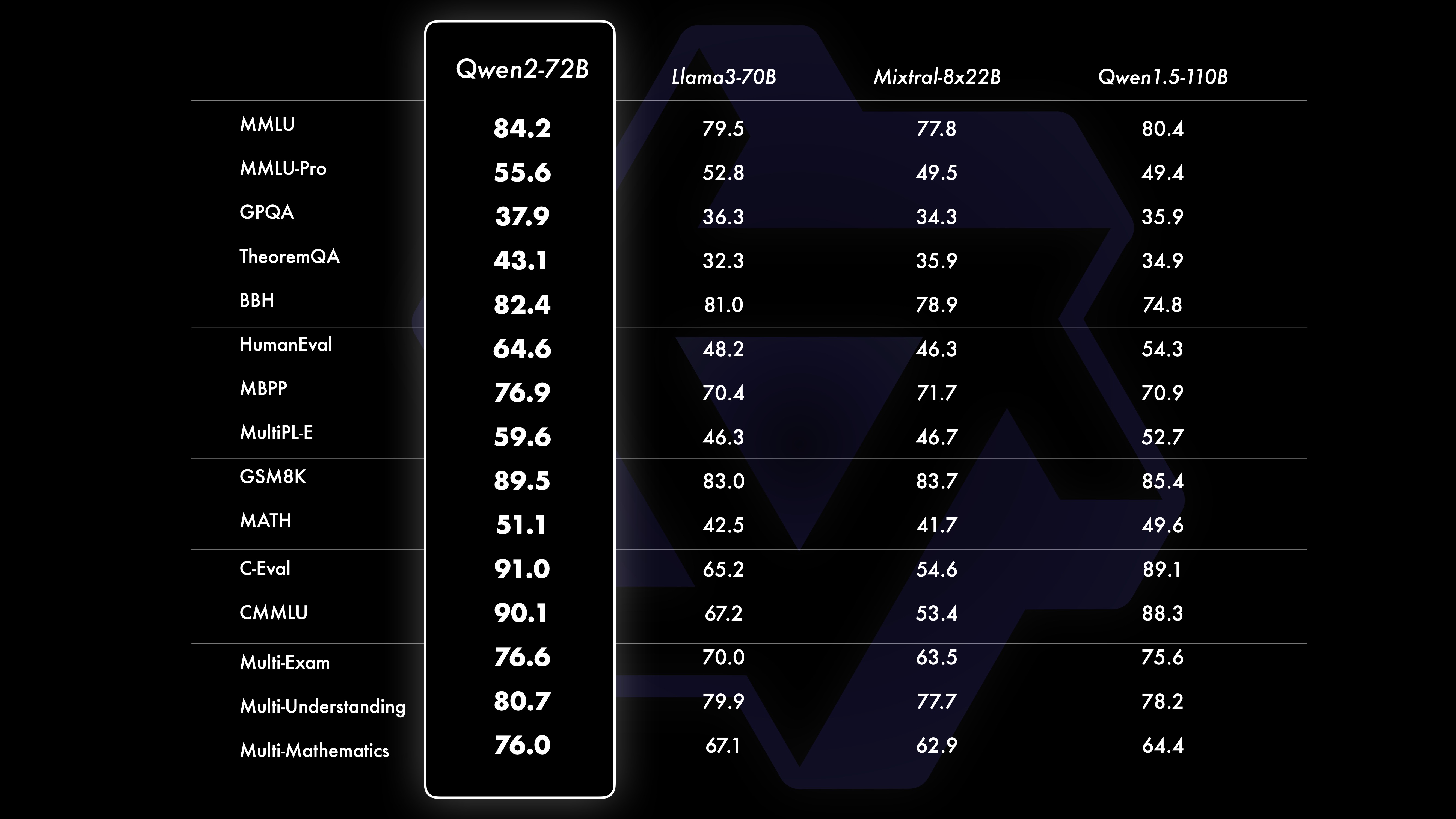
Figure 2. Comparison table showing Qwen2-72B benchmark scores relative to Llama3-70B, Mixtral-8x22B, and Qwen1.5-110B across multiple datasets.
Qwen2-72B exhibits robust performance across a broad array of benchmarks. Evaluations on standard datasets demonstrate competitive or superior results to contemporary models such as Llama-3-70B and Mixtral-8x22B, as well as achieving notable gains over its predecessor, Qwen1.5-110B, despite a smaller parameter count. Key benchmark results include high scores on MMLU (84.2), HumanEval (64.6), GSM8K (89.5), C-Eval (91.0), and Multi-Mathematics (76.0). These figures represent the model's capabilities in tasks ranging from general language understanding and mathematics to code generation.
The instruction-tuned variant, Qwen2-72B-Instruct, demonstrates further improvements in alignment and applied task performance.
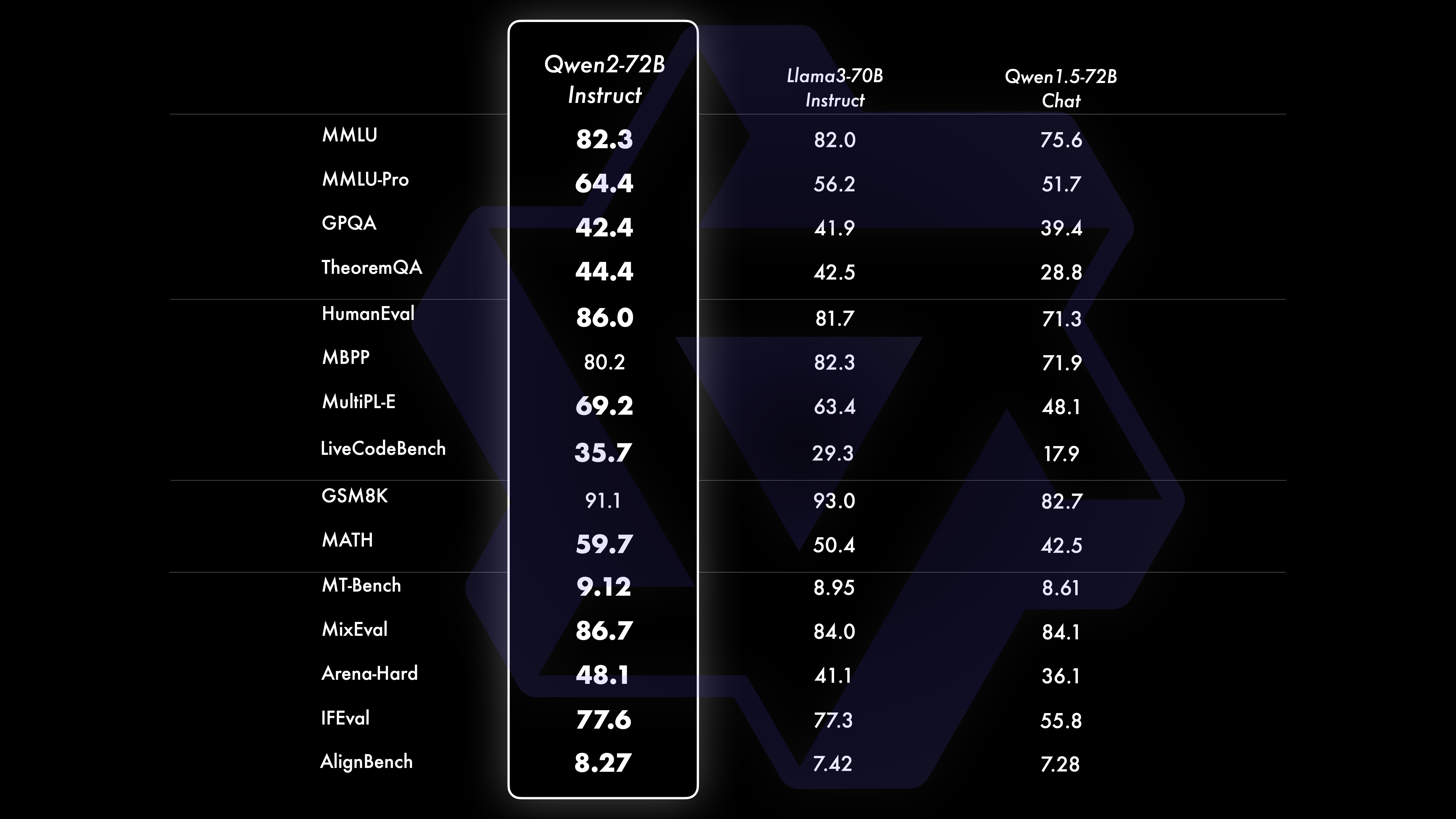
Figure 3. Benchmark comparison of Qwen2-72B-Instruct, Llama-3-70B-Instruct, and Qwen1.5-72B-Chat, highlighting Qwen2-72B-Instruct's results across MMLU, HumanEval, and additional datasets.
On popular benchmarks, Qwen2-72B-Instruct attains scores such as 82.3 on MMLU, 86.0 on HumanEval, and 91.1 on GSM8K, closely matching or outperforming other leading models tested at similar scales.
Further analysis of domain-specific capabilities shows Qwen2-72B-Instruct possessing strong coding and mathematical proficiency across programming languages and mathematical benchmarks.
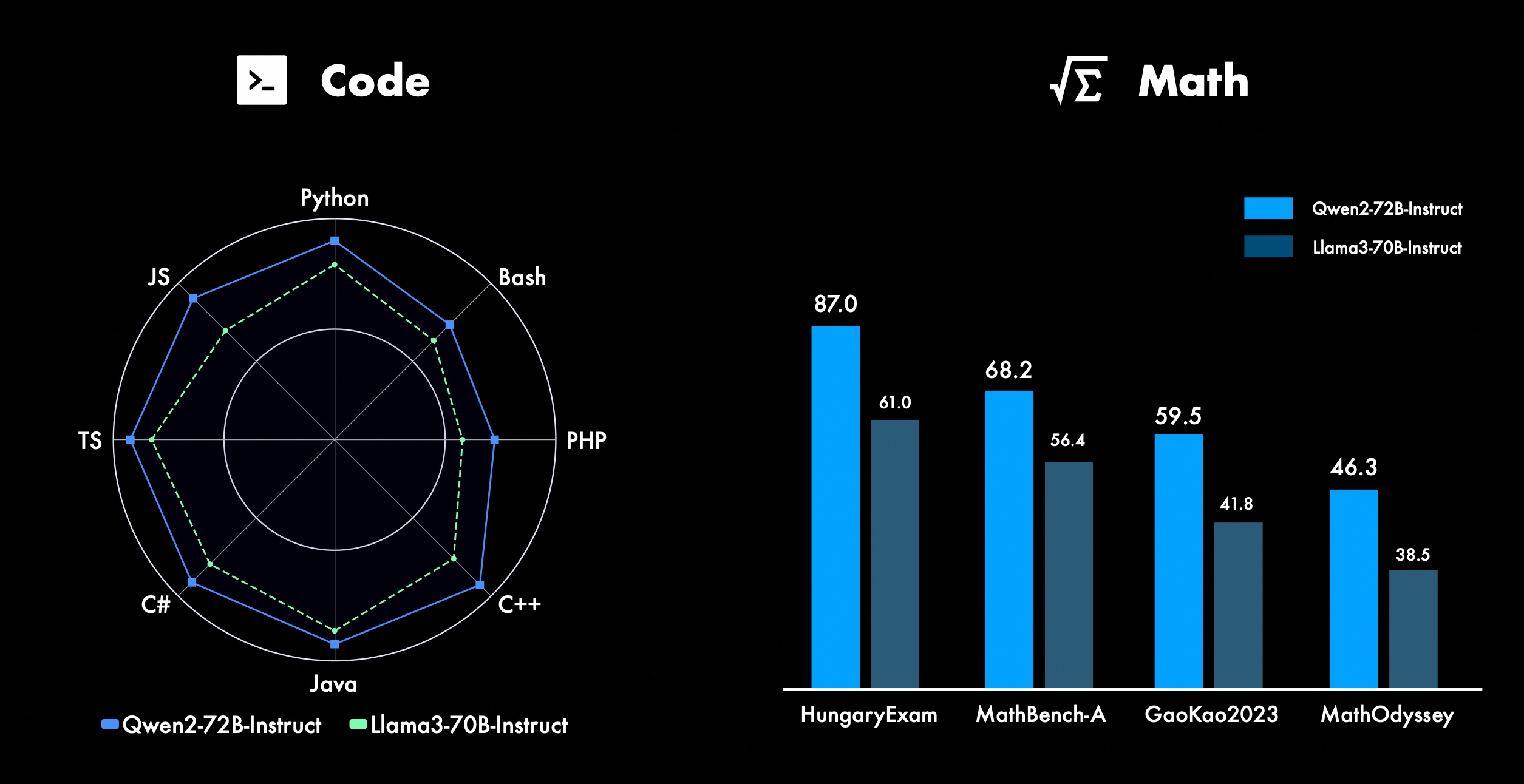
Figure 4. Charts illustrating coding and mathematical performance of Qwen2-72B-Instruct compared to Llama3-70B-Instruct across both language and mathematics subdomains.
In addition to high raw scores, Qwen2-72B-Instruct demonstrates strong multilingual and context-handling capabilities. Human evaluation studies and benchmarking on M-MMLU and MGSM further confirm robust performance in language understanding and mathematical reasoning across multiple languages.
Extended Context and Long-Range Understanding
A distinctive feature of the Qwen2 series, including Qwen2-72B-Instruct, is its capacity to process exceptionally long contexts. Models are trained on contexts up to 32,000 tokens and are evaluated at lengths as high as 128,000 tokens via techniques such as YARN and Dual Chunk Attention.
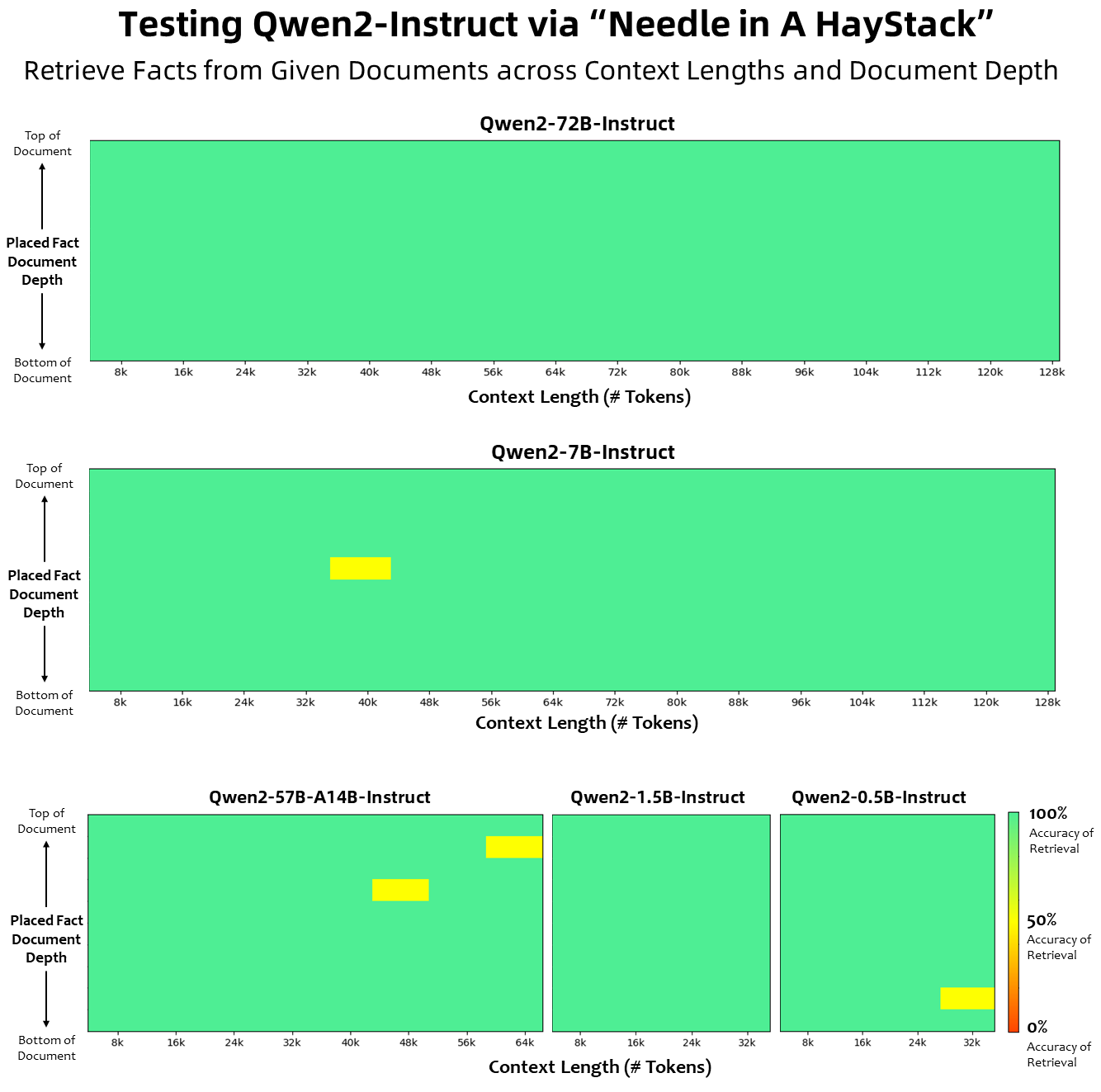
Figure 5. Heatmaps from the Needle in a Haystack task, showing Qwen2-72B-Instruct achieving 100% accuracy in retrieving facts across up to 128,000 token contexts.
Heatmap-based evaluation from the Needle in a Haystack benchmark demonstrates that Qwen2-72B-Instruct maintains perfect retrieval accuracy for factual information even at 128,000 tokens, indicating robust long-range memory and information extraction. This positions the model for use cases demanding precise recall across extensive documents.
Applications, Limitations, and Model Family
Qwen2-72B serves primarily as a base model for specialized post-training, including instructional fine-tuning and reinforcement learning workflows. The instruction-tuned Qwen2-72B-Instruct displays aptitude for tasks in reasoning, code generation, mathematics, multilingual understanding, and information extraction from long texts. As a general-purpose model, it can be applied to language generation, code synthesis, educational tasks, and research scenarios where large-context comprehension and multilingual support are required.
Within the Qwen2 family, models range in scale from 0.5B to 72B parameters, encompassing both dense and MoE architectures. Context length capabilities vary from 32K to 128K tokens for instruction-tuned versions, depending on model size.
The primary limitation of Qwen2-72B is that its base form is intended for further post-training and not optimized for direct deployment in text generation applications without additional alignment. Licensing for Qwen2-72B is governed by the Qianwen License, while other family members typically utilize the Apache 2.0 open-source license.
Release and Further Resources
Qwen2 was officially announced on June 7, 2024. Ongoing updates, including derivative models such as Qwen2.5-72B, are catalogued on the project's GitHub repository and through community platforms. Usage instructions and technical documentation are available via the official Hugging Face model card and Qwen documentation portal.
Helpful Links
- Qwen2 official announcement and blog
- Qwen2-72B model card on Hugging Face
- Qwen2 source code and releases on GitHub
- Qwen official documentation
- Needle in a Haystack evaluation repository
- YARN long context paper
- Dual Chunk Attention paper
- Online Merging Optimizer research
- M-MMLU evaluation suite
- MGSM multilingual mathematics paper
More in the Qwen 2 Family
Qwen2.5 VL 3B
Qwen2.5 VL 7B
Qwen2.5 VL 72B
QwQ 32B Preview
QwQ 32B
Qwen 2.5 Math 1.5B
DeepSeek R1 Distill Qwen 1.5B
DeepCoder 1.5B Preview
Qwen 2.5 Math 7B
Qwen 2.5 Math PRM 7B
DeepSeek R1 Distill Qwen 7B
Qwen 2.5 Math 72B
Qwen 2.5 Math PRM 72B
Qwen 2.5 Coder 7B
Qwen 2.5 Coder 32B
Qwen 2.5 7B
Qwen2.5 7B 1M
Qwen 2.5 14B
Qwen2.5 14B 1M
DeepSeek R1 Distill Qwen 14B
DeepCoder 14B Preview
Cogito V1 Preview 14B
Qwen 2.5 32B
DeepSeek R1 Distill Qwen 32B
Cogito V1 Preview 32B
Qwen 2.5 72B
Qwen 2 7B
More from Alibaba Cloud
Qwen3 0.6B
Qwen3 1.7B
Qwen3 4B
Qwen3 8B
Qwen3 14B
Qwen3 32B
Qwen3 30B A3B
Qwen3 235B A22B
Qwen 1.5 32B
Qwen 1.5 72B
Compatible Apps
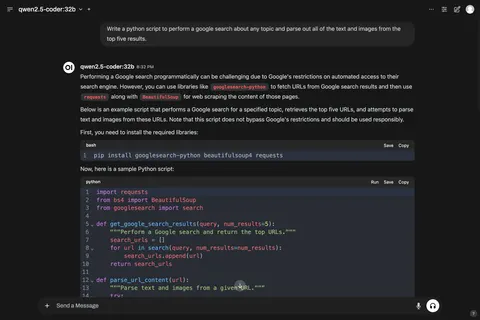
Open WebUI
A polished, self-hosted chat interface for LLMs with Ollama integration, multimodal prompts, and extensive workspace customization.
Web UI
Chat UIs · Beginner Friendly
llama.cpp
GGUF model inference with a polished web UI and OpenAI-format API. CPU-only build — high hardware compatibility, works on any machine without a GPU.
Web UI · API · CLI
LLM Inference · Chat UIs
llama.cpp (CUDA)
GGUF model inference with a polished web UI and OpenAI-format API. CUDA build — GPU-accelerated for NVIDIA GPUs.
Web UI · API · CLI
LLM Inference · Chat UIs
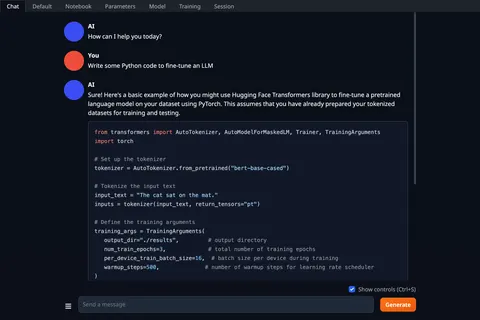
Text Generation Web UI
A feature-rich interface for running and experimenting with open-weight LLMs, including multiple inference backends, plugins, and tuning controls.
Web UI · API
Chat UIs · LLM Inference