Agentica
DeepCoder 1.5B Preview
Downloads
Model Report
Overview
DeepCoder-1.5B-Preview is an open-source generative AI model tailored for code reasoning tasks and optimized for long-context understanding. Developed by Agentica, this model extends the capabilities of reinforcement learning for large language models (RLLMs), building upon DeepSeek-R1-Distilled-Qwen-1.5B as its foundational architecture. Through its innovative training methodology and rigorous dataset curation, DeepCoder-1.5B-Preview aims to advance the state-of-the-art in verifiable program synthesis and automated code analysis. For further background, details on this model are provided via the official model documentation and an in-depth technical blog post.
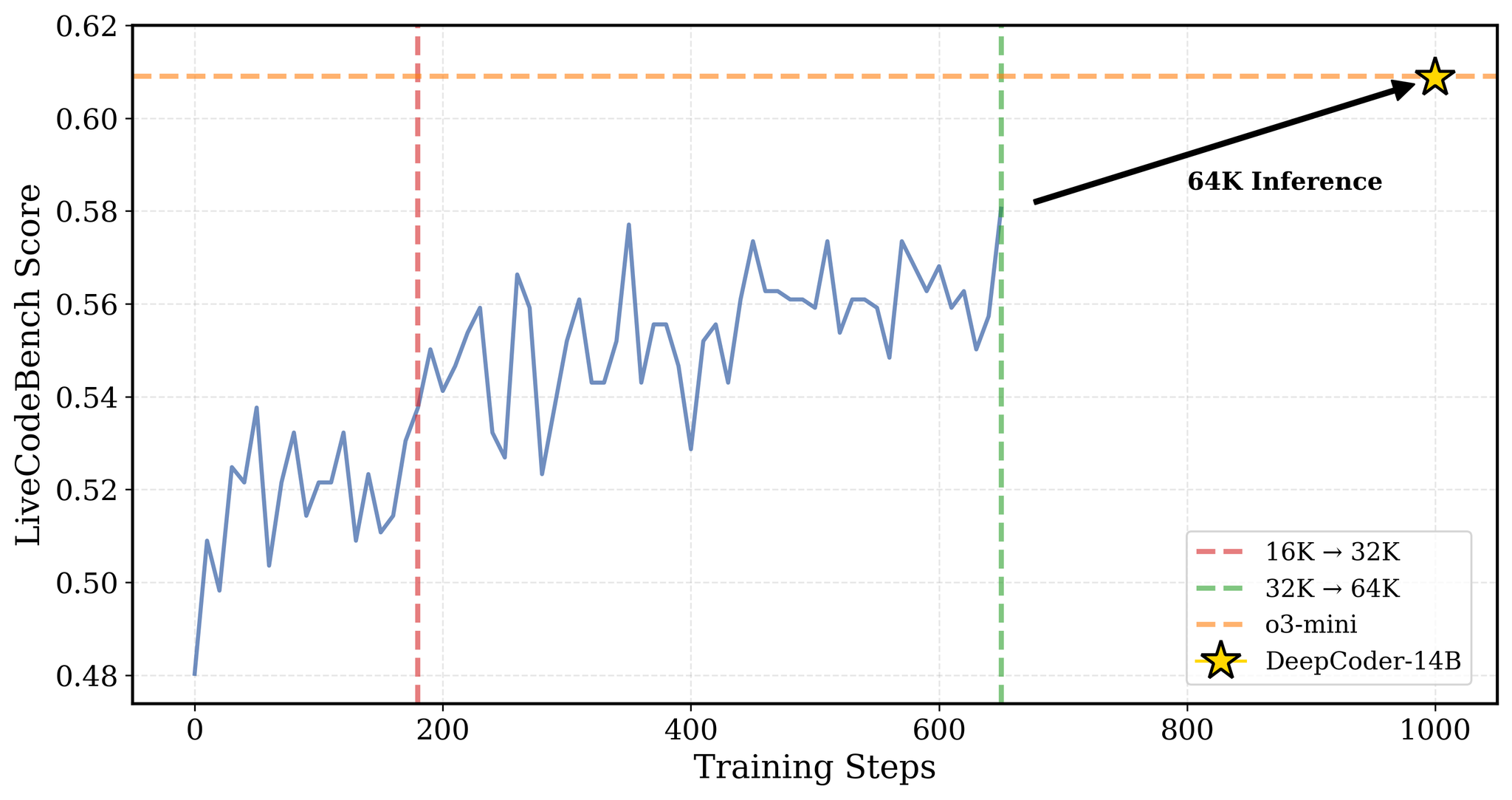
Figure 1. LiveCodeBench (LCB) score progression as DeepCoder's context length increases, illustrating adaptation to larger sequence inputs.
Model Architecture and Training Methodology
DeepCoder-1.5B-Preview is fine-tuned from the DeepSeek-R1-Distilled-Qwen-1.5B model, employing an advanced variant of the GRPO (Generalized Reward Policy Optimization) algorithm known as GRPO+. This methodology stems from the reinforcement learning paradigm and incorporates iterative context lengthening as introduced in DeepScaleR. The GRPO+ strategy improves stability and efficiency by integrating offline difficulty filtering, dispensing with entropy and KL losses, and leveraging techniques such as overlong filtering and surrogate loss clipping, as detailed in the DAPO research.
Iterative context lengthening allows the model to learn from shorter input sequences before gradually extending to longer ones. In practice, DeepCoder-1.5B-Preview was trained across sequential context lengths from 8K to 16K and finally to 24K tokens. This enables the model to generalize reasoning capabilities over contexts as long as 64K tokens during inference.
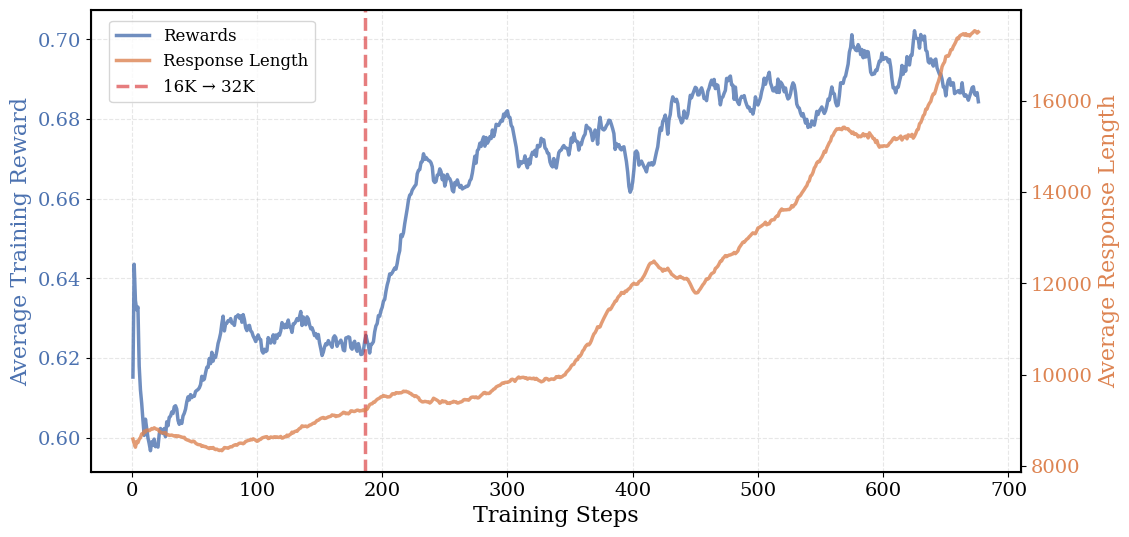
Figure 2. Training curve showing how DeepCoder's average response length and reward evolve as context size increases from 16K to 32K tokens.
Data Sources, Filtering, and Verification
To ensure high-quality training and verifiability, DeepCoder-1.5B-Preview draws from approximately 24,000 unique problem-test pairs, integrating datasets such as Taco-Verified, PrimeIntellect SYNTHETIC-1, and LiveCodeBench v5. A multi-stage filtering pipeline is employed. First, problems are programmatically verified against their official solutions, retaining only cases where all standard unit tests (minimum of five per problem) pass, thereby minimizing the possibility of reward exploitation or ambiguous evaluation. Deduplication further ensures that each problem in the training set is unique.
The reward computation process operates within isolated code sandboxes for security and determinism. The Together Code Interpreter facilitates efficient, parallelized code evaluation, while a local subprocess sandbox aligns with LiveCodeBench's standard evaluation framework. The reward function is implemented as a sparse Outcome Reward Model: a generated solution receives a reward of 1 only if it passes all of up to 15 challenging unit tests; otherwise, the reward is 0. Each test is subject to a strict timeout, usually between 6 and 12 seconds.
System Optimization and Computational Pipeline
To accelerate RL-based training, DeepCoder leverages a modified 'verl-pipeline' system—an optimized extension to the Verl post-training library. These optimizations include one-off pipelining, which separates sampling and training into successive alternating steps to maximize throughput and minimize idle time during trainer and reward calculation.
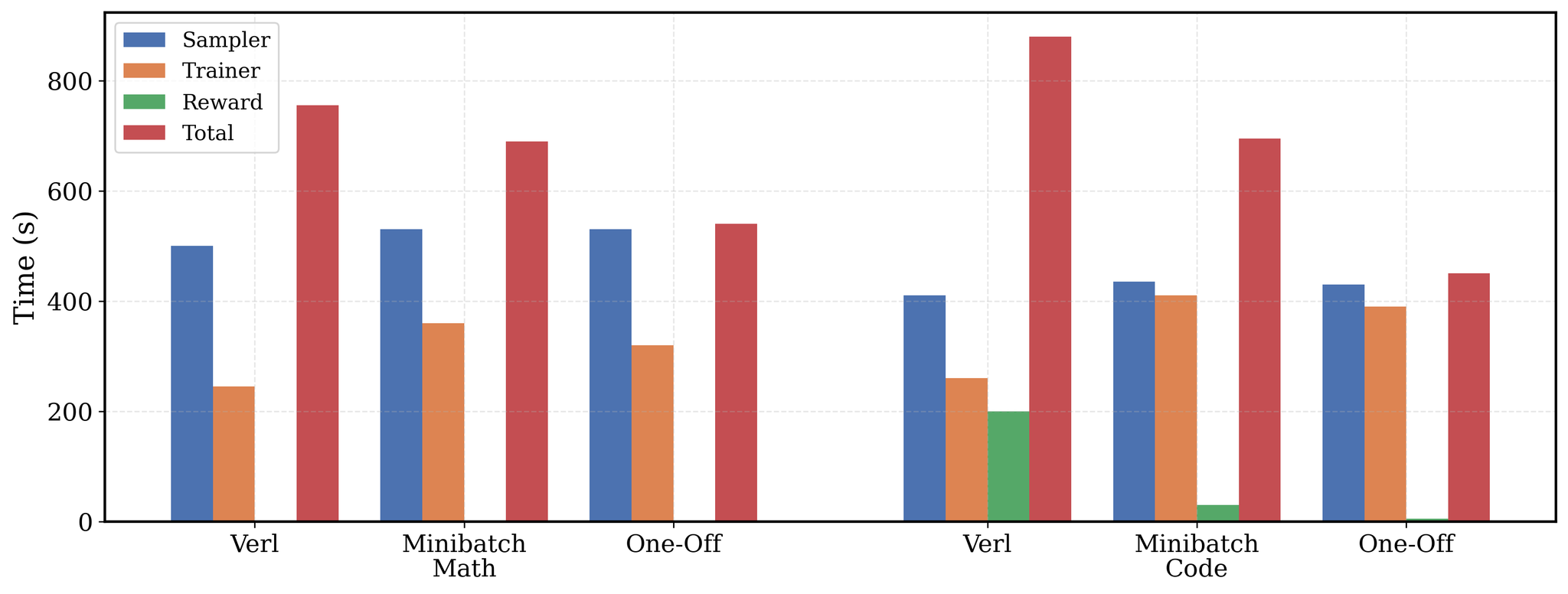
Figure 3. Comparison of training times by component and workload, showing that 'One-Off' pipelining significantly reduces total training time.
This approach enables near-complete masking of reward computation and trainer idle times, reducing overall training durations by a reported factor of 1.4x for mathematical reasoning and up to 2x for code generation workloads.
Performance Metrics and Benchmarking
DeepCoder-1.5B-Preview has been benchmarked on several key evaluation suites, including LiveCodeBench (LCBv5), Codeforces, and HumanEval+. On LCBv5, the model achieves a score of 25.1, with a Codeforces rating of 963, placing it in the 28.5 percentile, and a HumanEval+ success rate of 73.0%. By comparison, its base model (DeepSeek-R1-Distilled-Qwen-1.5B) attains an LCBv5 score of 16.9 and a HumanEval+ score of 58.3%, underscoring a marked improvement attributable to the reinforcement learning and context lengthening strategies. Detailed evaluation logs and further breakdowns are available from model resources.
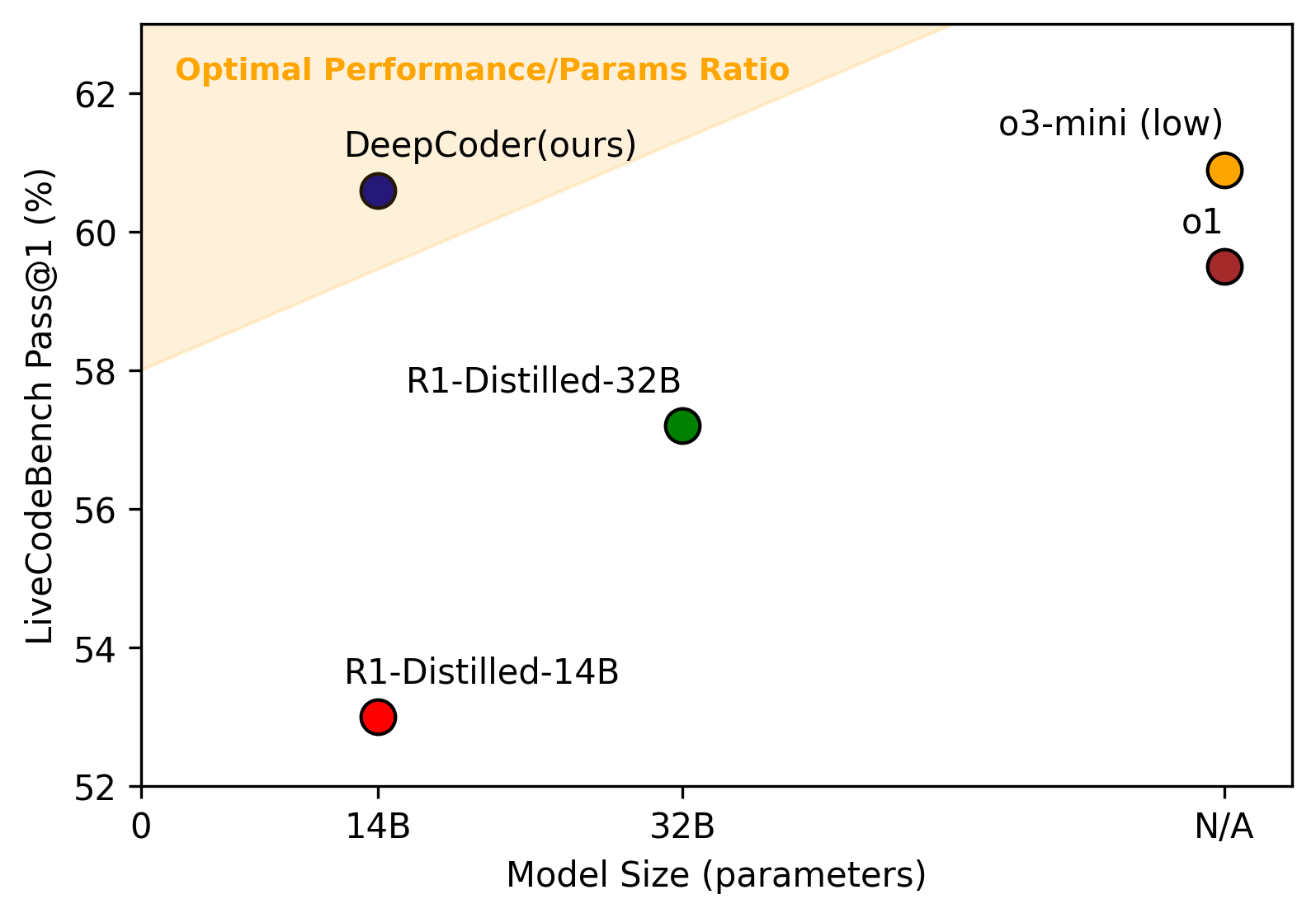
Figure 4. LiveCodeBench Pass@1 accuracy plotted against model size, illustrating DeepCoder's performance efficiency relative to parameter count.
Model Family and Comparative Analysis
DeepCoder-1.5B-Preview is part of a broader family. A closely related model, DeepCoder-14B-Preview, is fine-tuned from Deepseek-R1-Distilled-Qwen-14B and achieves a LiveCodeBench Pass@1 accuracy of 60.6% at 64K context—a performance level comparable to other frontier reasoning models at similar or greater scale. Both models employ the same principles of iterative context length expansion and GRPO+ reinforcement learning, but differ in model size and eventual context generalization capacity. Additional details, including context scaling and comparisons with peer models, can be found in the comprehensive technical blog.
Limitations and Licensing
While DeepCoder-1.5B-Preview demonstrates robust long-context reasoning, there are noted trade-offs at shorter context lengths. For instance, average response lengths can exceed standard truncation thresholds at 16K tokens, leading to the potential for response truncation and corresponding reductions in benchmark scores. These effects are discussed further in model documentation.
DeepCoder-1.5B-Preview is released under the MIT License, with the aim of promoting open access and scientific transparency in AI research.
External Resources
- Agentica DeepCoder Model Card on Hugging Face
- DeepCoder Notion Technical Blog
- LiveCodeBench Benchmark Site
- Together Code Interpreter Documentation
- Verl-Pipeline for RL Pipelines
- Reinforcement Learning for LLMs (RLLM) GitHub
- DeepCoder-14B-Preview on Hugging Face
- DeepCoder-Preview-Dataset on Hugging Face
- Evaluation Logs and Reports (Google Drive)
More in the Qwen 2 Family
Qwen2.5 VL 3B
Qwen2.5 VL 7B
Qwen2.5 VL 72B
QwQ 32B Preview
QwQ 32B
Qwen 2.5 Math 1.5B
DeepSeek R1 Distill Qwen 1.5B
Qwen 2.5 Math 7B
Qwen 2.5 Math PRM 7B
DeepSeek R1 Distill Qwen 7B
Qwen 2.5 Math 72B
Qwen 2.5 Math PRM 72B
Qwen 2.5 Coder 7B
Qwen 2.5 Coder 32B
Qwen 2.5 7B
Qwen2.5 7B 1M
Qwen 2.5 14B
Qwen2.5 14B 1M
DeepSeek R1 Distill Qwen 14B
DeepCoder 14B Preview
Cogito V1 Preview 14B
Qwen 2.5 32B
DeepSeek R1 Distill Qwen 32B
Cogito V1 Preview 32B
Qwen 2.5 72B
Qwen 2 7B
Qwen 2 72B
Compatible Apps
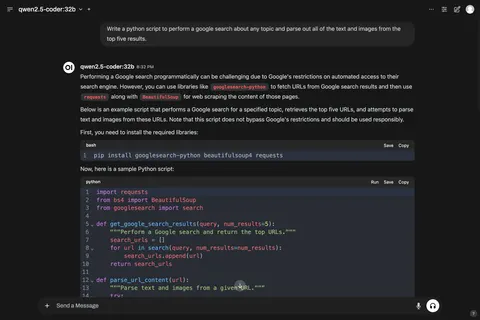
Open WebUI
A polished, self-hosted chat interface for LLMs with Ollama integration, multimodal prompts, and extensive workspace customization.
Web UI
Chat UIs · Beginner Friendly
llama.cpp
GGUF model inference with a polished web UI and OpenAI-format API. CPU-only build — high hardware compatibility, works on any machine without a GPU.
Web UI · API · CLI
LLM Inference · Chat UIs
llama.cpp (CUDA)
GGUF model inference with a polished web UI and OpenAI-format API. CUDA build — GPU-accelerated for NVIDIA GPUs.
Web UI · API · CLI
LLM Inference · Chat UIs
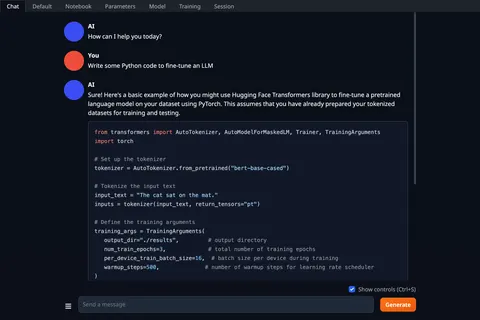
Text Generation Web UI
A feature-rich interface for running and experimenting with open-weight LLMs, including multiple inference backends, plugins, and tuning controls.
Web UI · API
Chat UIs · LLM Inference