Alibaba Cloud
Qwen2.5 VL 3B
Downloads
Model Report
Overview
Qwen2.5-VL-3B-Instruct is a multimodal, instruction-tuned large language model developed by the Qwen team at Alibaba Cloud. As part of the Qwen2.5-VL series, which includes larger 7B and 72B parameter variants, the 3B model is designed for efficient, on-device deployment while maintaining capabilities in image, video, and multimodal understanding. Released in January 2025, Qwen2.5-VL-3B-Instruct includes architectural and functional refinements over its predecessor, Qwen2-VL, particularly in visual comprehension, agentic behavior, and temporal processing for long videos, with further developments described in the Qwen2.5-VL technical report.

Figure 1. Qwen2.5-VL-3B processes and describes scenes involving people, animals, and diverse objects, supporting detailed multimodal understanding.
Model Architecture and Innovations
Qwen2.5-VL-3B-Instruct employs a multi-stage training strategy and incorporates several architectural elements. The core of the system integrates a Vision Transformer (ViT) encoder with a Qwen2.5-series large language model decoder, connected via cross-modal layers. The ViT architecture incorporates window attention for efficiency, with four of its layers utilizing full attention and the remainder operating in windowed mode for computational scalability. The model natively supports dynamic resolution inputs for both image and video data, enabling it to process media in their original aspect ratios for spatial sensitivity.
A critical innovation is the extension of dynamic resolution into the temporal dimension for video understanding. Qwen2.5-VL-3B samples video frames at dynamic rates and applies Multimodal Rotary Position Embedding (mRoPE) with absolute time alignment, allowing it to discern and reason over long video sequences and accurately localize events.
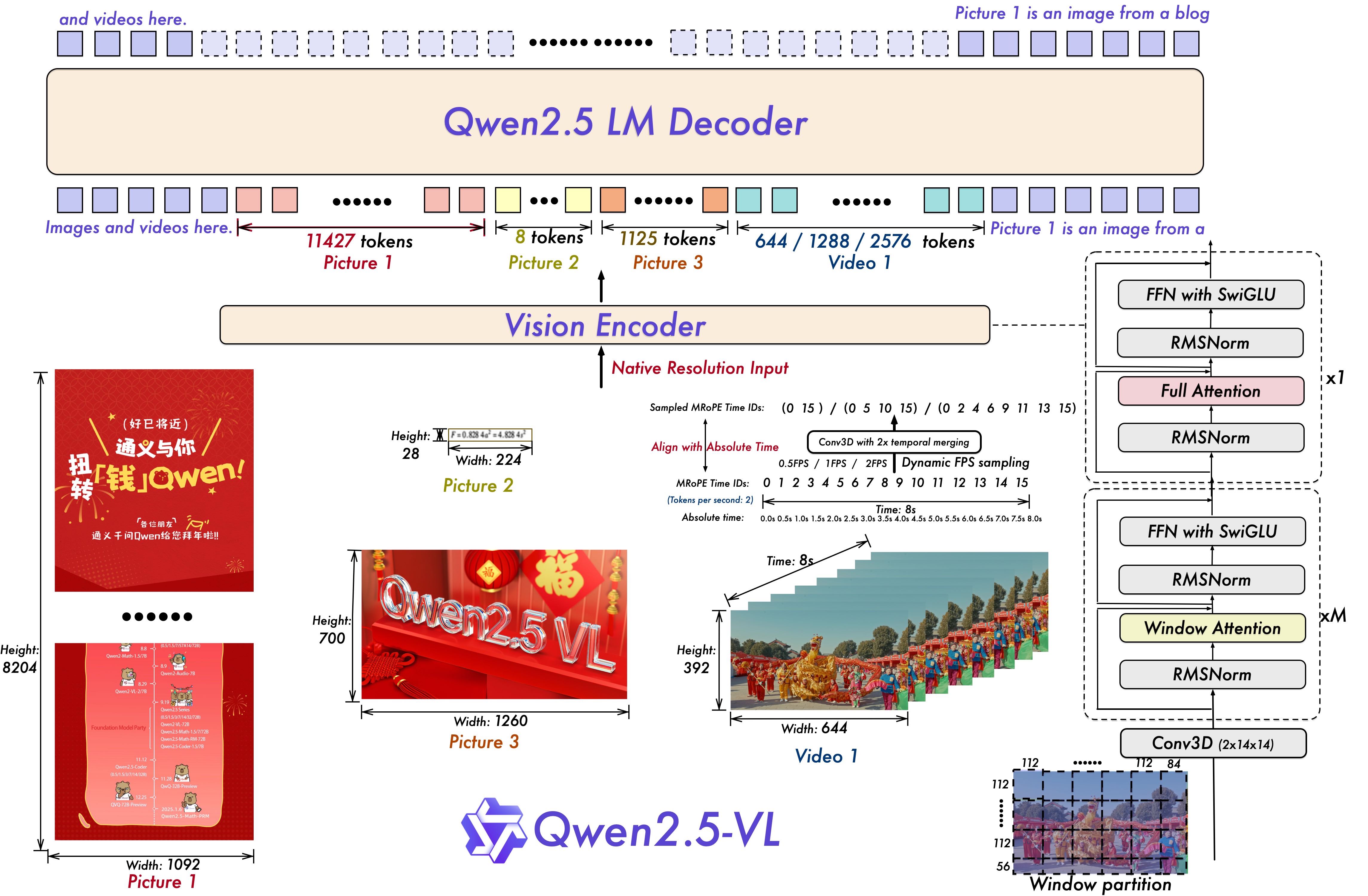
Figure 2. Technical diagram of the Qwen2.5-VL model, showing the interaction between the vision encoder, dynamic resolution handling, and temporal processing for images and videos.
Additionally, the model is configured for native box and point representation: it can directly output bounding box coordinates and keypoints in the context of the original image frame, bypassing traditional normalization techniques and contributing to fidelity in object localization.
Technical Capabilities
The 3B-Instruct variant provides multimodal reasoning across images, documents, and video streams. It demonstrates performance in object recognition, chart analysis, layout understanding, and text extraction, including optical character recognition (OCR) for multilingual and multi-orientational scenarios.
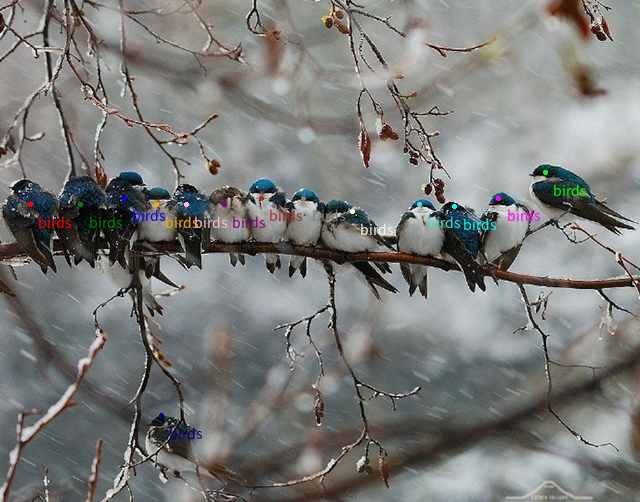
Figure 3. Bird counting demonstration: Qwen2.5-VL-3B detects and counts all birds in the image, including partially visible ones.
In video-related tasks, the model performs event detection, segment localization, and structured captioning, supporting variable resolution and video length.
The model’s agentic features allow it to interact with computer and mobile interfaces by interpreting user interfaces and executing actions in applications—including document editing, image manipulation, and task automation.
Performance and Evaluation
Qwen2.5-VL-3B-Instruct has been evaluated against established vision-language benchmarks. Results from evaluations against established vision-language benchmarks indicate its performance in comparison to larger models in its class and similarly efficient open models. On tasks such as multi-modal reasoning (MMMU), chart and diagram interpretation (DocVQA), visual question answering (AI2D, InfoVQA, TextVQA), mathematics (MathVista, MathVision), and video reasoning (VideoMME, MVBench), the 3B model's reported scores are comparable to those of some higher-parameter open models.
Figure 4. Model banner for the Qwen2.5-VL series, highlighting its multimodal focus.
The model's structured output capabilities enable extraction of information from invoices, forms, and receipts, and its QwenVL HTML format provides detailed document layout extraction, supporting downstream applications in finance, logistics, and commercial documentation.
Training Data and Methodology
Training of Qwen2.5-VL-3B-Instruct follows a three-stage process. Initially, the vision encoder is trained independently on a corpus of image-text pairs to establish foundational multimodal representations. In the subsequent stage, all model parameters are unfrozen and are further pre-trained on a broader dataset incorporating images, OCR, document formats, and visual question answering (VQA) data. The final stage involves locking the visual encoder weights and fine-tuning the language model on curated instruction datasets formatted in ChatML, encompassing both text and multimodal conversational data.
Pretraining leverages approximately 1.4 trillion tokens, including image, video, and text modalities. The data is composed of cleaned web data, curated open-source datasets, and synthetic sources, with a knowledge cutoff in June 2023. During fine-tuning, datasets span standard dialog, multi-image comparison, document parsing, video comprehension, and agent interaction.
Typical Applications
Qwen2.5-VL-3B-Instruct is suited for a range of applications requiring fine-grained visual analysis, document and chart parsing, information extraction from receipts or invoices, object counting, keypoint detection, and temporal localization within video. It supports accessibility solutions, process automation in mobile and desktop environments, multimedia content moderation, and educational applications that rely on multimodal understanding.
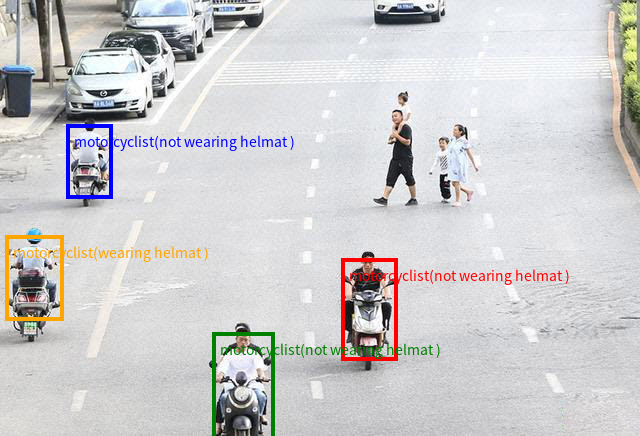
Figure 5. Demonstrating precise object grounding: the model localizes multiple motorcyclists, indicating helmet usage with bounding boxes.
Limitations and Licensing
While Qwen2.5-VL-3B-Instruct processes context up to 32,768 tokens by default, certain extensions to context length (such as YaRN) may negatively impact the spatial or temporal precision required for some tasks. Careful parameter configuration is necessary in these cases, particularly when performing OCR on small images, where excessive upscaling may degrade performance due to shifts in data distribution.
Qwen2.5-VL-3B-Instruct is released under the Apache-2.0 license, which permits broad research and development use.
External Resources
More in the Qwen 2 Family
Qwen2.5 VL 7B
Qwen2.5 VL 72B
QwQ 32B Preview
QwQ 32B
Qwen 2.5 Math 1.5B
DeepSeek R1 Distill Qwen 1.5B
DeepCoder 1.5B Preview
Qwen 2.5 Math 7B
Qwen 2.5 Math PRM 7B
DeepSeek R1 Distill Qwen 7B
Qwen 2.5 Math 72B
Qwen 2.5 Math PRM 72B
Qwen 2.5 Coder 7B
Qwen 2.5 Coder 32B
Qwen 2.5 7B
Qwen2.5 7B 1M
Qwen 2.5 14B
Qwen2.5 14B 1M
DeepSeek R1 Distill Qwen 14B
DeepCoder 14B Preview
Cogito V1 Preview 14B
Qwen 2.5 32B
DeepSeek R1 Distill Qwen 32B
Cogito V1 Preview 32B
Qwen 2.5 72B
Qwen 2 7B
Qwen 2 72B
More from Alibaba Cloud
Qwen3 0.6B
Qwen3 1.7B
Qwen3 4B
Qwen3 8B
Qwen3 14B
Qwen3 32B
Qwen3 30B A3B
Qwen3 235B A22B
Qwen 1.5 32B
Qwen 1.5 72B
Compatible Apps
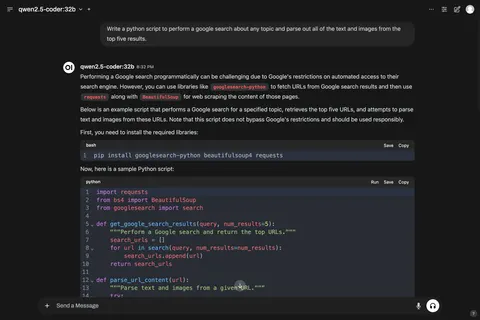
Open WebUI
A polished, self-hosted chat interface for LLMs with Ollama integration, multimodal prompts, and extensive workspace customization.
Web UI
Chat UIs · Beginner Friendly
llama.cpp
GGUF model inference with a polished web UI and OpenAI-format API. CPU-only build — high hardware compatibility, works on any machine without a GPU.
Web UI · API · CLI
LLM Inference · Chat UIs
llama.cpp (CUDA)
GGUF model inference with a polished web UI and OpenAI-format API. CUDA build — GPU-accelerated for NVIDIA GPUs.
Web UI · API · CLI
LLM Inference · Chat UIs
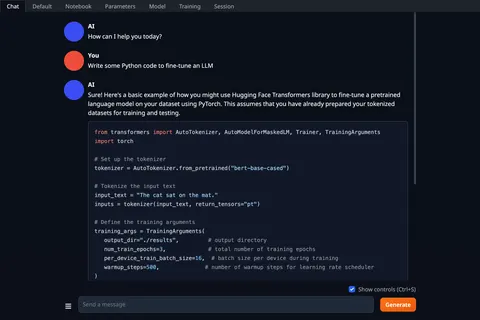
Text Generation Web UI
A feature-rich interface for running and experimenting with open-weight LLMs, including multiple inference backends, plugins, and tuning controls.
Web UI · API
Chat UIs · LLM Inference