Meta
Llama 3.3 70B
Downloads
Model Report
Overview
Llama 3.3 70B Instruct is a large-scale, instruction-tuned language model released by Meta on December 6, 2024. Developed as part of the Llama 3.3 family, the model is engineered for both research and commercial applications, emphasizing multilingual support, advanced reasoning, and improved safety through robust fine-tuning methods. Built on a transformer architecture, the model exhibits capabilities in conversational contexts and performance across a range of natural language processing benchmarks, with technical details and supporting resources made available by Meta for public use and further development, as detailed in their Llama Docs Overview.
Model Architecture and Technical Features
Llama 3.3 70B Instruct employs an optimized transformer-based architecture, incorporating Grouped-Query Attention (GQA) to enhance inference scalability, as outlined in the Llama Docs Overview. As an auto-regressive model, it generates text token-by-token based on input context, supporting a context window of up to 128,000 tokens. The architecture is further adapted for instruction-based interaction through supervised fine-tuning and reinforcement learning from human feedback (RLHF), aligning model outputs with preferred human responses to enhance utility and safety, as described in the Llama GitHub README.
A key feature of the Llama 3.3 70B Instruct model is its multilingual capacity. While pretraining draws on a broad array of languages, the model is explicitly validated for English, German, French, Italian, Portuguese, Hindi, Spanish, and Thai. Developers considering applications in additional languages are encouraged to perform their own safety and reliability evaluations, as recommended in the Llama Docs Overview.
Support for external tool use is built into the architecture, allowing the model to interface with APIs or functions such as weather lookups or data retrieval. This is made possible via chat templating and function calling within the Transformers framework, as detailed in Hugging Face's documentation on Advanced Tool Use. Furthermore, memory optimization is available through quantization, supporting both 8-bit and 4-bit precision for resource-constrained deployments.
Training Data and Methodology
Llama 3.3 70B Instruct is pretrained on approximately 15 trillion tokens sourced from publicly available datasets. Fine-tuning data includes a combination of curated human-generated instructions and over 25 million synthetic examples created to augment alignment and safety, as noted in the Llama Docs Overview. A multitiered data collection process is used, blending vendor-supplied human data with large-scale synthetic data generation and rigorous filtering via classifier models to aim to produce high-quality outputs. The model knowledge is current up to December 2023, reflecting a diverse and recent corpus.
During instruction-tuning, reinforcement learning from human feedback is extensively used. This methodology combines labeler preferences with synthetic scenarios to foster safe and helpful behaviors in generated responses, as described in the Llama Responsible Use Guide. Meta also applies automated quality control to reduce safety risks and improve performance across supported languages and applications.
Benchmark Performance
The Llama 3.3 70B Instruct model has been evaluated across a suite of widely recognized benchmarks covering reasoning, mathematics, programming, multilingual understanding, and tool use. Comparative analysis with prior entries in the Llama family—including Llama 3.1 8B and Llama 3.1 70B—demonstrates specific performance metrics in accuracy, code generation, and steerability. For instance, on the MMLU (CoT) benchmark, Llama 3.3 70B achieves a macro average accuracy of 86.0%, while on HumanEval for code generation, it attains a pass@1 score of 88.4%. In multilingual math (MGSM), the model yields an exact match score of 91.1%, as documented in the Llama Docs Overview.
Other tasks, such as IFEval for steerability and BFCL v2 for tool use, reveal similar gains, indicating the model's applicability across various general and specialized AI workloads. Context length and inference optimizations further enhance practical deployment possibilities.
Applications and Use Cases
Llama 3.3 70B Instruct is designed for a broad spectrum of applications across commercial and research domains, as outlined in the Llama Responsible Use Guide. Its instruction-tuned design makes it particularly suitable for assistant-like chat interfaces requiring rich, extended reasoning, as well as for code generation, summarization, translation, and general-purpose natural language generation.
The model’s support for external tool calls extends its capability to agentic systems that can query databases, fetch real-time information, or interact with other software tools. Outputs from Llama 3.3 can be leveraged for synthetic data generation, dataset distillation, or further model training. Multilingual capabilities and robust alignment strategies further position the model for globally relevant deployments while enabling downstream customization for specific tasks and regions.
Limitations and Responsible Use
Despite extensive training and alignment, Llama 3.3 70B Instruct retains limitations inherent to large language models. Outputs may still contain inaccuracies, biases, or rare failures to comply with safety constraints, as acknowledged in the Llama Trust & Safety documentation. The model is static, trained on an offline dataset, and not designed for real-time adaptation or knowledge updates without further retraining. Developers are expected to conduct rigorous application-specific safety evaluations and to integrate appropriate guardrails, especially when extending support to languages or domains not natively verified by Meta.
Furthermore, as a component in larger AI systems, the model should not be deployed in isolation, and any integration with external tools or services places responsibility on the developer to define policy and assess operational risks. Additional compliance requirements apply to tool use and the integration of third-party resources, as specified in the Llama Acceptable Use Policy.
Licensing and Compliance
Llama 3.3 70B Instruct is released under the Llama 3.3 Community License Agreement, a custom license tailored for broad research and commercial use, as stated in the Llama 3.3 Community License. The license grants rights to use, reproduce, modify, and distribute the model, subject to attribution, compliance with law, and prominent marking for products utilizing the model (such as “Built with Llama” badging).
Redistribution and derivative model naming are subject to specific guidelines, and users with products exceeding 700 million monthly active users on the release date require a separate commercial license from Meta. The acceptable use policy prohibits illicit or harmful activities, including applications that violate safety, legal, or ethical standards. It is important to note that the license for multimodal variants includes regional restrictions, such as different terms for entities located in the European Union. No warranty or trademark rights are provided outside the explicit terms of the Llama 3.3 Acceptable Use Policy.
External Resources
- Meta Privacy Policy
- Llama Docs Overview
- Llama Downloads
- Llama 3.3 Acceptable Use Policy
- Meta Brand Guidelines
- Llama 3.3 Community License
- Llama GitHub README
- Llama Recipes GitHub
- Llama 3.1 Prompt Format Docs
- Transformers Chat Templating Docs
- Training Energy Use and GHG Emissions Methodology
- Llama Community Stories
- Llama Responsible Use Guide
- Llama Trust and Safety
- Llama Agentic System GitHub
- Purple Llama GitHub Repository
- Llama Impact Grants
- Llama Output Reporting Mechanism
- Meta Bug Bounty Program
- Llama Get Started Resources
More in the Llama 3 Family
Llama 3 8B
Llama 3 70B
Llama 3.1 8B
Llama 3.1 8B Stheno v3.4
DeepSeek R1 Distill Llama 8B
Cogito V1 Preview 8B
Llama 3.1 70B
Cogito V1 Preview 70B
Llama 3.2 3B
Dolphin 3.0 Llama3.2 3B
Cogito V1 Preview 3B
L3.3 70B Euryale v2.3
70B L3.3 Cirrus x1
Anubis 70B v1
Anubis 70B v1.1
Wayfarer Large 70B Llama 3.3
DeepSeek R1 Distill Llama 70B
More from Meta
LLaMA 7B
LLaMA 13B
LLaMA 33B
LLaMA 65B
Llama 2 7B
Llama 2 13B
CodeLlama 13B
CodeLlama 34B
Llama 2 70B
CodeLlama 70B
Llama 4 Scout (17Bx16E)
Llama 4 Maverick (17Bx128E)
MusicGen
Magnet
Seamless
Compatible Apps
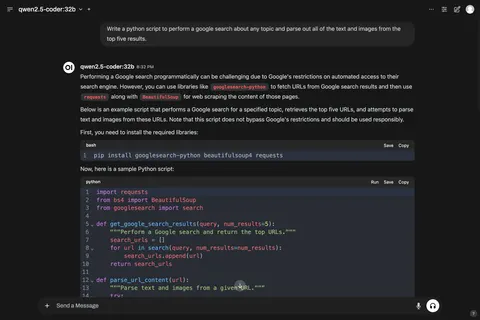
Open WebUI
A polished, self-hosted chat interface for LLMs with Ollama integration, multimodal prompts, and extensive workspace customization.
Web UI
Chat UIs · Beginner Friendly
llama.cpp
GGUF model inference with a polished web UI and OpenAI-format API. CPU-only build — high hardware compatibility, works on any machine without a GPU.
Web UI · API · CLI
LLM Inference · Chat UIs
llama.cpp (CUDA)
GGUF model inference with a polished web UI and OpenAI-format API. CUDA build — GPU-accelerated for NVIDIA GPUs.
Web UI · API · CLI
LLM Inference · Chat UIs
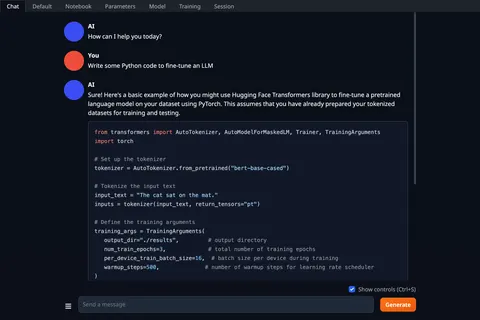
Text Generation Web UI
A feature-rich interface for running and experimenting with open-weight LLMs, including multiple inference backends, plugins, and tuning controls.
Web UI · API
Chat UIs · LLM Inference