Meta
MusicGen
Downloads
Model Report
Overview
MusicGen is a generative artificial intelligence model developed by the FAIR team at Meta AI for text-to-music synthesis. The model is a component of the AudioCraft library, which provides a suite of tools and models for audio generation and processing using deep learning techniques. Introduced in 2023, MusicGen is trained to generate high-fidelity musical audio conditioned on textual descriptions or, optionally, melody inputs. It supports both monophonic and stereophonic outputs and has been released for research and non-commercial use.
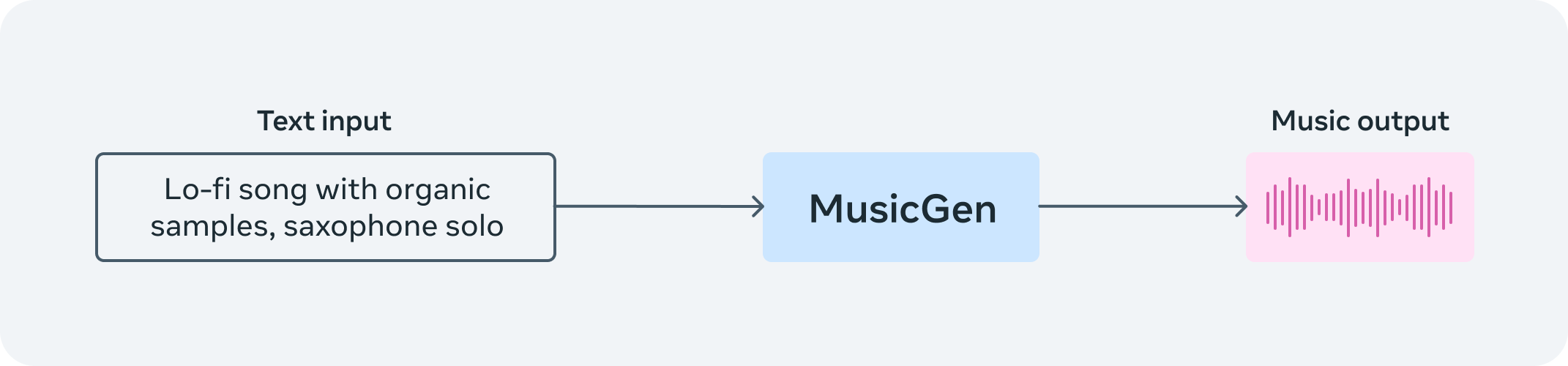
Figure 1. A conceptual flow diagram showing how MusicGen transforms a text prompt into an audio music output. Example prompt: 'Lo-fi song with organic samples, saxophone solo.'
Model Architecture
MusicGen employs a two-stage architecture combining a neural audio codec and a transformer-based autoregressive language model. The core audio representation is built upon EnCodec, a convolutional auto-encoder with Residual Vector Quantization (RVQ). Audio is tokenized into discrete codes, which the generative model then predicts sequentially.
The EnCodec model encodes audio signals at a 32 kHz sample rate into a latent representation, which is quantized using four stacked codebooks, each with 2048 entries. This process yields a discrete sequence of tokens representing the audio content. For stereo generation, EnCodec is applied independently to the left and right channels, producing eight codebooks per frame.
The generative stage uses a single-stage, causal transformer decoder, conditioned either on text, melodic context, or both. Text descriptions are transformed into embeddings via a dedicated text encoder. Melody conditioning relies on chromagram representations extracted from reference audio, providing harmonic and melodic guidance. The model employs cross-attention blocks to integrate conditioning signals and uses memory-efficient Flash Attention for scalability.
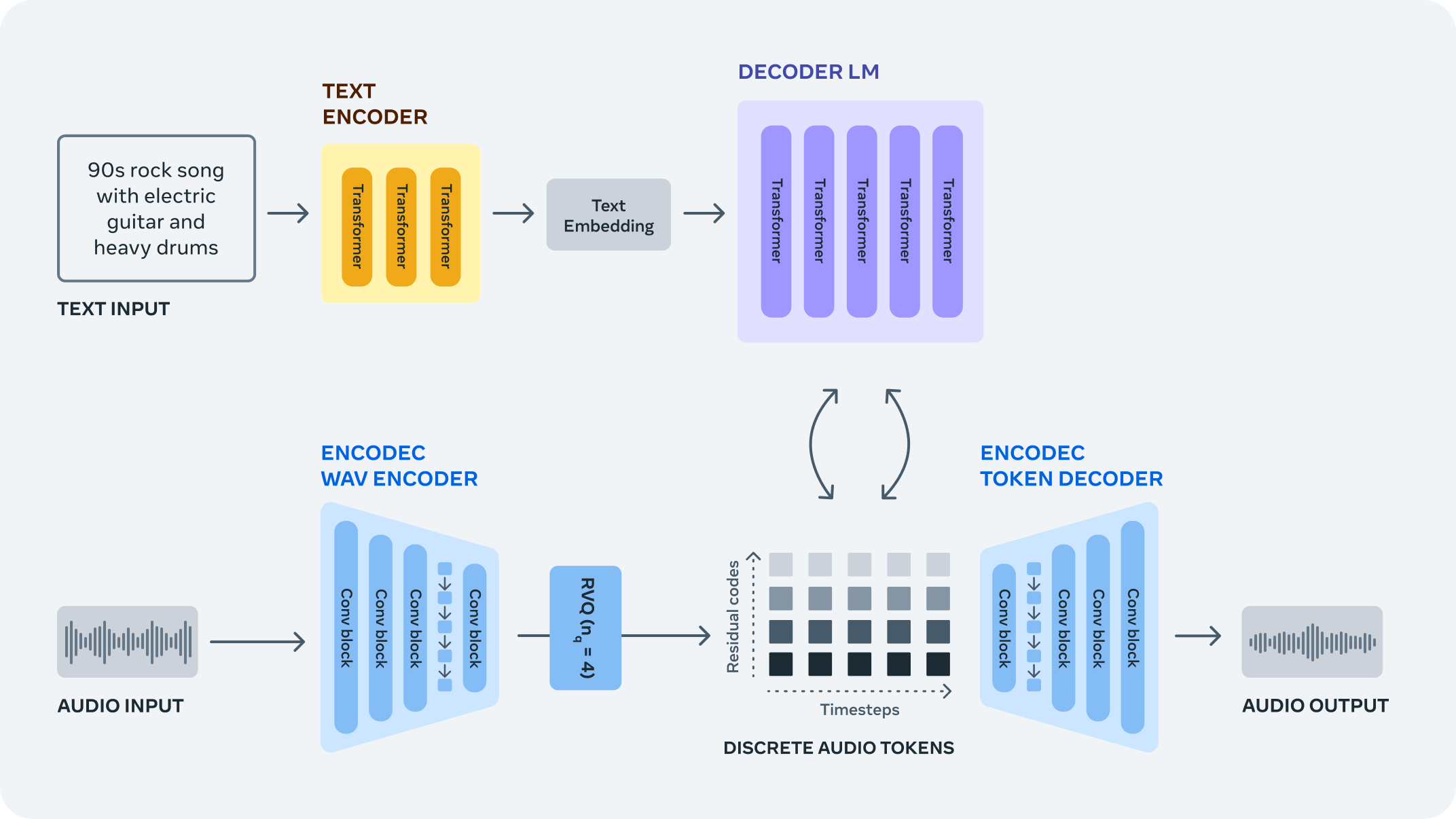
Figure 2. Schematic diagram of the AudioCraft architecture, illustrating how text descriptions and discrete audio tokens interact for audio generation in MusicGen and related models.
A feature of MusicGen is its efficient codebook interleaving approach, such as the "delay pattern," which reduces autoregressive steps for a given audio duration, enabling faster inference and support for longer outputs.
Training Data and Methods
MusicGen was trained on approximately 20,000 hours of licensed music spanning several curated datasets. Key sources include the Meta Music Initiative Sound Collection (10,000 high-quality full-length tracks), the Shutterstock music collection, and the Pond5 music collection, focusing on tracks without vocals for the publicly released versions. To facilitate instrument-only datasets, vocal elements were removed using HT-Demucs source separation.
The model is optimized on 30-second audio segments, using the AdamW optimizer and mixed-precision (float16) training to balance computational efficiency and performance. Conditioning and augmentation techniques—such as dropout and condition-merging—were applied to descriptions, improving robustness. For melody-guided training, conditioning is performed on extracted chromagrams, with drums and bass typically omitted from the chromagram reference for clarity. Classifier-free guidance is used during sampling to enhance adherence to user prompts.
Evaluation and Performance
MusicGen's performance has been evaluated using both objective and subjective criteria. Objective metrics include Frechet Audio Distance (FAD) for perceptual quality, Kullback-Leibler Divergence for label distribution similarity, CLAP Score for audio-text alignment, and chroma cosine similarity for melody adherence. Human studies assess overall perceptual quality, text relevance, and melodic alignment on a scale of 1–100.
Benchmarking on the MusicCaps dataset demonstrates that MusicGen achieves competitive results in both objective and subjective evaluations compared to contemporary models including MusicLM, Noise2Music, Riffusion, and Mousai. The 1.5B parameter version receives high marks for both audio quality and textual relevance, with the stereophonic models generally receiving higher perceptual ratings than monophonic counterparts.
Applications and Use Cases
MusicGen enables a variety of applications centered on automated and controlled music creation. Primary applications include generating music from descriptive text prompts, producing music that follows the structure of a provided melody, and supporting music co-creation tools for both research and artistic workflows. The model can generate outputs beyond its training window using a sliding window approach, facilitating the synthesis of longer tracks by reusing the last section of prior outputs as context.
Researchers utilize MusicGen to explore the capabilities and limitations of large-scale generative models for music, as well as to study aspects of musical coherence, conditioning, and style transfer. The design also facilitates iterative refinement of musical outputs, as users can combine text conditioning with melody inputs for more nuanced control.
Limitations
Despite its capabilities, MusicGen exhibits several notable limitations. The model is unable to generate realistic vocals, as its training data omitted vocal tracks. Its conditioning performance is optimized for English-language prompts, with reduced reliability for non-English inputs. Additionally, since the majority of the training data is Western or EDM-focused, the generated music often reflects these stylistic biases and may not generalize to all musical cultures or genres.
Technical limitations include occasional generation of abrupt or silent endings, a reliance on careful prompt engineering to achieve desired outcomes, and constrained fine-grained control over specific musical attributes due to its single-stage generation approach. MusicGen’s accuracy for out-of-domain prompts is limited, and subjective quality improvements tend to plateau for model sizes beyond 1.5 billion parameters.
Model Family and Related Work
MusicGen is a member of the AudioCraft library, which features related models such as AudioGen for text-to-sound effects, EnCodec for neural audio compression, and MAGNeT, a non-autoregressive text-to-music model. Within the landscape of music generation, MusicGen’s autoregressive approach, single-stage decoding, and chromagram-based melody conditioning distinguish it from models such as MusicLM and Noise2Music.
Licensing
The codebase for MusicGen is released under the MIT license, while the model weights are distributed under a Creative Commons Attribution-NonCommercial 4.0 International license, restricting use to non-commercial research and development with proper attribution.
External Resources
More in the AudioCraft Family
More from Meta