Sao10K
70B L3.3 Cirrus x1
Downloads
Model Report
Overview
The 70B L3.3 Cirrus x1 is a large-scale generative language model developed by Sao10K, notable for its distinctive data composition and extended training methodology. Building on the Llama model family, Cirrus x1 integrates advanced training strategies aimed at improving output stability and performance in text generation tasks. Its development reflects ongoing experimentation within the open-source language modeling community and emphasizes both technical rigor and iterative model refinement.

Figure 1. Introductory illustration associated with the public release of 70B L3.3 Cirrus x1.
Model Architecture and Lineage
At its core, 70B L3.3 Cirrus x1 is a finetuned variant within the Llama model ecosystem, specifically derived from Llama 3 70B and further refined from Llama 3.3 70B. This developmental lineage ensures compatibility with the Llama-3-Instruct prompt formatting and leverages advancements in underlying transformer architectures to manage large parameter counts efficiently. The model weights are stored using the BF16 tensor format, which supports efficient computation while maintaining numerical stability during inference.
With a parameter count of 70.6 billion, Cirrus x1 belongs to the class of high-capacity transformer-based language models designed for nuanced text understanding and generation. The model's development included merging with checkpoints using tailored techniques to enhance output consistency and minimize performance regressions observed in earlier iterations.
Training Methodology and Data Composition
A distinguishing characteristic of 70B L3.3 Cirrus x1 is its training regimen, which closely echoes the approach used for the "Freya" model while introducing unique adjustments in dataset curation and extended training duration. The implementation involved iterative checkpoint merging across multiple epochs—utilizing experimental tools such as dare_ties—to reinforce model stability and counteract overfitting tendencies observed in long-duration training scenarios.
The primary training phase was conducted over approximately 22 hours utilizing an 8xH100 node configuration, followed by an additional 3 hours focused on cross-epoch checkpoint merging. This latter phase employed a 2xH200 node setup, which allowed for experimental refinement of the trained network and integration of multiple learned representations to further bolster output diversity and reliability.
Evaluation and Performance
Formal benchmark scores and comprehensive leaderboard evaluations for 70B L3.3 Cirrus x1 have not been explicitly published. However, the model's stability and stylistic characteristics have been documented and are noted as key improvements compared to previous versions. Contributions to various leaderboard frameworks are possible if a suitable dataset is specified for evaluation within model card metadata.
Empirical observations by the developer suggest that the model produces outputs with a "nice style," addressing known generation issues present in earlier releases. Occasional artifacts or generation anomalies may still occur, but these are reported as being easily correctable through minor fine-tuning or prompt engineering adjustments.
Typical Use Cases and Configuration
70B L3.3 Cirrus x1 is optimized for text generation scenarios that demand high coherence and context retention over extended passages. It employs the Llama-3-Instruct prompt format, making it suitable for both general instruction-following tasks and creative composition. The recommended inference configuration includes a temperature setting of 1.1 to enable creative outputs and a minimum probability (min_p) value of 0.05 to ensure response diversity. While the model is compatible with standard sampling algorithms, alternative samplers such as DRY or XTC may be used at the operator's discretion, though detailed support for these is not provided by the developer.
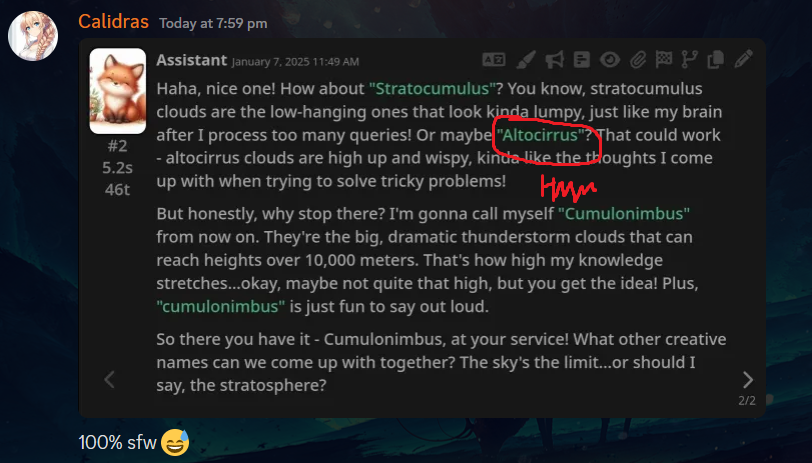
Figure 2. Example of model-generated dialogue discussing various cloud types. The conversation demonstrates contextual understanding and creative naming.
Limitations and Model Family
Despite its robust training and checkpoint merging strategy, 70B L3.3 Cirrus x1 may occasionally exhibit output inconsistencies that require post-processing or prompt refinement. Formal licensing details are not specified in the publicly available technical documentation. The model serves as both a foundation for derivative models—having been used in further finetunes, merges, and quantizations—and an experimental platform for continued research into large language model synthesis and stability.
For researchers and practitioners seeking comparative context, the model directly draws upon the data and approach utilized for the Freya model and represents a downstream extension of major releases within the Llama series. Metrics for derivative models and their relationship to Cirrus x1 can be explored through associated model card documentation.
External Resources
For further technical details and ongoing developments, the following resources may be helpful:
- Sao10K Contact Card — General information and contact details for the model author
- Safetensors Documentation — Guidance on the storage format for model weights
- Evaluation Results and Leaderboards — Instructions for reporting and interpreting model evaluation metrics
- Specifying a Base Model in Model Cards — Documentation for base model identification and comparison
- Model Card Evaluation Metadata — Technical reference for model card reporting standards
More in the Llama 3 Family
Llama 3 8B
Llama 3 70B
Llama 3.1 8B
Llama 3.1 8B Stheno v3.4
DeepSeek R1 Distill Llama 8B
Cogito V1 Preview 8B
Llama 3.1 70B
Cogito V1 Preview 70B
Llama 3.2 3B
Dolphin 3.0 Llama3.2 3B
Cogito V1 Preview 3B
Llama 3.3 70B
L3.3 70B Euryale v2.3
Anubis 70B v1
Anubis 70B v1.1
Wayfarer Large 70B Llama 3.3
DeepSeek R1 Distill Llama 70B
Compatible Apps
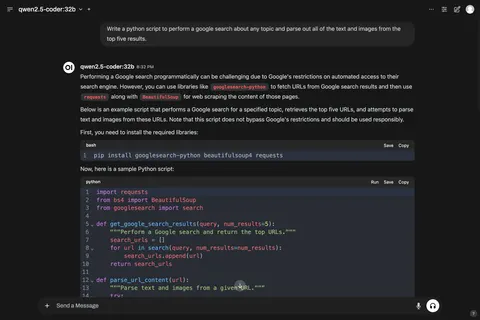
Open WebUI
A polished, self-hosted chat interface for LLMs with Ollama integration, multimodal prompts, and extensive workspace customization.
Web UI
Chat UIs · Beginner Friendly
llama.cpp
GGUF model inference with a polished web UI and OpenAI-format API. CPU-only build — high hardware compatibility, works on any machine without a GPU.
Web UI · API · CLI
LLM Inference · Chat UIs
llama.cpp (CUDA)
GGUF model inference with a polished web UI and OpenAI-format API. CUDA build — GPU-accelerated for NVIDIA GPUs.
Web UI · API · CLI
LLM Inference · Chat UIs
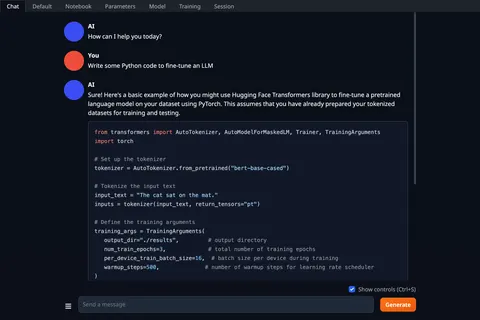
Text Generation Web UI
A feature-rich interface for running and experimenting with open-weight LLMs, including multiple inference backends, plugins, and tuning controls.
Web UI · API
Chat UIs · LLM Inference