Meta
Llama 3.1 70B
Downloads
Model Report
Overview
The Llama 3.1 70B model is a large-scale generative language model developed by Meta as part of the Llama 3.1 model suite. Released on July 23, 2024, alongside companion models of 8B and 405B parameters, Llama 3.1 70B is designed to enable advanced natural language processing tasks across multiple languages and extended context lengths. The model is open-source under the Llama 3.1 Community License Agreement, reflecting Meta’s ongoing commitment to openness in artificial intelligence model development, as articulated in Meta’s open-source AI principles.
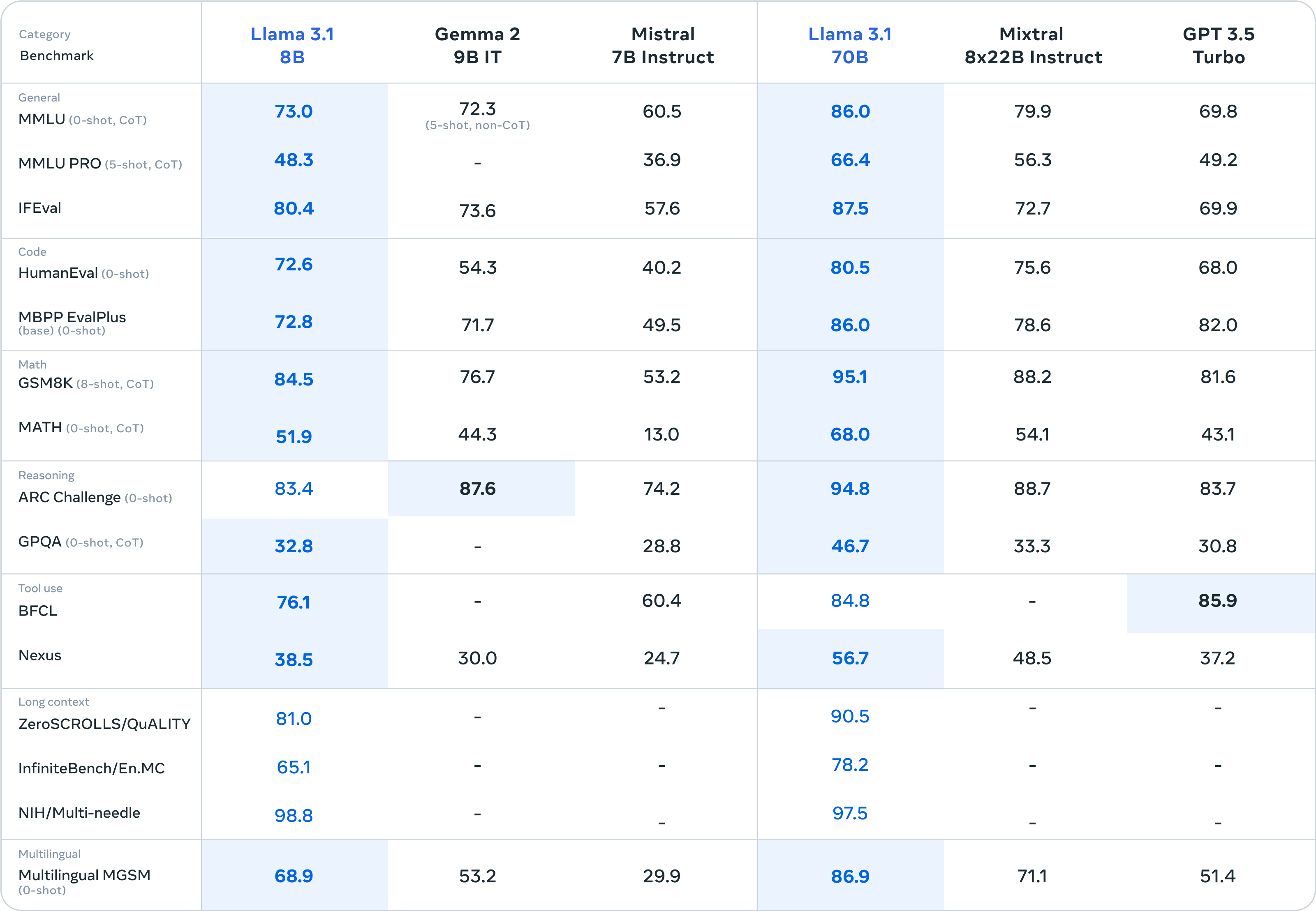
Figure 1. A comprehensive benchmark comparison of Llama 3.1 70B and other leading open large language models across general, code, math, reasoning, tool use, long-context, and multilingual tasks.
Architecture and Technology
Llama 3.1 70B employs a transformer-based, decoder-only architecture with enhancements focused on training stability and inference scale. The model uses Grouped Query Attention (GQA) to increase inference speed and scalability, facilitating deployment in diverse research and production settings. Unlike mixture-of-experts strategies, Llama 3.1 maintains a unified architecture, which supports efficient supervised fine-tuning and alignment methodologies.
Instruction-tuned variants are aligned to human preferences for utility and safety through supervised fine-tuning (SFT), Direct Preference Optimization (DPO), and Rejection Sampling (RS). This alignment is intended to enhance the model's usefulness in dialogue and assistive applications.
Training Data and Procedures
Llama 3.1 70B was trained on approximately 15 trillion tokens collected from a wide array of publicly available online sources, with the dataset cut off at December 2023. The pre-training corpus emphasizes data diversity and quality, encompassing multiple languages and domains. Fine-tuning incorporates instruction datasets amassed from both human and synthetic sources, with more than 25 million synthetically generated samples used for refinement.
The iterative post-training process leverages SFT and DPO to generate increasingly high-quality synthetic data and adjust the balance between short- and long-context performance, supporting the model’s expanded 128K context window. This context length enables advanced use-cases such as long-document summarization and codebase analysis.
Capabilities and Evaluation
Llama 3.1 70B demonstrates competitive performance across a range of standardized benchmarks designed to assess language understanding, reasoning, coding, mathematics, multilingual proficiency, and tool usage.
On widely recognized metrics such as MMLU, IFEval, HumanEval, GSM8K, and various multilingual and reasoning datasets, the model performs on par with, or above, many other open-source peers of comparable scale. For instance, in the published benchmarks, Llama 3.1 70B Instruct achieves:
- 83.6 on 5-shot MMLU macro-average,
- 80.5 on 0-shot HumanEval pass@1 (code generation),
- 95.1 on 8-shot GSM8K for grade-school math,
- 86.9 on multilingual MGSM for math reasoning in diverse languages.
These results reflect the model's aptitude for complex, real-world tasks, including code synthesis, multilingual conversation, robust reasoning, and effective tool manipulation. The model’s multilingual training covers English, German, French, Italian, Portuguese, Hindi, Spanish, and Thai, though coverage outside these languages is not officially supported by Meta without further fine-tuning and appropriate safeguards.
Applications and Use Cases
Llama 3.1 70B is suited for both research and production in a broad spectrum of natural language processing applications. Its enhanced instruction-following aligns well with assistant-style dialogue, chatbots, and virtual agents. The expanded context window facilitates tasks such as summarization of lengthy texts, complex document question-answering, and maintaining context over extended conversations.
Other prominent uses include code generation, scientific Q&A, data extraction, and knowledge retrieval. The model supports synthetic data generation and distillation workflows, enabling developers to build or refine smaller models using its outputs. Community-built applications have utilized preceding Llama models for educational bots, medical decision support (e.g., Meditron developed with Yale Medicine and EPFL), and organizing health records for secure communication in clinical settings.
Limitations and Responsible Use
As with all large language models, Llama 3.1 70B presents specific limitations and risks. High computational requirements may challenge individual developers seeking to fine-tune or deploy the model at scale. As a static model with a fixed training cutoff, Llama 3.1 does not incorporate real-time knowledge updates.
Meta advises that the model is only officially supported for eight languages, and use in other languages necessitates rigorous additional tuning and risk assessment. Model outputs, while filtered and aligned, may contain inaccuracies, biases, or potentially harmful content. Meta recommends employing the model as a component of a broader AI system with safety guardrails such as Llama Guard 3, Prompt Guard, and policy-based overlays.
Developers remain responsible for downstream system safety, including integration with tools, enforcing usage policies, and continued risk monitoring, particularly in areas such as CBRNE, child safety, and cybersecurity.
Licensing
Llama 3.1 70B is distributed under the Llama 3.1 Community License Agreement, which grants free, worldwide, non-exclusive rights for usage, reproduction, modification, and redistribution subject to attribution and compliance requirements. The license mandates clear labeling (e.g., "Built with Llama") and stipulates additional terms for platforms with over 700 million monthly users. It prohibits use in activities violating laws or ethical standards, mandates compliance with the Acceptable Use Policy, and restricts redistribution in sensitive domains. Derivative works created using Llama outputs must include “Llama” in the model name.
Related Models
Within the broader Llama 3.1 release, Meta introduced three models: 8B, 70B, and 405B parameters. The Llama 3.1 8B and 70B models are designed for accessibility and resource-efficient experimentation, while the 405B model represents a larger-scale research baseline. Each variant benefits from the same training improvements and architectural design.
External Resources
- Mark Zuckerberg’s letter on open-source AI
- Llama 3.1 official download portal
- Hugging Face: Llama 3.1 model collection
- Technical paper: The Llama 3 herd of models
- Llama GitHub repository
- AI Responsibility in Llama 3.1
- Llama 3.1 Acceptable Use Policy
- Llama Responsible Use Guide
- Community use-cases and stories
- Reporting issues with Llama
- Llama Impact Grants
- Purple Llama GitHub tools for AI safety
- Llama 3.1 Reference System and Guardrails
- Meta Privacy Policy
More in the Llama 3 Family
Llama 3 8B
Llama 3 70B
Llama 3.1 8B
Llama 3.1 8B Stheno v3.4
DeepSeek R1 Distill Llama 8B
Cogito V1 Preview 8B
Cogito V1 Preview 70B
Llama 3.2 3B
Dolphin 3.0 Llama3.2 3B
Cogito V1 Preview 3B
Llama 3.3 70B
L3.3 70B Euryale v2.3
70B L3.3 Cirrus x1
Anubis 70B v1
Anubis 70B v1.1
Wayfarer Large 70B Llama 3.3
DeepSeek R1 Distill Llama 70B
More from Meta
LLaMA 7B
LLaMA 13B
LLaMA 33B
LLaMA 65B
Llama 2 7B
Llama 2 13B
CodeLlama 13B
CodeLlama 34B
Llama 2 70B
CodeLlama 70B
Llama 4 Scout (17Bx16E)
Llama 4 Maverick (17Bx128E)
MusicGen
Magnet
Seamless
Compatible Apps
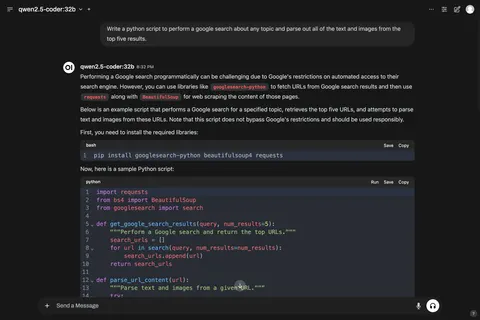
Open WebUI
A polished, self-hosted chat interface for LLMs with Ollama integration, multimodal prompts, and extensive workspace customization.
Web UI
Chat UIs · Beginner Friendly
llama.cpp
GGUF model inference with a polished web UI and OpenAI-format API. CPU-only build — high hardware compatibility, works on any machine without a GPU.
Web UI · API · CLI
LLM Inference · Chat UIs
llama.cpp (CUDA)
GGUF model inference with a polished web UI and OpenAI-format API. CUDA build — GPU-accelerated for NVIDIA GPUs.
Web UI · API · CLI
LLM Inference · Chat UIs
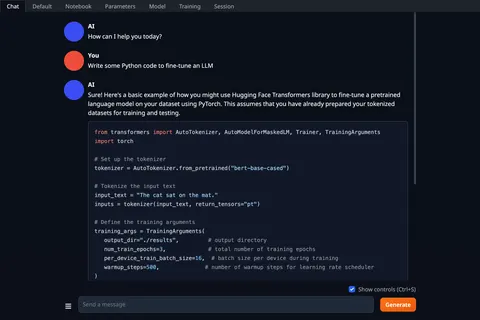
Text Generation Web UI
A feature-rich interface for running and experimenting with open-weight LLMs, including multiple inference backends, plugins, and tuning controls.
Web UI · API
Chat UIs · LLM Inference