Xwin-LM
Xwin LM 7B
Downloads
Model Report
Overview
Xwin-LM-7B is a member of the Xwin-LM family of large language models, developed with a focus on advancing open-source alignment techniques such as supervised fine-tuning, reward modeling, reject sampling, and reinforcement learning from human feedback (RLHF). Built upon the Llama 2 architecture, Xwin-LM-7B is designed to facilitate research in alignment technologies and provide an accessible, high-performance language model for a wide range of text generation and comprehension tasks. The model has garnered attention for its benchmark performance across several evaluation platforms, demonstrating competitive results against contemporary large language models.
Model Architecture and Training Methodology
Xwin-LM-7B is based on the Llama 2 transformer architecture, leveraging its structures while introducing alignment-focused training strategies. The development process is characterized by multi-stage training, beginning with supervised fine-tuning (SFT) to establish foundational abilities, followed by reward modeling (RM) to guide the model's preference learning through human-annotated comparison data. Reject sampling is then applied to improve output robustness, and reinforcement learning from human feedback, particularly via Proximal Policy Optimization (PPO), enhances the model's capacity to align responses with user intent and human values. The architecture supports multi-turn conversation formatting, utilizing the prompt format introduced by Vicuna, which structures dialogues for natural and context-aware interactions between users and the model.
Benchmark Performance and Evaluation
Xwin-LM-7B has been evaluated on leading benchmarks assessing instruction-following, factuality, and general-purpose linguistic skills. According to the AlpacaEval benchmark, Xwin-LM-7B-V0.2 achieves a win-rate of 89.31% versus Text-Davinci-003, 79.60% versus ChatGPT, and 59.83% versus GPT-4, indicating competitive performance relative to both open and closed models. On the Open LLM Leaderboard, Xwin-LM-7B-V0.2 demonstrates balanced results: MMLU (50.0 5-shot), ARC (56.4 25-shot), TruthfulQA (49.5 0-shot), and HellaSwag (78.9 10-shot), with an overall average score of 58.7. These results illustrate Xwin-LM-7B's capacity for broad language understanding and alignment with expected behavior on a diverse array of natural language tasks.
Training Data and Alignment Techniques
The training process for Xwin-LM-7B emphasizes alignment through incremental supervision and learning from curated human feedback. The supervised fine-tuning stage utilizes instruction data designed to foster coherent, contextually relevant outputs. Reward modeling assigns preferences based on human comparison judgments, making it possible to optimize for responses deemed helpful, detailed, and safe. Reject sampling introduces an iterative filtering mechanism, discarding undesirable generations before subsequent optimization. The backbone of alignment in Xwin-LM-7B comes from applying RLHF with PPO, enabling the model to iteratively improve based on human feedback and direct optimization of response quality. The combination of these methodologies places a strong emphasis on ensuring helpful, polite, and informative model behavior.
Applications and Use Cases
Xwin-LM-7B is intended as a general-purpose large language model, suitable for a range of applications requiring natural language understanding and generation. Benchmark performance suggests utility in assistant-oriented dialogue, question-answering, text summarization, and instruction synthesis. Additionally, the Xwin-LM project’s focus on open-sourcing alignment methodologies supports research into the effectiveness of various training strategies such as SFT, RM, reject sampling, and RLHF. Its conversational formatting also makes it well-suited for integration within multi-turn dialogue systems, enabling extended and context-aware user interactions for research prototypes and academic studies.
Known Limitations and Licensing
While Xwin-LM-7B demonstrates strong benchmark results, its technical report for version V0.2 is still forthcoming, and further improvements are anticipated in specialized domains such as mathematical reasoning and domain-specific expertise. The full model source code has not yet been released but is planned by the development team. Xwin-LM-7B and all models in its family are released under the Llama 2 License, aligning with standard practices for responsible open distribution and use of large language models.
Timeline and Model Versions
The initial release of Xwin-LM-7B-V0.1 occurred in September 2023, appearing in top rankings among similarly sized models on public benchmarks. Subsequent refinements led to the release of Xwin-LM-7B-V0.2 in October 2023, incorporating improved comparison data and Proximal Policy Optimization (PPO), and showing higher win-rates against leading proprietary systems. The Xwin-LM family is actively maintained, with larger model variants such as 13B and 70B versions also available for comparison and research purposes. Continued updates and model releases are planned, extending both the model’s capabilities and the breadth of alignment research supported.
Helpful Resources
More in the Llama 2 Family
Llama 2 7B
CodeLlama 7B
Vicuna 7B
Pygmalion 2 7B
OpenChat 3.5 7B
Llama 2 13B
CodeLlama 13B
Nous Hermes 13b
Vicuna 13B
MythoMax L2
WizardLM 13B
Pygmalion 2 13B
Mythalion 13B
Xwin LM 13B
CodeLlama 34B
Llama 2 70B
CodeLlama 70B
Xwin 70B
WizardLM 70B
Nous Hermes Llama 2 70B
Compatible Apps
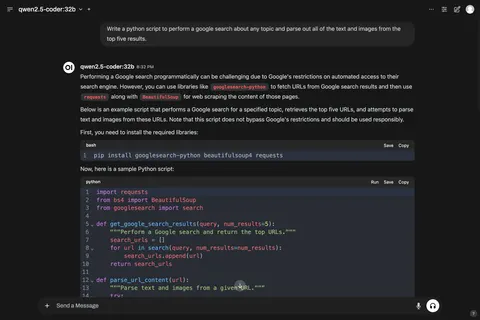
Open WebUI
A polished, self-hosted chat interface for LLMs with Ollama integration, multimodal prompts, and extensive workspace customization.
Web UI
Chat UIs · Beginner Friendly
llama.cpp
GGUF model inference with a polished web UI and OpenAI-format API. CPU-only build — high hardware compatibility, works on any machine without a GPU.
Web UI · API · CLI
LLM Inference · Chat UIs
llama.cpp (CUDA)
GGUF model inference with a polished web UI and OpenAI-format API. CUDA build — GPU-accelerated for NVIDIA GPUs.
Web UI · API · CLI
LLM Inference · Chat UIs
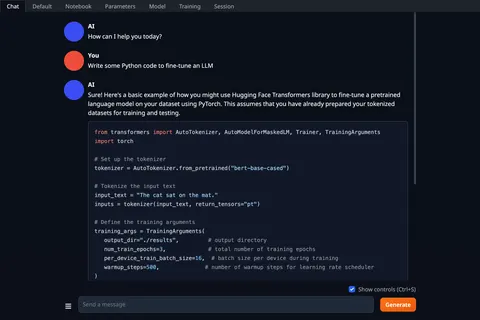
Text Generation Web UI
A feature-rich interface for running and experimenting with open-weight LLMs, including multiple inference backends, plugins, and tuning controls.
Web UI · API
Chat UIs · LLM Inference