Xwin-LM
Xwin 70B
Downloads
Model Report
Overview
Xwin 70B is a large language model (LLM) developed as part of the broader Xwin-LM project, which focuses on advancing open-source alignment technologies for LLMs through techniques such as supervised fine-tuning, reward modeling, reject sampling, and reinforcement learning from human feedback. Released in September 2023, Xwin 70B is built upon the Llama 2 architecture and leverages reinforcement learning from human feedback (RLHF) as a central methodology for improving communicative effectiveness and safety.
The model and its family are released under the Llama 2 License and are intended to foster reproducible, transparent research in model alignment and scalable conversational systems.
Model Architecture and Alignment Techniques
Xwin 70B is based on the Llama 2 70B parameter model, which provides a foundation for extended context and generative capabilities. The Xwin-LM team specifically focuses on enhancing alignment through a multi-step process that includes supervised fine-tuning to guide base behaviors, reward modeling to assess desirable system outputs, and reinforcement learning from human feedback to iteratively adapt the model based on user preference data.
Core to Xwin 70B's alignment is its use of RLHF, whereby human annotators provide feedback on model outputs to create a reward function that further tunes the system. This process is designed to yield more helpful, precise, and polite responses consistent with user expectations. The model also employs a conversational prompt format pioneered by Vicuna and incorporated by FastChat, which structures multi-turn dialogues for improved interaction.
Technical Features and Inference
Xwin 70B emphasizes stable and reproducible conversational alignment while maintaining compatibility with widely adopted machine learning frameworks. The model utilizes a prompt format that begins with an introductory description of the chat, followed by alternating user and assistant turns, as exemplified below:
“A chat between a curious user and an artificial intelligence assistant. The assistant gives helpful, detailed, and polite answers to the user’s questions. USER: Hi! ASSISTANT: Hello.</s>USER: Who are you? ASSISTANT: I am Xwin-LM.</s>”
For inference, Xwin 70B is compatible with Hugging Face’s AutoModelForCausalLM and AutoTokenizer, and is optimized for high-speed inference using vllm due to its Llama 2-based implementation. Strict adherence to the prescribed conversational templates is recommended to ensure coherent and contextually relevant outputs. Suggested inference settings include a max_new_tokens value of 4096 and a temperature parameter set around 0.7 to balance creativity and determinism in responses.
Benchmark Performance
Following release, Xwin 70B achieved strong performance across a number of public benchmarks. In the AlpacaEval evaluation, Xwin 70B recorded a 95.57% win-rate against Text-Davinci-003. It also achieved a 60.61% win-rate versus GPT-4 and 87.50% versus ChatGPT in the same benchmark. The model generally exhibited higher relative scores in head-to-head comparisons against models such as Llama-2-70B-Chat and WizardLM-70B in several evaluations.
Xwin 70B also scored highly on NLP foundation tasks recorded in the Open LLM Leaderboard. The reported average score across core tasks was 71.8, with detailed results including a score of 69.6 on MMLU (5-shot), 70.5 on ARC (25-shot), 60.1 on TruthfulQA (0-shot), and 87.1 on HellaSwag (10-shot). These results provide insight into its performance across various question-answering and reasoning challenges.
Xwin-LM Model Family
The Xwin-LM project has released several models alongside Xwin 70B, notably the Xwin-LM-13B-V0.1 and Xwin-LM-7B-V0.1 models. These models are also based on the Llama 2 architecture and employ the same alignment strategies, including RLHF.
The 13B variant achieved a 91.76% win-rate on AlpacaEval against Text-Davinci-003 and recorded win-rates of 81.79% versus ChatGPT and 55.30% compared to GPT-4. Its average score on NLP foundation tasks was 61.9. The 7B variant recorded an 87.82% win-rate on AlpacaEval, with corresponding win-rates of 76.40% and 47.57% against ChatGPT and GPT-4, respectively, and an average NLP score of 58.4. Both models are distributed under the Llama 2 License, ensuring alignment with open-source principles.
Limitations and Future Directions
While Xwin 70B and its related models demonstrate strong results on automated benchmarks, the Xwin-LM project has outlined areas for continued development. One primary aim is to release more comprehensive source code to support greater scientific transparency and reproducibility. Furthermore, the project envisions enhancing capabilities in mathematics and reasoning to address domains that require more rigorous logic or step-wise solution generation.
Ongoing research is also anticipated to address any limitations in prompt flexibility, context retention, or specific use-case adaptation as highlighted in the broader LLM community.
Helpful Links
More in the Llama 2 Family
Llama 2 7B
CodeLlama 7B
Vicuna 7B
Pygmalion 2 7B
OpenChat 3.5 7B
Xwin LM 7B
Llama 2 13B
CodeLlama 13B
Nous Hermes 13b
Vicuna 13B
MythoMax L2
WizardLM 13B
Pygmalion 2 13B
Mythalion 13B
Xwin LM 13B
CodeLlama 34B
Llama 2 70B
CodeLlama 70B
WizardLM 70B
Nous Hermes Llama 2 70B
Compatible Apps
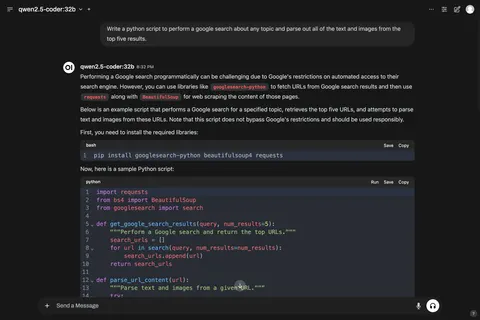
Open WebUI
A polished, self-hosted chat interface for LLMs with Ollama integration, multimodal prompts, and extensive workspace customization.
Web UI
Chat UIs · Beginner Friendly
llama.cpp
GGUF model inference with a polished web UI and OpenAI-format API. CPU-only build — high hardware compatibility, works on any machine without a GPU.
Web UI · API · CLI
LLM Inference · Chat UIs
llama.cpp (CUDA)
GGUF model inference with a polished web UI and OpenAI-format API. CUDA build — GPU-accelerated for NVIDIA GPUs.
Web UI · API · CLI
LLM Inference · Chat UIs
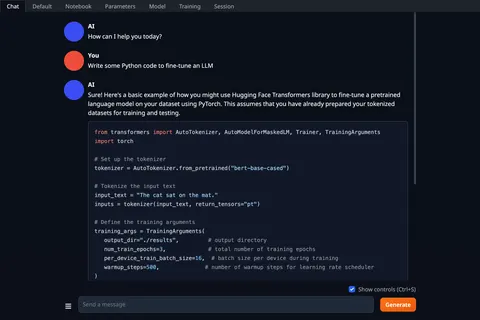
Text Generation Web UI
A feature-rich interface for running and experimenting with open-weight LLMs, including multiple inference backends, plugins, and tuning controls.
Web UI · API
Chat UIs · LLM Inference