PygmalionAI
Mythalion 13B
Downloads
Model Report
Overview
Mythalion 13B is a generative language model tailored for fictional writing and entertainment-focused conversational applications. It is the result of a collaborative merge between PygmalionAI and Gryphe, combining aspects from both parties’ prior models to provide a tool for roleplay (RP) and chat-based storytelling tasks. As with many contemporary language models, Mythalion 13B is built atop the foundational Llama-2 architecture, maintaining an open release for both research and commercial contexts.
Model Development and Release
Mythalion 13B was introduced as a part of the PygmalionAI initiative to advance text-generation models with an emphasis on creative writing and interactive roleplay. This model is specifically a merge, using advanced merging techniques, of Pygmalion-2 13B and Gryphe's MythoMax L2 13B, both of which are themselves derivatives of Meta's Llama-2. The release was particularly aimed at the RP community, with a focus on designing longer, in-character responses and facilitating conversational fiction.
The development incorporated community feedback, notably from testers who highlighted improved performance relative to MythoMax L2 13B for inline roleplay and chat scenarios. Technical details regarding the merge can be found in the official PygmalionAI blog post, which also offers guidance on use with various chat interfaces.
Model Architecture
Mythalion 13B’s architecture is grounded in the Llama-2 transformer design. It comprises approximately 13 billion parameters and utilizes 16-bit floating-point (FP16) tensors, providing a balance between model expressiveness and computational efficiency. The model was built using the Axolotl training framework, which supports modular experiment workflows for large language model research.
This architecture enables the model's ability to produce long-form, context-rich dialogue, remaining attentive to narrative structure and character consistency throughout extended exchanges. The merging of underlying models leverages techniques that blend their respective strengths, resulting in synthesized model behaviors designed for creative output and in-character roleplay.
Training Techniques and Data
For training, Mythalion 13B utilizes specialized conversational prompts characterized by explicit role tokens: <|system|>, <|user|>, and <|model|>. The <|system|> token injects meta-context or out-of-band narrative guidance, <|user|> marks the user's direct contributions, and <|model|> prompts the AI to generate its response. This conversational scaffolding enables chaining of turns for multi-step dialogues and was a design choice to mirror natural RP and storytelling formats seen in user communities.
The core component Pygmalion-2 13B was trained on data that includes a diverse selection of fictional dialogues, character-driven scenarios, and entertainment-oriented exchanges, aligning with the model’s intended use cases.
Applications and Usage
The primary application of Mythalion 13B is found in fictional and entertainment contexts, with capabilities for RP chat environments. Users engage the model to enact characters, develop plotlines, and simulate interactive storytelling. Community assessments note its ability to generate extended responses and maintain persona-specific consistency.
The model supports two prompting formats to maximize compatibility with popular chat applications. The Alpaca format structures prompts as instruction-response pairs, while the Pygmalion/Metharme format leverages the role tokens defined above for nuanced conversation management. Details concerning these formats and recommended generation settings are available via the PygmalionAI documentation.
Limitations and Responsible Use
While capable of creative entertainment, Mythalion 13B was not fine-tuned for safety, factual accuracy, or moderation. Training data for both its foundation models and merged variants includes unfiltered internet text, which may lead to the output of content that is profane, offensive, or factually incorrect. The developers recommend restricting its use to designated fictional and entertainment purposes, as outputs may be unsuitable for other contexts or sensitive applications.
The model's licensing aligns with the Llama-2 community license, allowing both non-commercial and commercial use cases, provided users adhere to the responsible AI use guidelines specified therein.
Helpful Links
More in the Llama 2 Family
Llama 2 7B
CodeLlama 7B
Vicuna 7B
Pygmalion 2 7B
OpenChat 3.5 7B
Xwin LM 7B
Llama 2 13B
CodeLlama 13B
Nous Hermes 13b
Vicuna 13B
MythoMax L2
WizardLM 13B
Pygmalion 2 13B
Xwin LM 13B
CodeLlama 34B
Llama 2 70B
CodeLlama 70B
Xwin 70B
WizardLM 70B
Nous Hermes Llama 2 70B
Compatible Apps
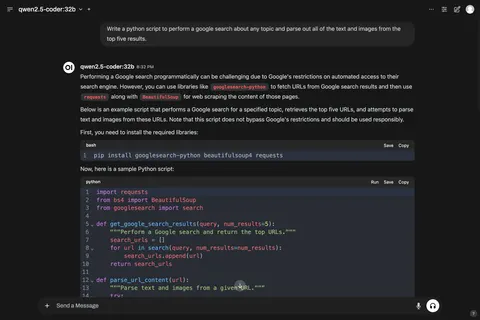
Open WebUI
A polished, self-hosted chat interface for LLMs with Ollama integration, multimodal prompts, and extensive workspace customization.
Web UI
Chat UIs · Beginner Friendly
llama.cpp
GGUF model inference with a polished web UI and OpenAI-format API. CPU-only build — high hardware compatibility, works on any machine without a GPU.
Web UI · API · CLI
LLM Inference · Chat UIs
llama.cpp (CUDA)
GGUF model inference with a polished web UI and OpenAI-format API. CUDA build — GPU-accelerated for NVIDIA GPUs.
Web UI · API · CLI
LLM Inference · Chat UIs
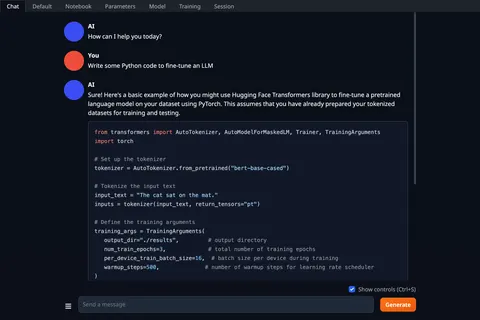
Text Generation Web UI
A feature-rich interface for running and experimenting with open-weight LLMs, including multiple inference backends, plugins, and tuning controls.
Web UI · API
Chat UIs · LLM Inference