lmsys
Vicuna 13B
Downloads
Model Report
Overview
Vicuna-13B is an open-source large language model developed by LMSYS and introduced on March 30, 2023. Building upon the LLaMA architecture, Vicuna-13B is fine-tuned using a substantial dataset of user-shared conversations, enabling it to operate as a conversational AI chatbot suitable for research and development in natural language processing (NLP) and artificial intelligence (AI). The model is recognized for its open accessibility and detailed documentation, fostering transparency in the study and advancement of language models.

Figure 1. Stylized mascot artwork representing the Vicuna-13B model, inspired by the animal vicuña.
Model Architecture and Training
Vicuna-13B is based on the auto-regressive transformer architecture established in LLaMA, with enhancements directed at chatbot performance. The model is fine-tuned on the LLaMA foundation model using approximately 70,000 user-shared ChatGPT conversations collected from ShareGPT, later expanded to about 125,000 conversations for subsequent iterations such as Vicuna v1.5. Fine-tuning is performed with a focus on multi-turn dialogues, where the training loss is computed exclusively on the chatbot's responses, an approach that increases training efficiency and dialogue fluency.
Technical improvements in Vicuna-13B facilitate support for longer conversational contexts, extending the maximum context window from 512 tokens (as in Alpaca) to 2048 tokens. To accommodate the increased computational demand, memory optimization techniques such as gradient checkpointing and FlashAttention are employed during training. The training pipeline is implemented in PyTorch FSDP, typically utilizing clusters of A100 GPUs. For serving, the system incorporates distributed serving infrastructure that supports scalable deployment.
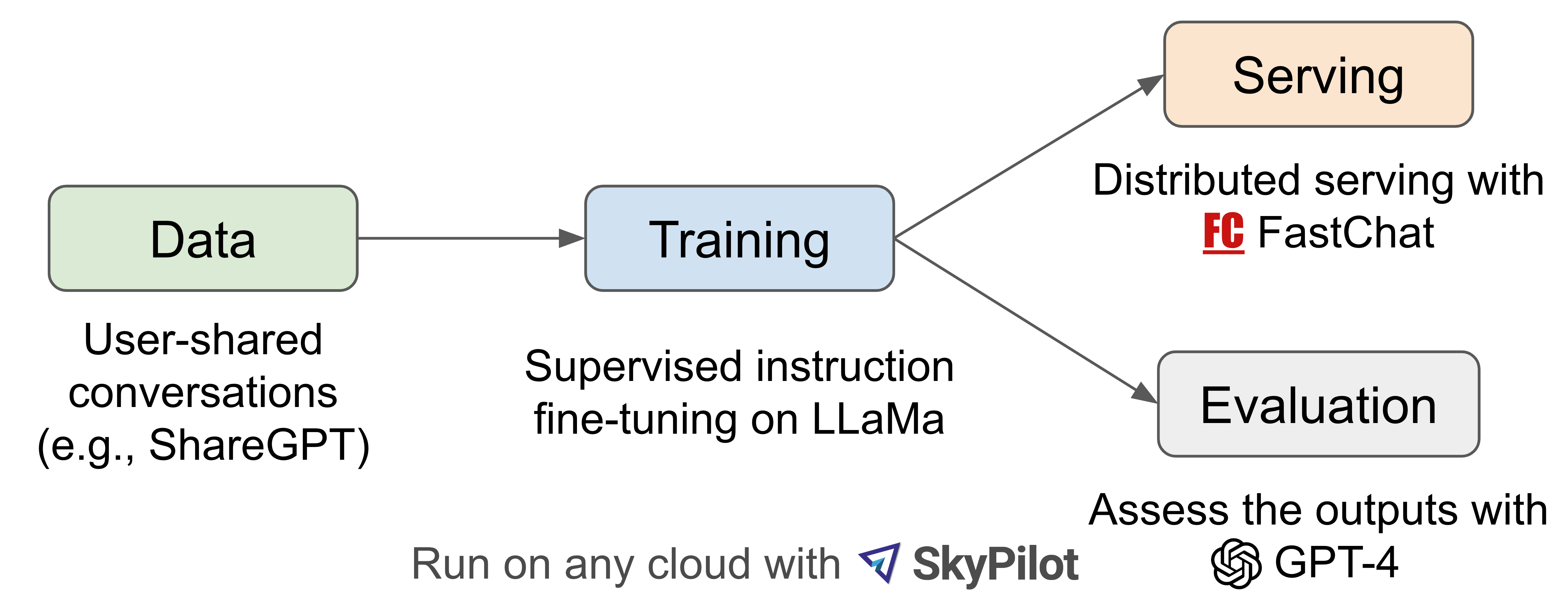
Figure 2. Workflow diagram summarizing Vicuna's data collection, training, serving, and evaluation pipeline.
Evaluation and Performance Metrics
The performance of Vicuna-13B has been systematically evaluated using both language model and human assessments. Notably, the MT-Bench evaluation, in which responses are scored by GPT-4, provides a comparative assessment across multiple chatbot models. According to these studies, Vicuna-13B achieves a relative response quality assessed by GPT-4 at 92% of ChatGPT's performance and closely matches proprietary models such as Bard.
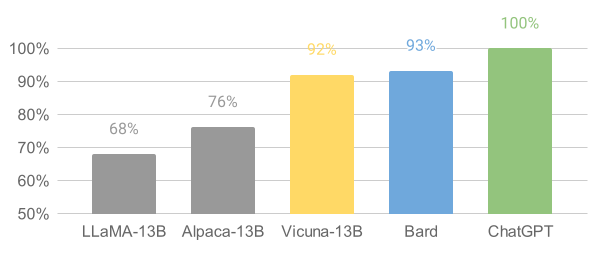
Figure 3. Bar chart of relative response quality as assessed by GPT-4 for various chatbot models, showing Vicuna-13B achieving 92% of ChatGPT's performance.
Benchmarking details demonstrate Vicuna-13B's strong comparative preference against open-source models. In direct comparisons, GPT-4 judges selected Vicuna-13B's responses over those of LLaMA-13B and Alpaca-13B in over 90% of prompts, and in approximately 45% of cases, Vicuna-13B's answers were rated as equivalent to or better than those of ChatGPT.
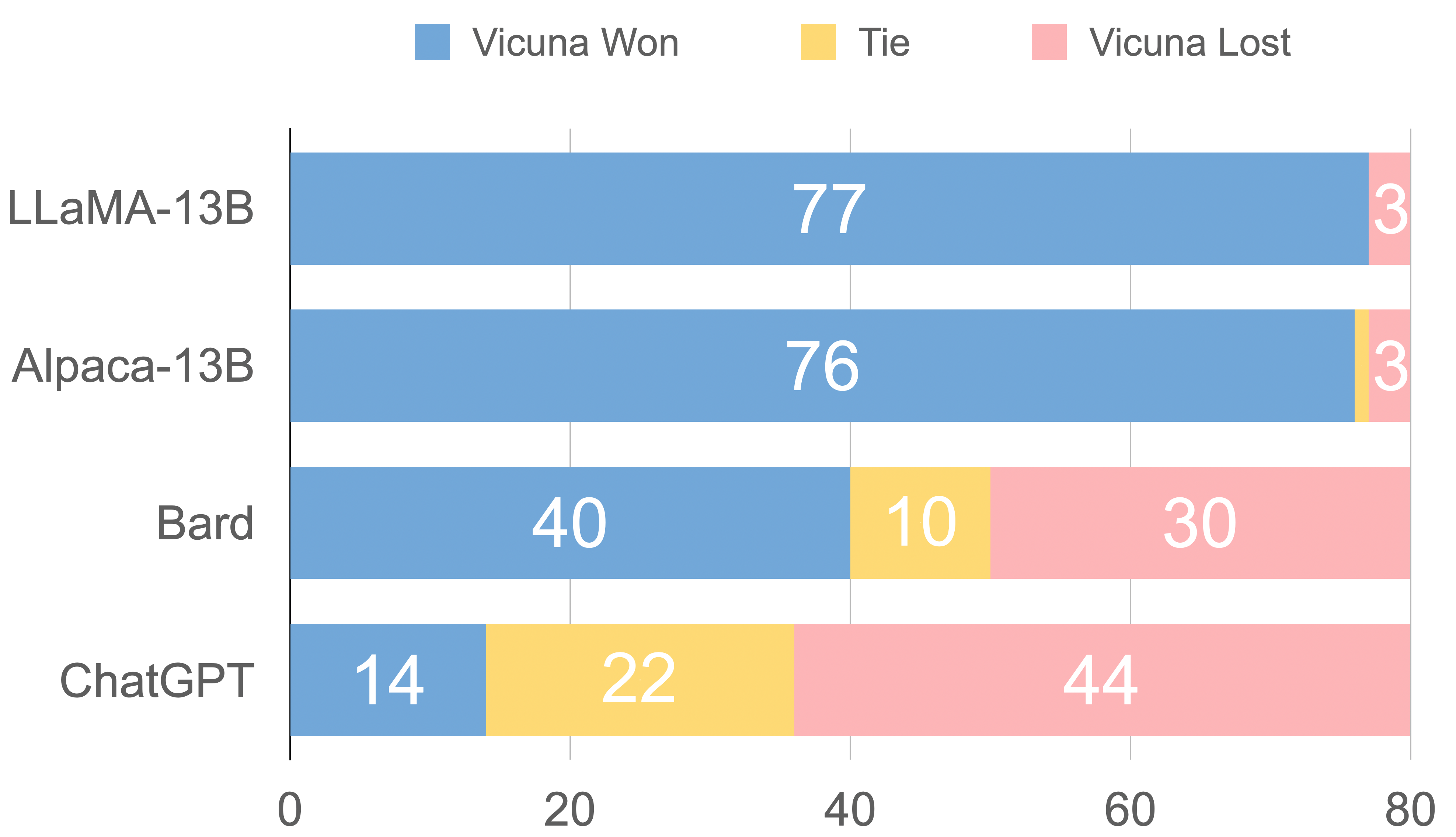
Figure 4. Stacked bar chart illustrating Vicuna-13B's comparative win/tie/loss rates against LLaMA-13B, Alpaca-13B, Bard, and ChatGPT based on GPT-4's evaluation.
Despite these results, Vicuna-13B exhibits lower effectiveness in specialized domains such as mathematics, reasoning, and programming when compared to the latest proprietary models, including GPT-3.5 and GPT-4. This indicates a proficiency for general conversation and writing tasks, but reveals limits in more technical areas.
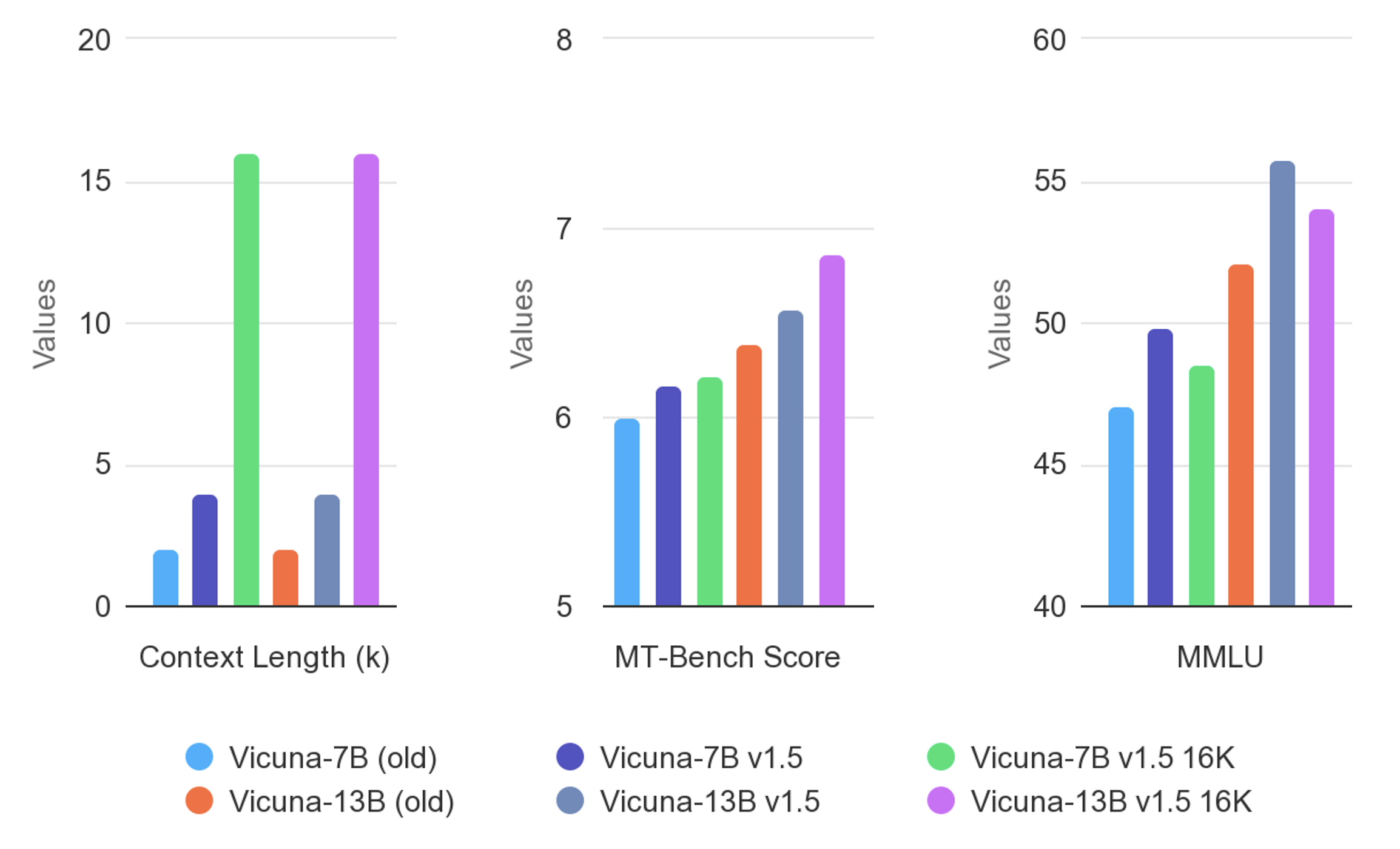
Figure 5. Comparative evaluation graphs for different Vicuna versions, covering context length, MT-Bench score, and MMLU benchmarks.
Training Data and Methodology
Vicuna-13B leverages a data-driven approach, utilizing conversation datasets sourced primarily from the ShareGPT platform. These datasets comprise user-contributed, multi-turn dialogues with ChatGPT, supporting the development of more contextually aware chatbot responses. The fine-tuning process incorporates techniques first established in Stanford Alpaca, but with critical modifications such as tuning specifically on the chatbot-generated outputs for improved dialogue consistency. The model's training process emphasizes memory efficiency to allow for larger context lengths, with further cost optimizations achieved by utilizing tools like SkyPilot to manage compute resources.
Applications, Limitations, and Model Family
Vicuna-13B is primarily targeted for research applications, such as large language model development, chatbot prototyping, and benchmarking studies. It provides an accessible platform for experimentation in NLP and is particularly suited for researchers and practitioners interested in open research ecosystems.
As with many large language models, Vicuna-13B has certain limitations. Its performance in abstract reasoning, mathematics, and coding remains behind that of contemporary proprietary models. Additionally, while it achieves strong general conversational ability, there exist concerns regarding self-identification, factual precision, and the potential for generating biased or unsafe outputs. The evaluation methodology—often relying on "LLM-as-a-judge" techniques using models like GPT-4—also introduces biases, such as position or verbosity bias, which are the subject of ongoing research and refinement, as explored in the MT-Bench paper.
Vicuna-13B is part of a broader family of models sharing the LLaMA foundation, including related variants like Vicuna-7B and models such as Alpaca-13B, but distinguishes itself through enhancements in conversational quality and extended context handling.
Licensing and Availability
Vicuna-13B is distributed under the Llama 2 Community License Agreement due to its reliance on Llama models as a base. Additionally, any use of Vicuna-trained weights and user-shared conversations must adhere to associated terms, including the OpenAI data usage policies and ShareGPT's privacy practices. The supporting codebase is made publicly available under the Apache License 2.0, facilitating broad collaboration within the research community.
Helpful Links
- FastChat GitHub Repository – Source code for model training, inference, and evaluation.
- Vicuna Weights and Usage Instructions – Official access to model weights with setup guidance.
- Vicuna 13B Model Card on Hugging Face – Technical details and updates for Vicuna v1.5.
- Judging LLM-as-a-Judge Paper (arXiv) – Methodology for GPT-4-based benchmarking and evaluation tools.
- LLM-as-a-Judge Evaluation Tool – Implementation of evaluation frameworks for large language models.
- Stanford Alpaca Overview – Foundational project that influenced Vicuna's training regimen.
- Chatbot Arena Leaderboard – Regularly updated comparative benchmarks for conversational AI models.
- Vicuna Version Differences Documentation – Information on updates and changes between Vicuna releases.
- SkyPilot Project – Resource management tool utilized in Vicuna's training infrastructure.
More in the Llama 2 Family
Llama 2 7B
CodeLlama 7B
Vicuna 7B
Pygmalion 2 7B
OpenChat 3.5 7B
Xwin LM 7B
Llama 2 13B
CodeLlama 13B
Nous Hermes 13b
MythoMax L2
WizardLM 13B
Pygmalion 2 13B
Mythalion 13B
Xwin LM 13B
CodeLlama 34B
Llama 2 70B
CodeLlama 70B
Xwin 70B
WizardLM 70B
Nous Hermes Llama 2 70B
Compatible Apps
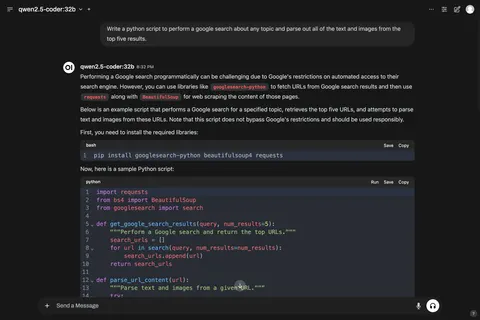
Open WebUI
A polished, self-hosted chat interface for LLMs with Ollama integration, multimodal prompts, and extensive workspace customization.
Web UI
Chat UIs · Beginner Friendly
llama.cpp
GGUF model inference with a polished web UI and OpenAI-format API. CPU-only build — high hardware compatibility, works on any machine without a GPU.
Web UI · API · CLI
LLM Inference · Chat UIs
llama.cpp (CUDA)
GGUF model inference with a polished web UI and OpenAI-format API. CUDA build — GPU-accelerated for NVIDIA GPUs.
Web UI · API · CLI
LLM Inference · Chat UIs
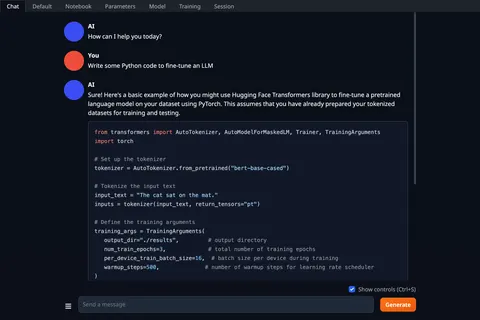
Text Generation Web UI
A feature-rich interface for running and experimenting with open-weight LLMs, including multiple inference backends, plugins, and tuning controls.
Web UI · API
Chat UIs · LLM Inference