Alibaba Cloud
Qwen 1.5 32B
Downloads
Model Report
Overview
Qwen1.5-32B is a large-scale generative language model in the Qwen1.5 series, developed by the Qwen Team and released in February 2024. This model, part of the Qwen lineup, incorporates designs for enhanced alignment, multilingual capabilities, long-context processing, and aims for improved performance across a range of natural language processing tasks.
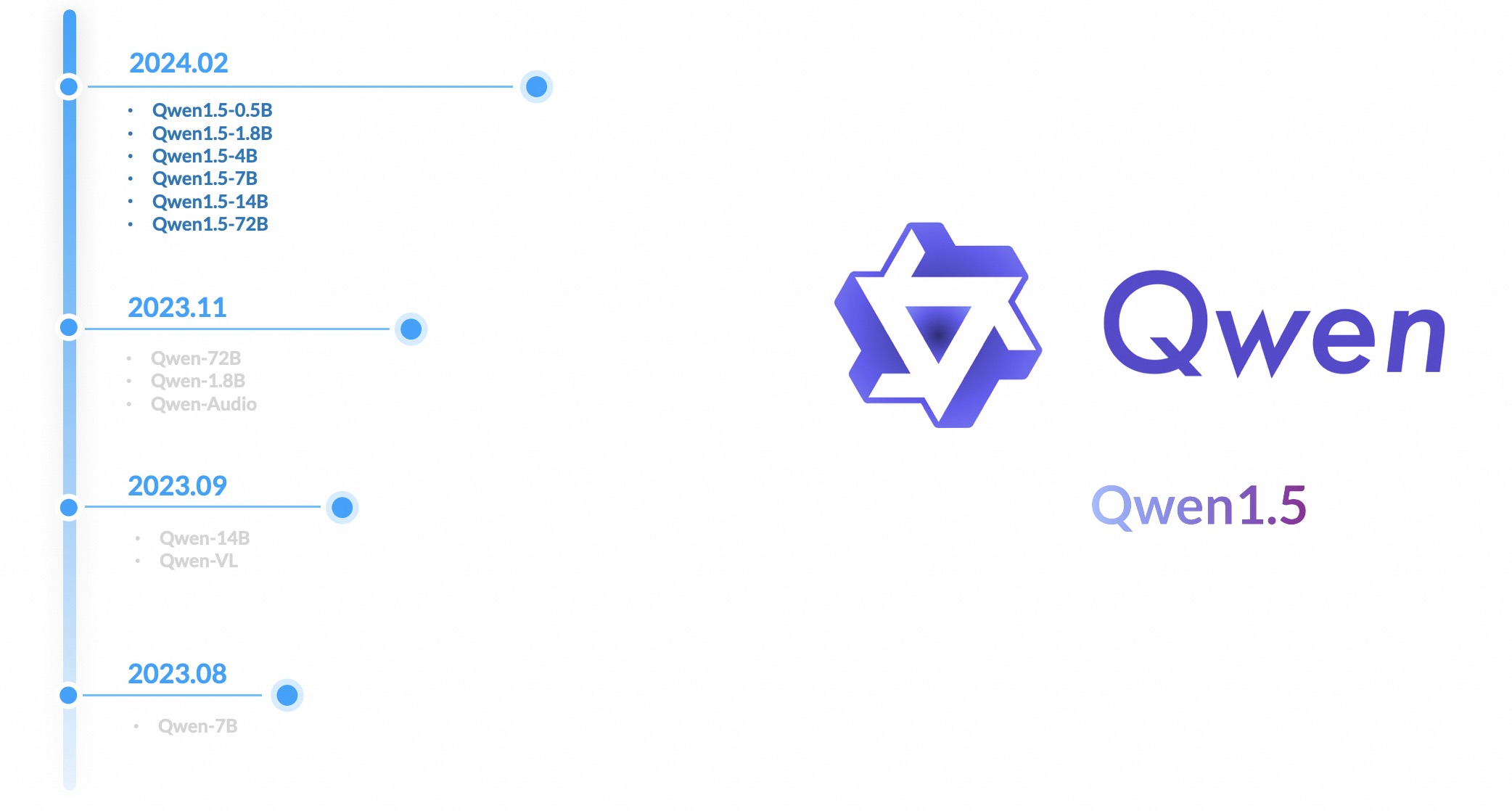
Figure 1. Timeline graphic highlighting releases in the Qwen series, with a focus on the launch of Qwen1.5.
Model Architecture and Training
The Qwen1.5-32B model is built as part of a modular series covering a spectrum of model sizes, from 0.5B to 110B parameters, alongside a mixture-of-experts (MoE) variant. All models in this series are unified by support for an extended context window of up to 32,768 tokens, which enhances their ability to process and retain information over lengthy documents or complex, multi-turn conversations. The architecture is accessible via the Hugging Face Transformers library (version 4.37.0 and above), allowing integration without modification or reliance on custom execution environments, as described in the official Qwen1.5 release documentation.
Alignment to human preferences is achieved using reinforcement learning techniques such as Direct Policy Optimization (DPO) and Proximal Policy Optimization (PPO), which are incorporated during the fine-tuning stages of development. These methods refine the model's tendency to follow human instructions and produce responses that are helpful, accurate, and contextually appropriate, as detailed in the Qwen team's technical blog post. While the specific pretraining datasets employed remain undisclosed, the focus on diverse data and multilingual resources is stated as a priority for broad generalization.
The Qwen1.5-32B model is published in multiple quantized formats, including Int4/Int8 GPTQ, AWQ, and GGUF, enabling efficient inference and adaptation to a range of deployment scenarios.
Performance and Benchmark Evaluation
Qwen1.5-32B demonstrates competitive results across numerous language understanding, reasoning, and coding benchmarks. The base model’s performance includes an MMLU score of 73.4, with scores indicating knowledge and reasoning competencies; a C-Eval score of 83.5; GSM8K at 77.4 for mathematical reasoning; MATH at 36.1; HumanEval at 37.2 for programming tasks; MBPP at 49.4; BBH at 66.8; and CMMLU at 82.3. These results, published in the Qwen1.5 performance overview, indicate its performance relative to peer language models of similar scale.
Although the Qwen1.5-32B model's multilingual and tool-use specific results are less extensively documented than those of larger siblings such as Qwen-1_5-72B, the series as a whole exhibits capabilities in language understanding, translation, and code-related tasks. The model family has been evaluated using benchmarks such as MT-Bench and AlpacaEval v2 for instruction following, L-Eval for long context handling, RGB for retrieval-augmented generation, and additional assessments for code interpretation and tool use.
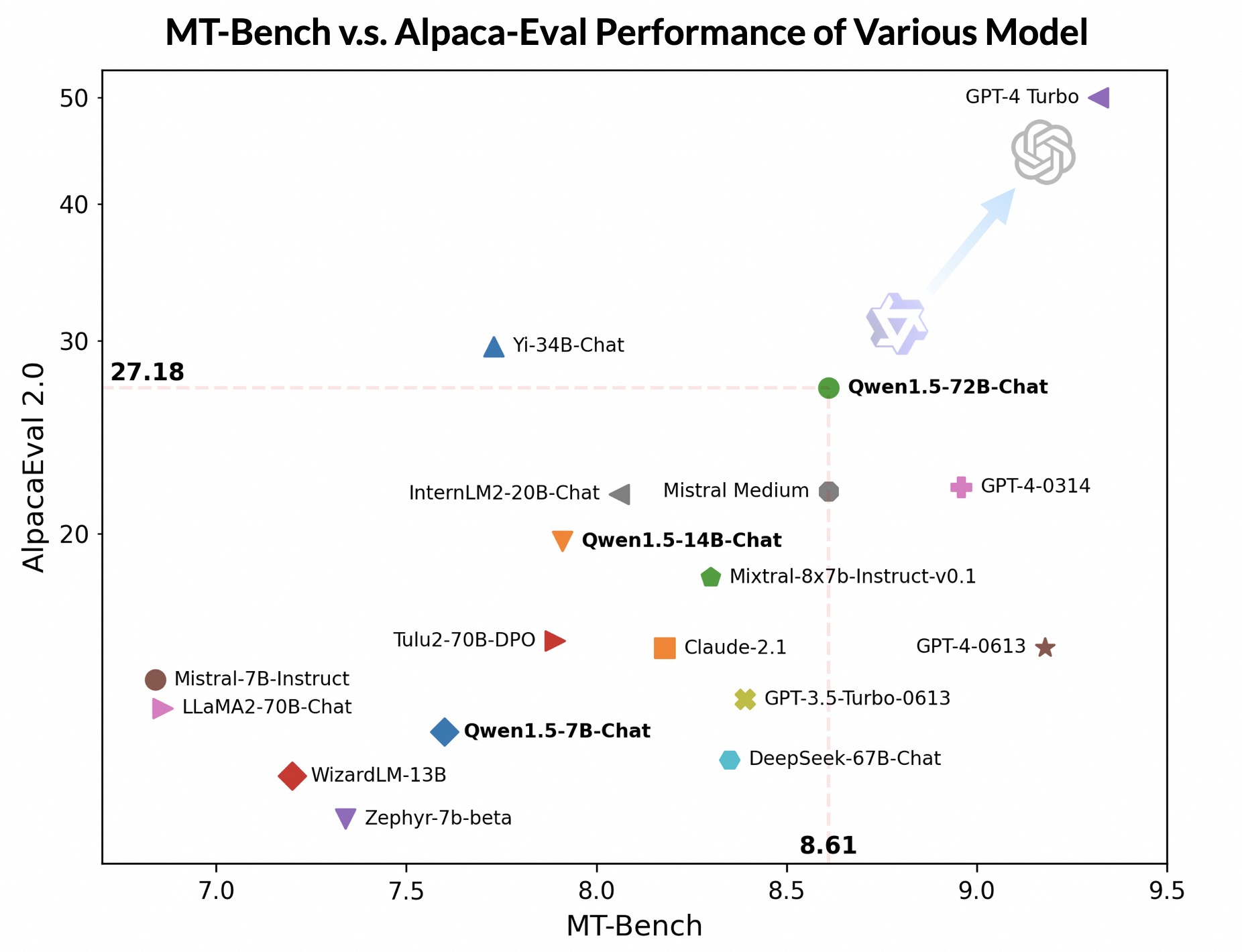
Figure 2. Scatter plot comparing alignment with human preferences across Qwen1.5 and other prominent language models on MT-Bench and AlpacaEval 2.0.
Multilinguality and Context Handling
Qwen1.5-32B includes support for multiple languages spanning Europe, East Asia, and Southeast Asia, with demonstrable performance across exams, translation, comprehension, and mathematical reasoning tasks. The design emphasizes uniform multilingual evaluation and large context capacity, allowing applications in translation, cross-lingual information retrieval, and multilingual dialogue.
Illustrative results in the broader Qwen1.5 family indicate score parity or, in some cases, an advantage compared to other leading models in multilingual benchmarks, as highlighted in bar charts comparing Qwen-1_5-72B-Chat with models like GPT-3.5 across languages such as Arabic, French, Vietnamese, Korean, Japanese, and others in a performance comparison.
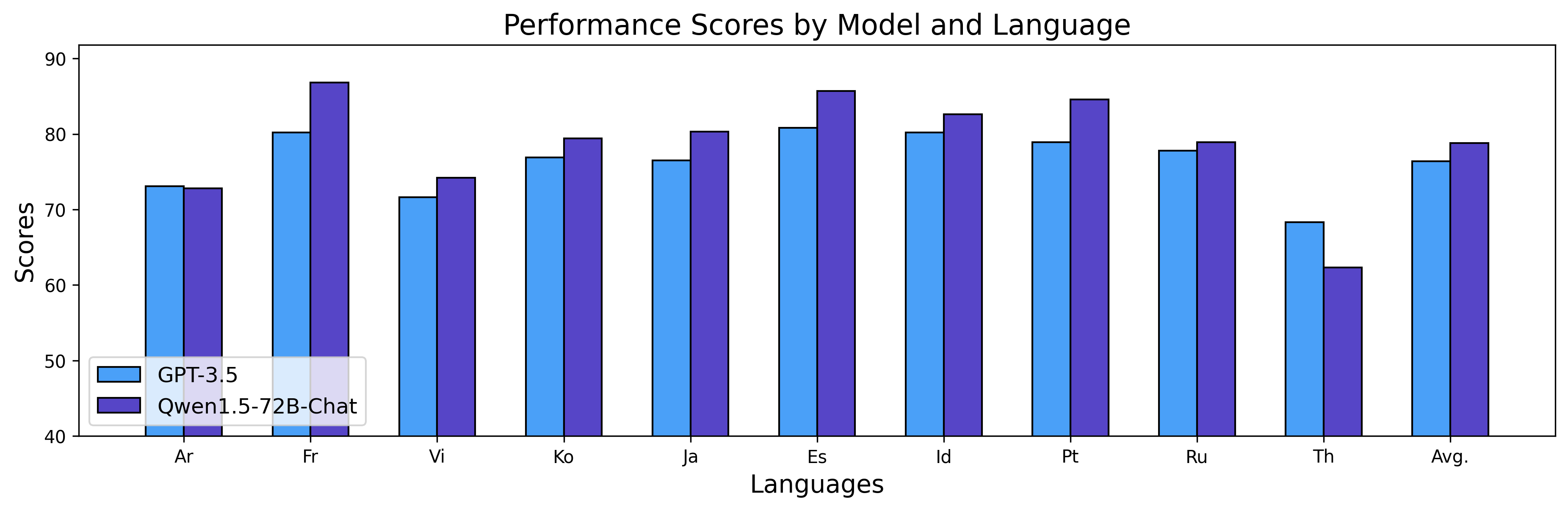
Figure 3. Bar chart comparing multilingual evaluation scores between Qwen1.5-72B-Chat and GPT-3.5 across various languages.
The consistent support for context lengths up to 32,768 tokens increases usability in scenarios requiring rich document understanding and handling of complex multi-step instructions without premature truncation or loss of coherence.
Integration, Alignment, and System Connectivity
Beyond core language modeling, Qwen1.5-32B is developed with capabilities for integration with external systems. Features include support for retrieval-augmented generation (RAG), enabling the use of up-to-date or private knowledge via connected external databases or APIs. The model series is also designed for API-based interaction, function/tool calling, and interaction with agent-oriented frameworks.
Alignment with human intent and safety guidelines is addressed via the aforementioned DPO and PPO training regimes. These steps contribute to instruction-following reliability and human-aligned outputs, validated through comprehensive crowd-sourcing and evaluation results in alignment-oriented benchmarks, as described in the Qwen1.5 technical overview.
Comparative Position and Limitations
Within the Qwen1.5 series, the 32B model occupies a middle-size tier, offering a balance between scale and resource efficiency. Larger siblings, such as Qwen-1_5-72B, are reported to outperform models like Llama-2-70B across diverse metrics and demonstrate high scores in alignment and multilingual evaluations. However, on code interpretation and visual reasoning tasks, the series is noted to trail behind frontier models such as GPT-4, particularly in tool-use and math-centric reasoning.
While the models achieve parity in many multi-turn, chat, and reasoning benchmarks, ongoing work is planned by the Qwen Team to bolster code reasoning and interpreter accuracy, as noted in the model’s official blog announcement.
Applications and Use Cases
Qwen1.5-32B finds application across a wide range of domains, including language comprehension and generation, coding assistance, complex reasoning, multilingual dialogue, retrieval-augmented workflows, and integration with agent frameworks capable of tool invocation. Fine-tuning support and configurability allow adaptation to specialized domains and research. Local inference in quantized formats and integration with open-source tools further extend practical accessibility.
Helpful Links
- Qwen1.5 Blog (Traditional Chinese)
- Qwen1.5 GitHub Repository
- Qwen Hugging Face Profile
- Qwen ModelScope Organization
- Qwen1.5-72B-Chat Demo
- MT-Bench Benchmark Information
- L-Eval Benchmark
- RGB RAG Benchmark (arXiv)
- SGLang GitHub Repository
- AutoAWQ GitHub Repository
- LLaMA-Factory GitHub Repository
- llama.cpp GitHub Repository
- LlamaIndex Website
- LangChain Website
- CrewAI Website
More in the Qwen 1 Family
More from Alibaba Cloud
Qwen3 0.6B
Qwen3 1.7B
Qwen3 4B
Qwen3 8B
Qwen3 14B
Qwen3 32B
Qwen3 30B A3B
Qwen3 235B A22B
Qwen2.5 VL 3B
Qwen2.5 VL 7B
Qwen2.5 VL 72B
QwQ 32B Preview
QwQ 32B
Qwen 2.5 Math 1.5B
Qwen 2.5 Math 7B
Qwen 2.5 Math PRM 7B
Qwen 2.5 Math 72B
Qwen 2.5 Math PRM 72B
Qwen 2.5 Coder 7B
Qwen 2.5 Coder 32B
Qwen 2.5 7B
Qwen2.5 7B 1M
Qwen 2.5 14B
Qwen2.5 14B 1M
Qwen 2.5 32B
Qwen 2.5 72B
Qwen 2 7B
Qwen 2 72B
Compatible Apps
Open WebUI
A polished, self-hosted chat interface for LLMs with Ollama integration, multimodal prompts, and extensive workspace customization.
Web UI
Chat UIs · Beginner Friendly
llama.cpp
GGUF model inference with a polished web UI and OpenAI-format API. CPU-only build — high hardware compatibility, works on any machine without a GPU.
Web UI · API · CLI
LLM Inference · Chat UIs
llama.cpp (CUDA)
GGUF model inference with a polished web UI and OpenAI-format API. CUDA build — GPU-accelerated for NVIDIA GPUs.
Web UI · API · CLI
LLM Inference · Chat UIs
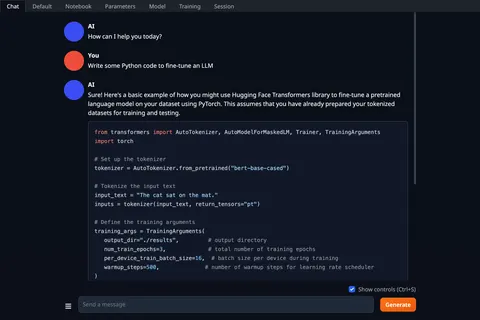
Text Generation Web UI
A feature-rich interface for running and experimenting with open-weight LLMs, including multiple inference backends, plugins, and tuning controls.
Web UI · API
Chat UIs · LLM Inference