Mistral AI
Mistral Small 3 (2501)
Downloads
Model Report
Overview
Mistral Small 3 (2501) is a 24-billion-parameter instruction-fine-tuned large language model (LLM) developed by Mistral AI. Released on January 30, 2025, Mistral Small 3 is positioned in the "small" LLM category (models with fewer than 70 billion parameters), demonstrating instruction-following performance, low latency, and competitive benchmark results across a variety of natural language tasks. The model is built upon the Mistral-Small-24B-Base-2501 foundation, emphasizing efficiency and versatility while adopting an Apache 2.0 license for broad accessibility.
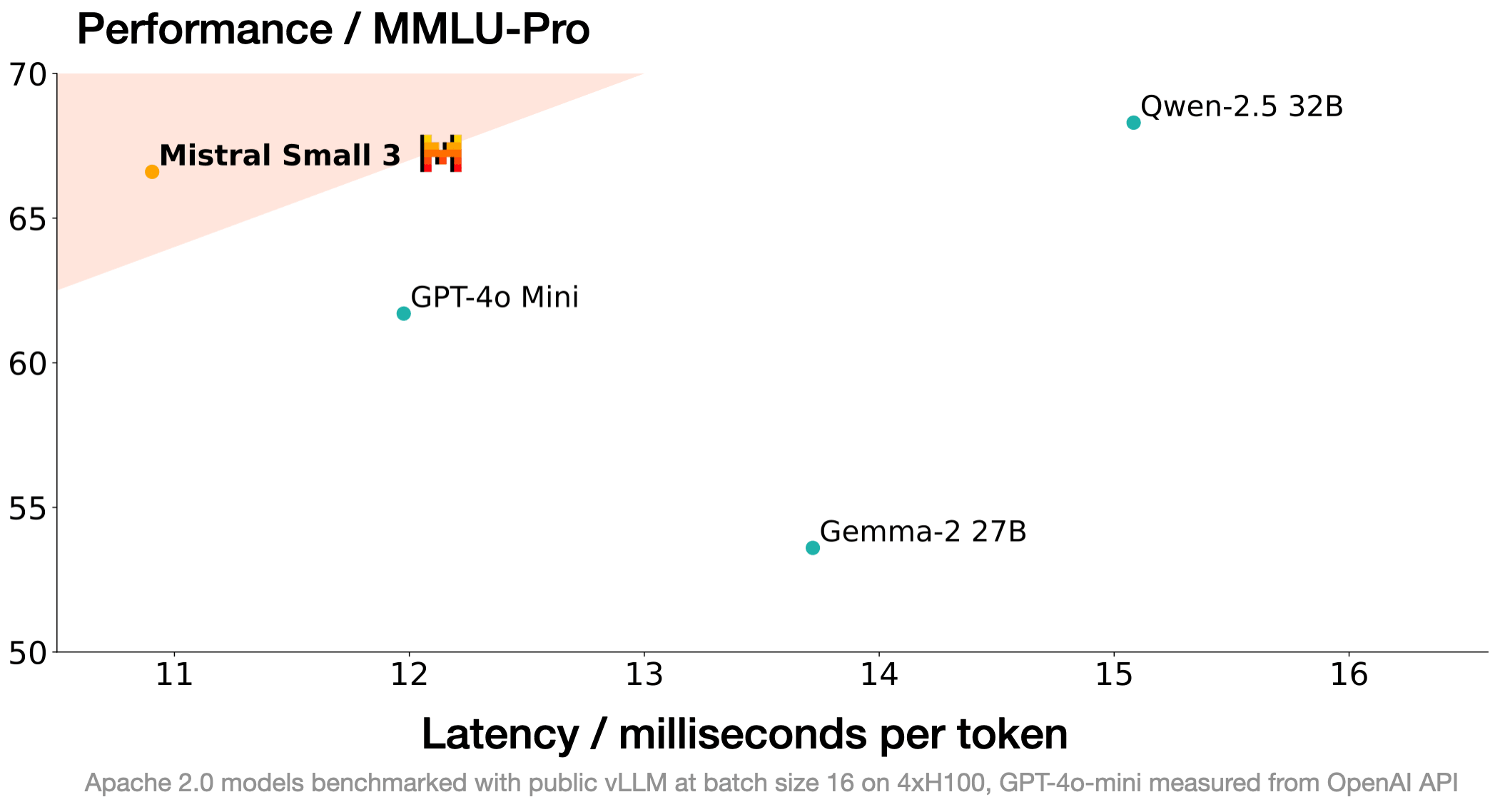
Figure 1. A performance versus latency scatter plot shows Mistral Small 3 positioned in an optimal region relative to peer models, according to MMLU-Pro and ms/token benchmarks.
Model Architecture and Training
Mistral Small 3 comprises 24 billion parameters and utilizes an architecture explicitly designed for high efficiency and responsiveness. It features a streamlined configuration with fewer layers than many competing models, which can reduce time per forward pass. The model offers a 32,000-token context window, allowing it to effectively handle extended conversations or analyses. Multilingual capabilities are intrinsic to the design; Mistral Small 3 can process and generate text in languages including English, French, German, Spanish, Italian, Chinese, Japanese, Korean, Portuguese, Dutch, and Polish.
Instruction fine-tuning is a core aspect of this model, with the training pipeline avoiding both reinforcement learning and the use of synthetic data, as documented in the official announcement. The tokenizer deployed is the Tekken tokenizer, which leverages a 131,000-token vocabulary for effective text processing. The training corpus covers data up to October 2023, with subsequent instruction tuning designed to maximize generalist performance.
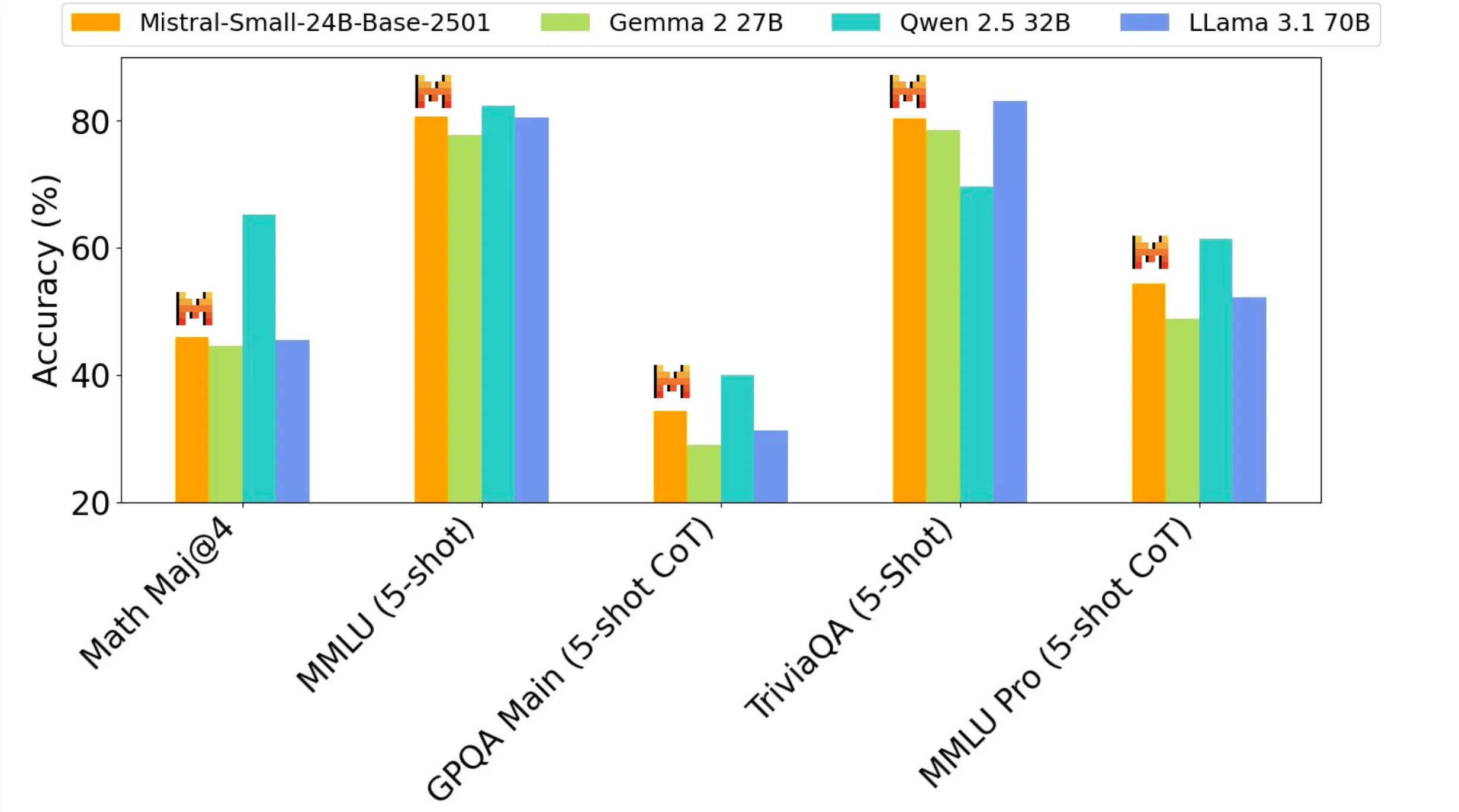
Figure 2. Bar chart showing comparative pretraining performance on multiple tasks, highlighting the metrics for Mistral-Small-24B-Base-2501 against [Gemma 2 27B](https://openlaboratory.ai/models/gemma-2-27b), [Qwen 2.5 32B](https://openlaboratory.ai/models/qwen-2_5-32b), and [Llama 3.1 70B](https://openlaboratory.ai/models/llama3_1-70b) across accuracy-based benchmarks.
Performance and Benchmarking
Mistral Small 3 demonstrates competitive performance according to both human evaluations and standardized public benchmarks. In human preference assessments conducted with external third-party vendors across 1,000+ prompts, responses from Mistral Small 3 were rated as preferred to those from other models, including Gemma-2 27B, Qwen-2.5 32B, Llama-3.3 70B, and GPT-4o-mini.
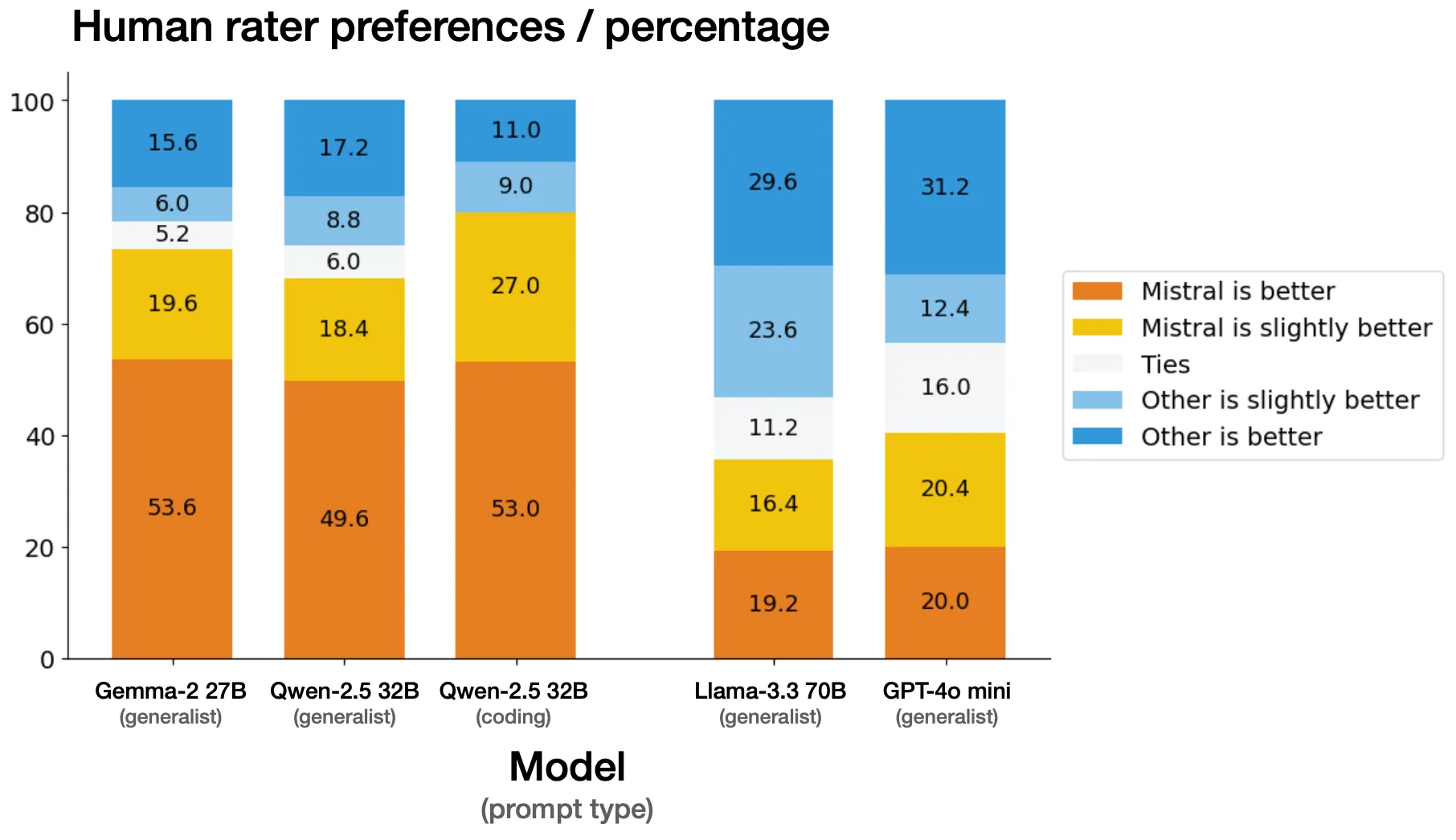
Figure 3. Human rater preferences exhibit competitive outcomes for Mistral Small 3, particularly against [Gemma-2 27B](https://openlaboratory.ai/models/gemma-2-27b) and [Qwen-2.5 32B](https://openlaboratory.ai/models/qwen-2_5-32b), as observed in this benchmark comparison.
Quantitative benchmarks further support these findings. On the MMLU Pro (5-shot) and GPQA main benchmarks, Mistral Small 3 achieves scores comparable to or exceeding other models in its category:
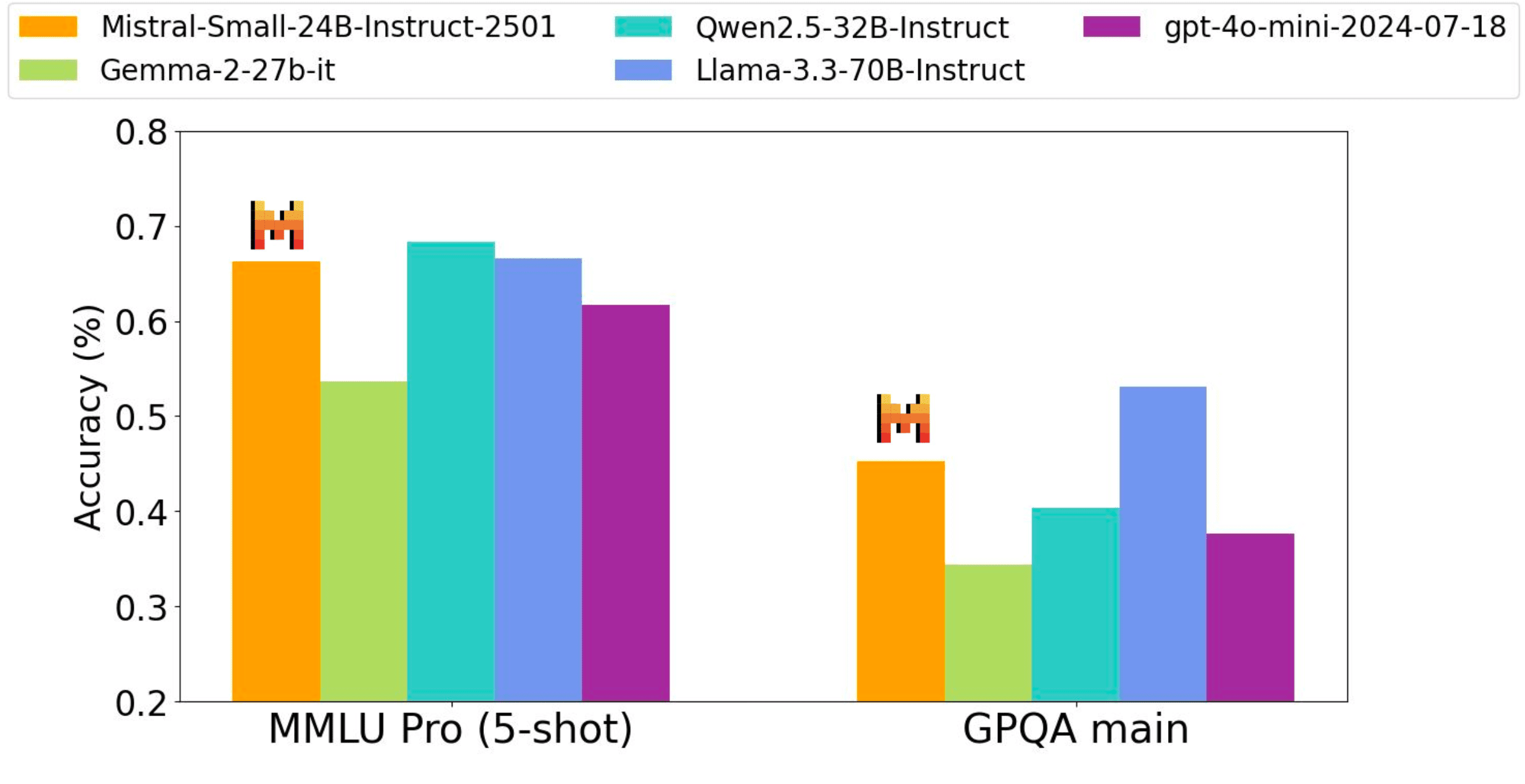
Figure 4. The model's performance is visualized across general knowledge benchmarks MMLU Pro (5-shot) and GPQA main, compared to peer models.
For code generation and mathematical reasoning, Mistral Small 3 demonstrates competitive results in HumanEval and Math Instruct evaluations:
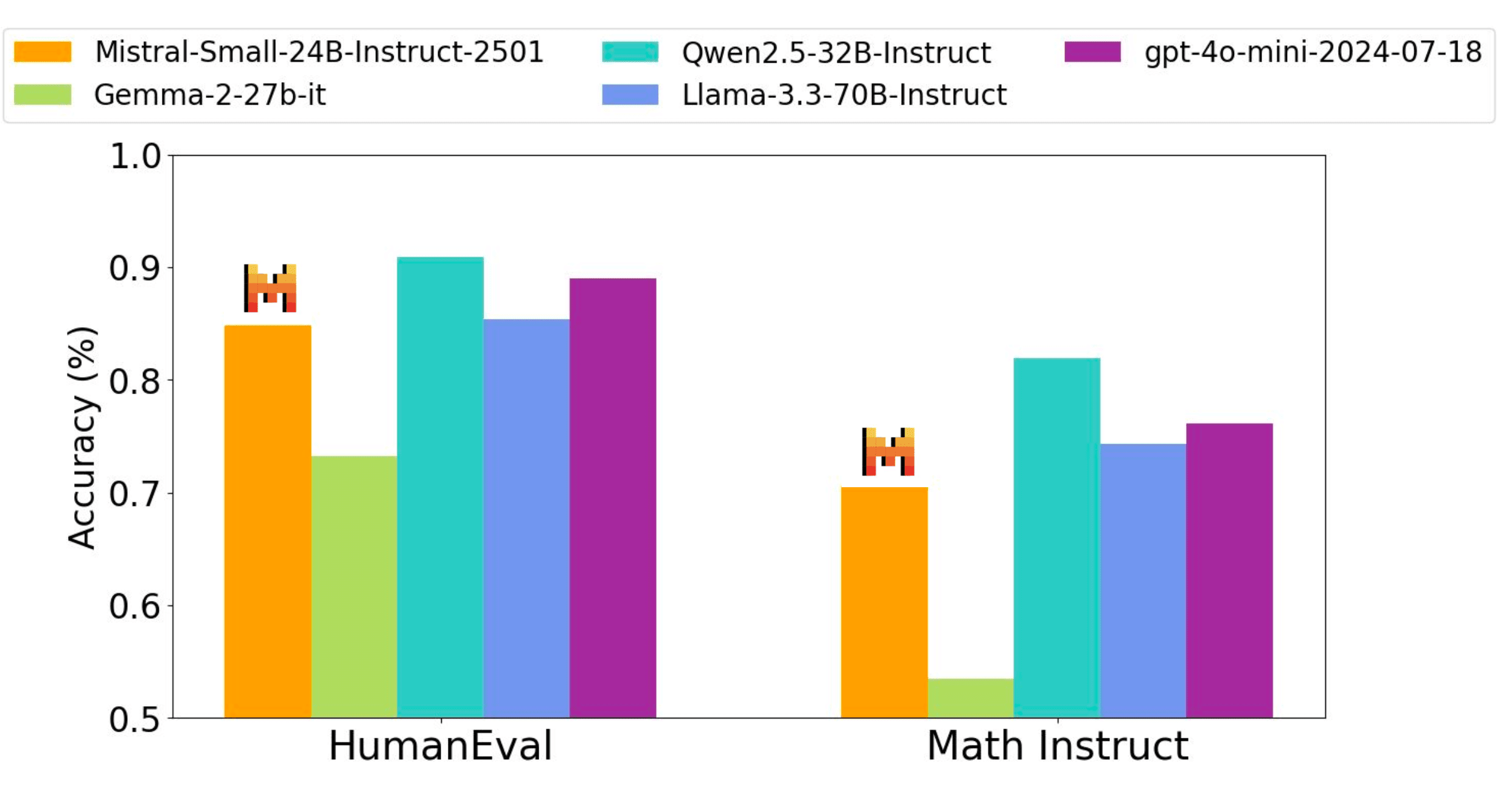
Figure 5. Benchmarking results indicate performance by Mistral Small 3 in code and math tasks alongside models like [Llama-3.3 70B](https://openlaboratory.ai/models/llama3_3-70b) and [Qwen-2.5 32B](https://openlaboratory.ai/models/qwen-2_5-32b).
Instruction-following accuracy, a characteristic of Mistral Small 3, is illustrated by its results on Wildbench, Arena Hard, MTBench, and IFEval:
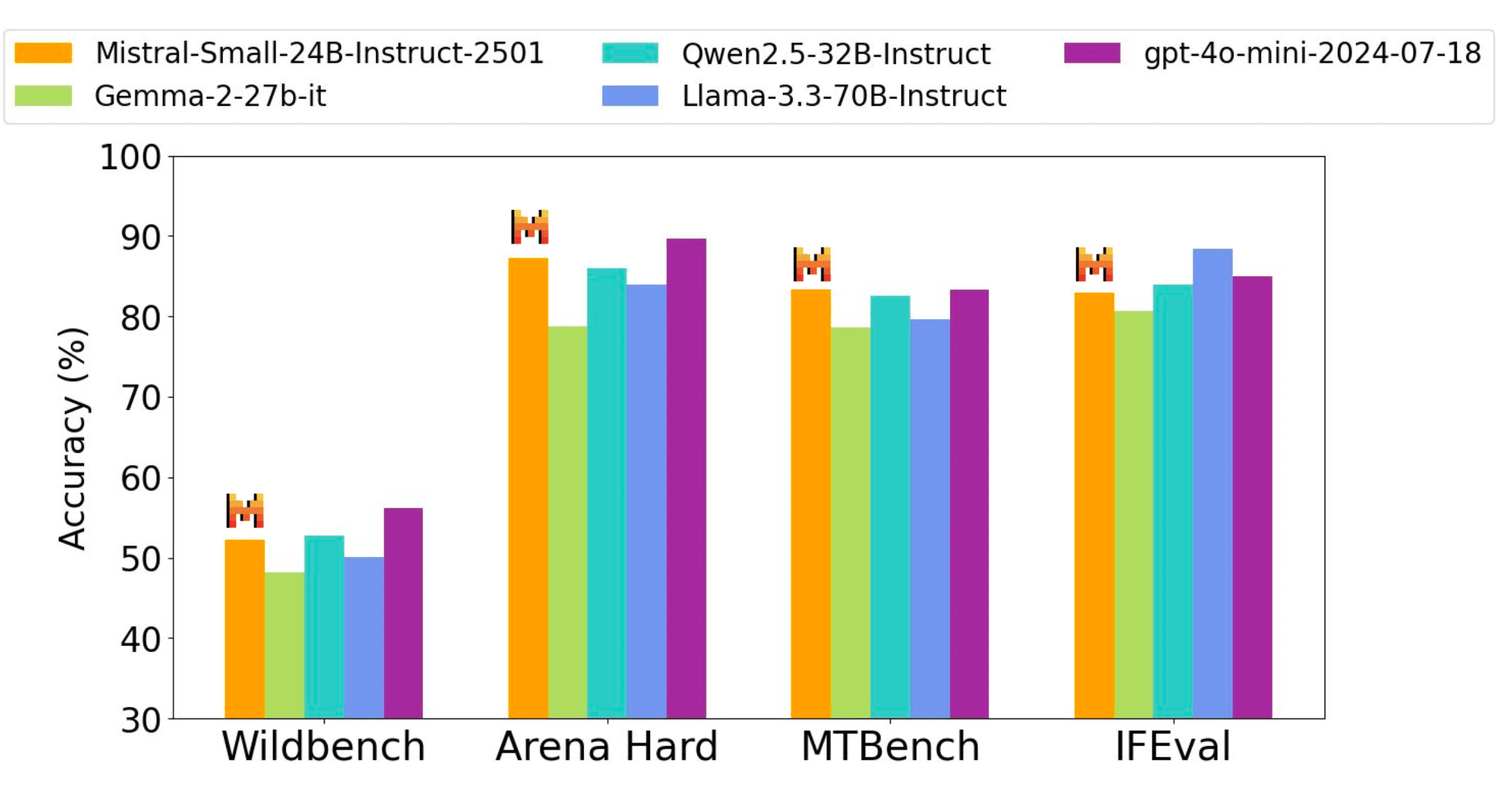
Figure 6. Mistral Small 3 demonstrates competitive instruction-following performance across four popular benchmarks.
Additionally, multilingual capabilities are highlighted in evaluations on language-specific MMLU benchmarks:
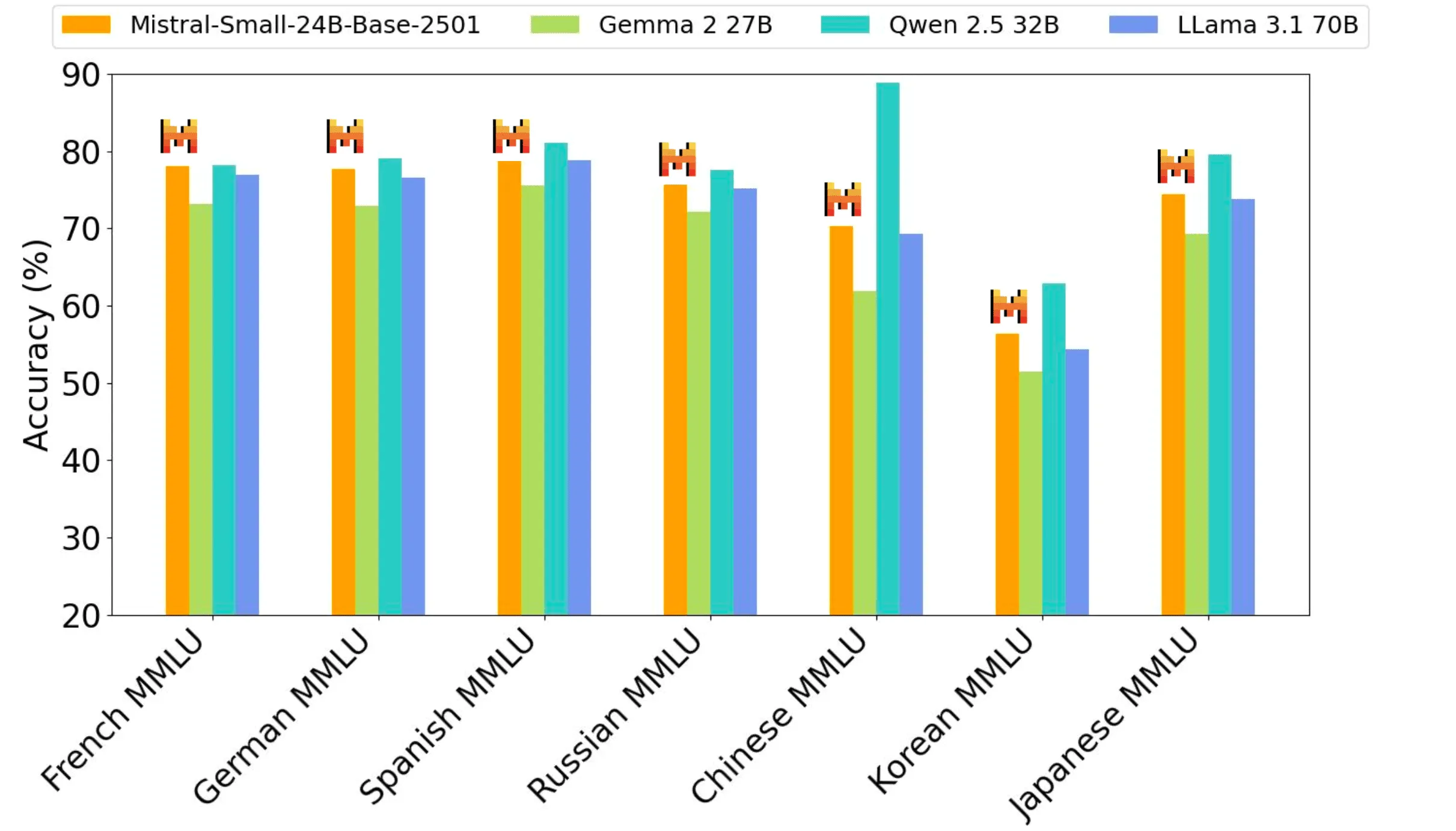
Figure 7. The bar chart illustrates the multilingual MMLU benchmark results, where Mistral Small 3 exhibits consistent accuracy across several non-English languages.
Efficiency and Deployment
Mistral Small 3 was optimized for low-latency inference, capable of producing up to 150 tokens per second. Its efficient architecture enables compatibility with a variety of deployment scenarios, including local and edge environments. When quantized, the model can be operated on single commercial GPUs or consumer hardware, making it suitable for privacy-sensitive and latency-critical applications. The model conforms to the V7-Tekken instruct template, supporting advanced system prompting and consistent instruction following.
The recommended inference temperature is 0.15 for production settings. System prompts can be formatted to ensure the model reliably disclaims uncertainty and requests clarification from users when required. For practical deployment, frameworks such as vLLM and Transformers are supported, as well as compatibility with Ollama for local inference.
Applications and Use Cases
Mistral Small 3 addresses a broad range of generative AI applications. Its capabilities including rapid instruction following, conversational engagement, and agentic workflows facilitate deployment as a foundation for virtual assistants, subject matter specialists through domain-specific fine-tuning, and automated function-calling agents within complex systems. The capacity for local inference supports scenarios with heightened privacy requirements, such as internal organizational workflows or industries handling sensitive data, including finance, healthcare, manufacturing, and customer service.
Limitations
While Mistral Small 3 provides generalist performance, it is not enhanced with reinforcement learning from human feedback (RLHF) or synthetic data, as noted in Mistral's technical release. This design choice positions the model in a specific segment of the generative model pipeline, focusing on reproducibility and interpretability.
Licensing and Model Access
Mistral Small 3 is distributed under the Apache 2.0 License, enabling both commercial and non-commercial modification and usage. This licensing paradigm aligns with Mistral AI’s stated intention to contribute general-purpose models to the open-source community. The model and associated resources are available via Mistral’s public repositories and documentation.
Helpful External Links
More in the Mistral Family
Mistral Large 2
Behemoth 123B v1.2
Mistral Small (2409)
Mistral Small 3.2 (2506)
Mistral Small 3.1 (2503)
Harbinger 24B
Devstral Small 1.0
Cydonia 24B v2
Dolphin 3.0 Mistral 24B
Mistral NeMo 12B
Rocinante 12B v1.1
More from Mistral AI
Mistral 7B
Codestral 22B v0.1
Mixtral 8x7B
Mixtral 8x22B
Compatible Apps
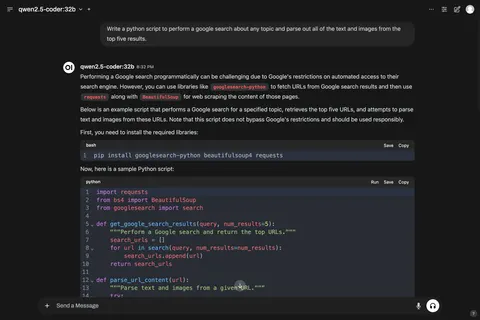
Open WebUI
A polished, self-hosted chat interface for LLMs with Ollama integration, multimodal prompts, and extensive workspace customization.
Web UI
Chat UIs · Beginner Friendly
llama.cpp
GGUF model inference with a polished web UI and OpenAI-format API. CPU-only build — high hardware compatibility, works on any machine without a GPU.
Web UI · API · CLI
LLM Inference · Chat UIs
llama.cpp (CUDA)
GGUF model inference with a polished web UI and OpenAI-format API. CUDA build — GPU-accelerated for NVIDIA GPUs.
Web UI · API · CLI
LLM Inference · Chat UIs
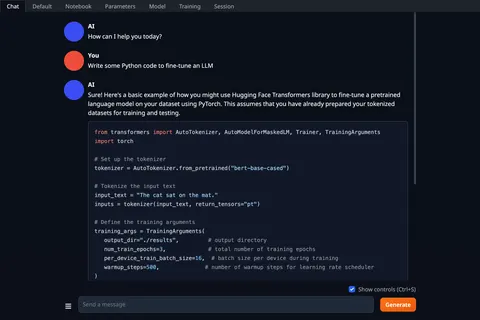
Text Generation Web UI
A feature-rich interface for running and experimenting with open-weight LLMs, including multiple inference backends, plugins, and tuning controls.
Web UI · API
Chat UIs · LLM Inference