Mistral AI
Devstral Small 1.0
Downloads
Model Report
Overview
Devstral is a specialized large language model (LLM) collaboratively developed by Mistral AI and All Hands AI, purpose-built for software engineering tasks. Finetuned from Mistral-Small-3.1, Devstral is engineered to act as an agentic coding assistant, with capabilities for codebase exploration, multi-file editing, and integration within software engineering agents. Released under the Apache 2.0 License on May 21, 2025, Devstral is available for both commercial and non-commercial uses and is positioned as a research preview to foster feedback and further development.
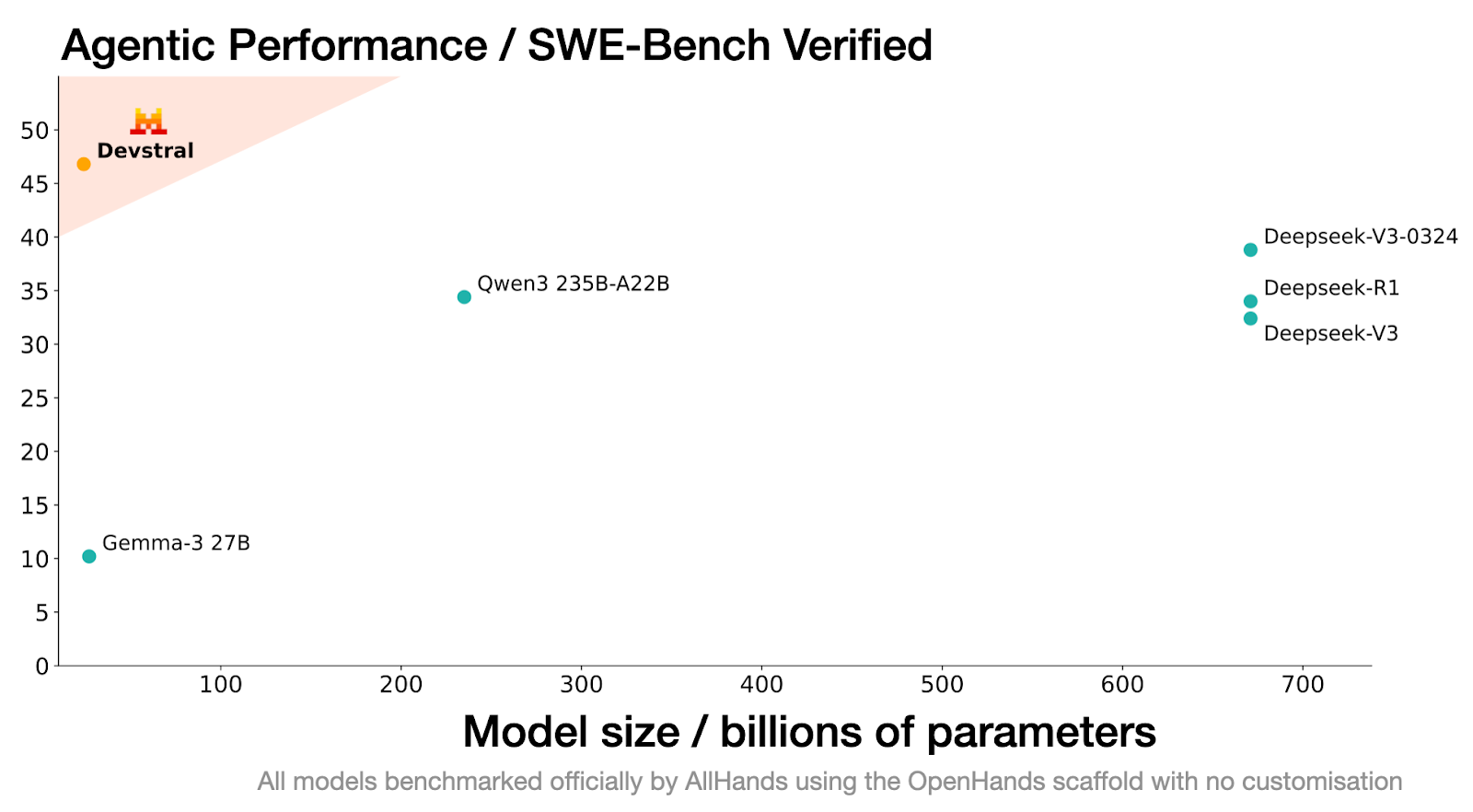
Figure 1. Agentic Performance: Chart comparing Devstral with peer models on SWE-Bench Verified, showing its competitive performance relative to model size.
Technical Specifications and Architecture
Devstral is finetuned from Mistral-Small-3.1. It has a parameter count of 23.6 billion. The model features a context window of up to 128,000 tokens, allowing for extended reasoning and manipulation within large codebases. Devstral employs the Tekken tokenizer with a vocabulary size of 131,000 tokens, optimizing input and output handling for coding-oriented tasks. To focus exclusively on textual inputs relevant to software engineering, the vision encoder from its base model has been removed, making Devstral a text-only LLM.
The model’s architecture is tailored for agentic workflows. It enables contextual analysis across multiple files, identifies software component relationships, and assists in diagnosing code issues, which are functions for software engineering automation.
Training Methodology and Datasets
Devstral’s training regimen emphasizes real-world applicability to modern software engineering challenges. The model is trained to address GitHub issues using open-source agent scaffolds such as OpenHands and SWE-Agent. These scaffolds define interaction protocols between the model, codebases, and automated test cases, providing a framework for the model to learn how to effect multi-step code changes and verify correctness. Through this approach, Devstral is equipped to reason about, edit, and validate software repositories.
Benchmark Performance
Devstral demonstrates results in software engineering benchmarks, particularly on the SWE-Bench Verified evaluation. Utilizing the OpenHands scaffold for testing, Devstral achieves a score of 46.8%, outperforming previous open-source models by over 6 percentage points.

Figure 2. SWE-Bench Benchmark Results: Devstral's performance compared to other models by size and verified solution rate.
Compared with similarly or larger-scaled models tested on the same scaffold, Devstral exceeds the performance of Claude 3.5 Haiku (40.6%), SWE-smith-LM 32B (40.2%), GPT-4.1-mini (23.6%), Deepseek-V3-0324 (38.8%, 671B), and Qwen3 232B-A22B (34.4%, 232B) models, as documented in benchmark summaries.
Usage Scenarios and Applications
Devstral is built for deployment within agentic software engineering systems. Its compact size facilitates local or on-device operation, which can be relevant for privacy-sensitive environments and integration into continuous integration/deployment workflows. Its primary applications include automated and interactive codebase analysis, bug detection, multi-file code editing, and test suite augmentation.
A common use case is repository test coverage analysis. Devstral can assess, aggregate, and visualize code test metrics, enabling identification of poorly covered modules and supporting targeted improvement.

Figure 3. Test Coverage Distribution: Devstral-generated pie chart of test coverage across files, produced in response to an analysis prompt.

Figure 4. Module-Level Detail: Horizontal bar chart of test coverage by module, produced by Devstral when prompted for detailed repository analysis.
In addition, Devstral can be embedded within agentic coding platforms and IDE plugins, functioning as a backend for interactive code completion, autonomous pull request generation, and resolution of multi-step tasks.

Figure 5. To-Do List App Output: Minimalist application interface generated by Devstral as part of the OpenHands agent workflow tutorial.
Model Family and Future Development
Devstral is the first release in a planned family of agentic coding models. Finetuned from Mistral-Small-3.1, it is designed for compatibility with frameworks that define agent actions in software repositories, such as OpenHands. Mistral AI has indicated plans for future commercial and larger-scale agentic coding models featuring greater context lengths and domain adaptation, as outlined in the official announcement.
Limitations and Research Status
Devstral is released as a research preview, and continued improvement is anticipated through community feedback and operational experience. As with any LLM, its outputs are subject to the limitations of its training data and agent scaffold integration, and users are encouraged to validate and review changes proposed by the model in automated coding workflows.
Licensing
Devstral is distributed under the Apache 2.0 License, permitting use, modification, and distribution for both private and commercial applications.
Helpful Links
- Official Devstral Blog Post
- Devstral Model Card on Hugging Face
- Mistral AI Website
- All Hands AI Website
- OpenHands Framework
- OpenHands Installation Documentation
- OpenHands Local LLMs Documentation
- OpenHands Tutorial Video
- vLLM Library
- Mistral Inference Library
- Transformers Library
- Model License Information
More in the Mistral Family
Mistral Large 2
Behemoth 123B v1.2
Mistral Small (2409)
Mistral Small 3.2 (2506)
Mistral Small 3.1 (2503)
Harbinger 24B
Mistral Small 3 (2501)
Cydonia 24B v2
Dolphin 3.0 Mistral 24B
Mistral NeMo 12B
Rocinante 12B v1.1
More from Mistral AI
Mistral 7B
Codestral 22B v0.1
Mixtral 8x7B
Mixtral 8x22B
Compatible Apps
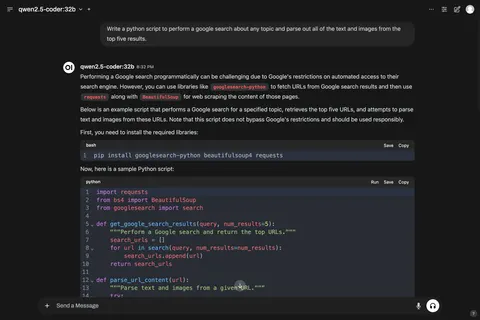
Open WebUI
A polished, self-hosted chat interface for LLMs with Ollama integration, multimodal prompts, and extensive workspace customization.
Web UI
Chat UIs · Beginner Friendly
llama.cpp
GGUF model inference with a polished web UI and OpenAI-format API. CPU-only build — high hardware compatibility, works on any machine without a GPU.
Web UI · API · CLI
LLM Inference · Chat UIs
llama.cpp (CUDA)
GGUF model inference with a polished web UI and OpenAI-format API. CUDA build — GPU-accelerated for NVIDIA GPUs.
Web UI · API · CLI
LLM Inference · Chat UIs
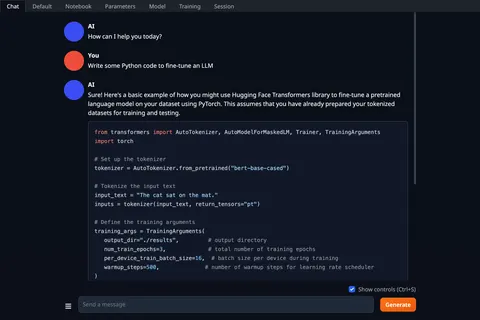
Text Generation Web UI
A feature-rich interface for running and experimenting with open-weight LLMs, including multiple inference backends, plugins, and tuning controls.
Web UI · API
Chat UIs · LLM Inference