Gemma 3n E4B
Downloads
Model Report
Overview
Gemma 3n E4B is a generative artificial intelligence model developed by Google DeepMind for on-device and mobile-first applications, as part of the broader Gemma model family. The model features multimodal capabilities, accepting image, audio, video, and text inputs while producing text outputs. Its architecture is specifically optimized for edge deployment, balancing resource efficiency with performance. This article outlines the architecture, capabilities, performance metrics, training methodology, and typical applications of Gemma 3n E4B within the wider context of generative AI.

Figure 1. LMArena Elo Score benchmark scores: Gemma 3n E4B is shown alongside other proprietary and open models, highlighting its performance among models under 10 billion parameters.
Technical Architecture
Gemma 3n E4B is grounded in a mobile-centric architecture built for both efficiency and versatility. Central to the model is the MatFormer (Matryoshka Transformer) design, which enables elastic inference: a large model contains smaller, fully-operational sub-models. In practice, the E4B model (with 8 billion raw parameters, yielding 4 billion effective parameters) incorporates an E2B sub-model. Developers can operate with either the main E4B model or deploy the E2B, benefiting from up to twice the inference speed.
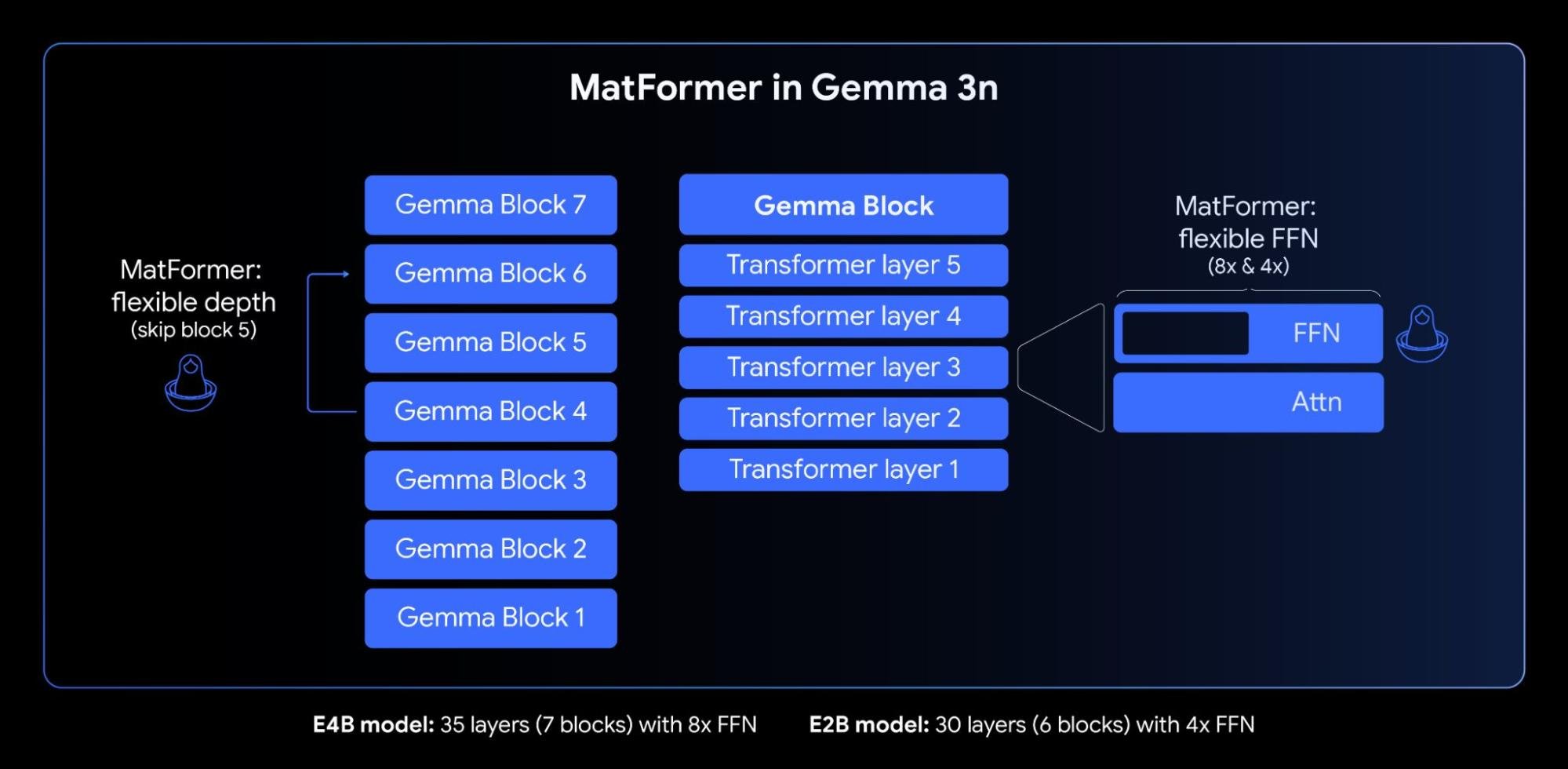
Figure 2. MatFormer architecture diagram: shows how Gemma 3n E4B contains elastic, nested sub-models, allowing custom model sizes and flexible feed-forward network configurations.
The model's architecture supports custom sizing of sub-models via the Mix-n-Match technique, which adjusts the feed-forward network hidden dimensions per layer and can skip entire blocks to optimize for various deployment scenarios. Memory efficiency is further enhanced through Per-Layer Embeddings (PLE), which allow a substantial portion of embeddings to reside in system memory, minimizing the load on the high-speed accelerator memory. This feature is important for running large models on devices with limited computational resources.
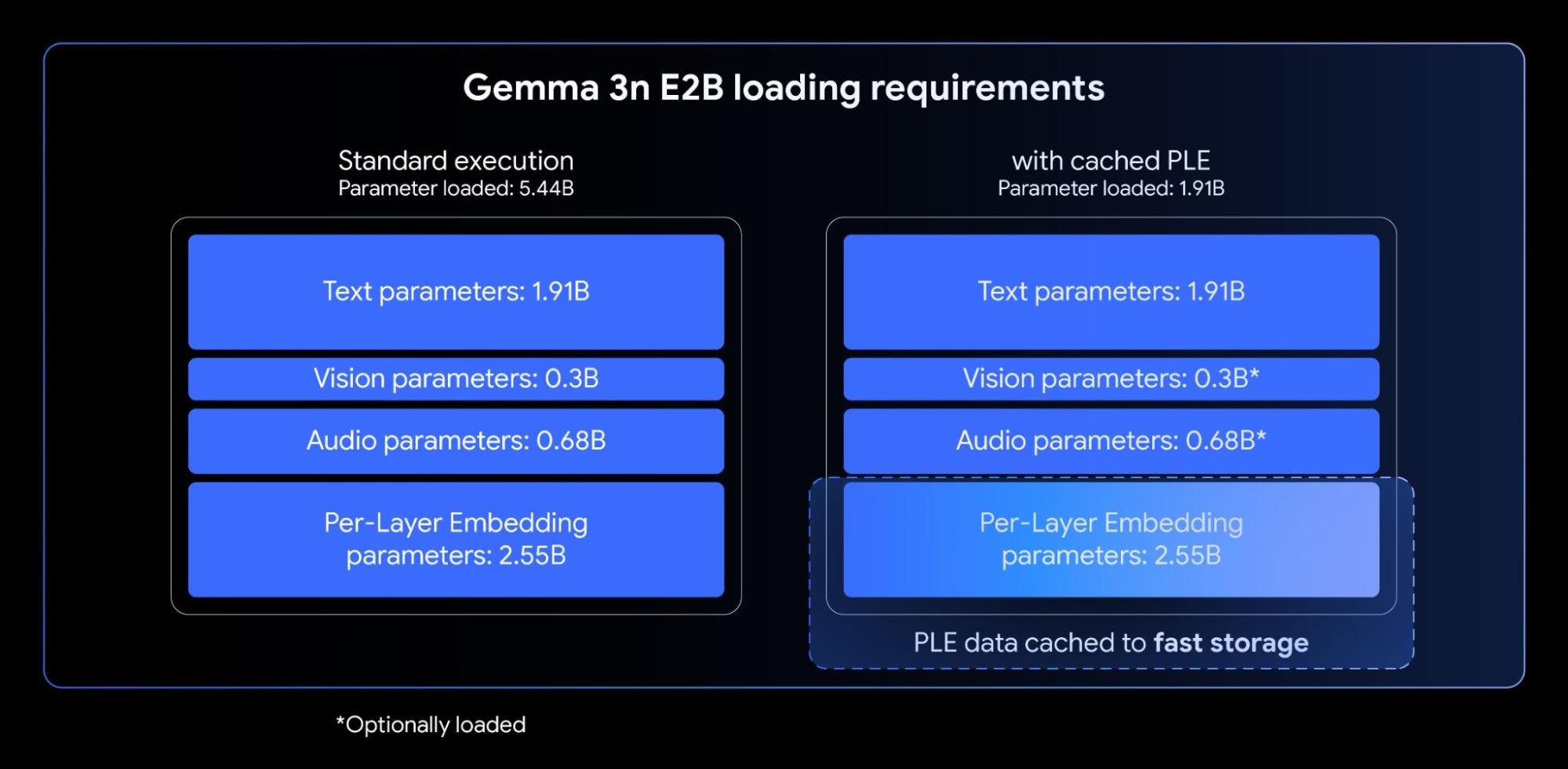
Figure 3. Per-Layer Embeddings (PLE) compare standard and optimized loading requirements, illustrating reduced on-device memory usage for large model deployments.
Efficiency for streaming and real-time applications is improved by KV cache sharing, directly sharing keys and values of intermediary layers with top layers, leading to faster initial response times.
Multimodal Capabilities
Gemma 3n E4B is designed for multimodal interactions, processing not only text but also images, audio, and video inputs. For visual tasks, it integrates the MobileNet-V5-300M vision encoder, characterized by its ability to process images at multiple input resolutions—including 256x256, 512x512, and 768x768 pixels. Co-trained on multimodal data, MobileNet-V5-300M enables video analysis and visual understanding on edge devices, achieving up to 60 frames per second on supported mobile hardware.
For audio understanding, Gemma 3n E4B adopts an encoder based on the Universal Speech Model (USM), allowing the model to process speech by tokenizing audio in 160-millisecond segments. This encoder supports both automatic speech recognition (ASR) and speech translation (AST), with demonstrated effectiveness across numerous languages such as English, Spanish, French, Italian, and Portuguese. The architecture's modularity also enables the processing of extended audio sequences with appropriate latency controls.
Performance and Benchmarks
Gemma 3n E4B has been evaluated across language understanding, reasoning, multilingual capabilities, and code generation. On the LMArena benchmark, it achieved a score above 1300 Elo points (LMArena benchmark).
The model's performance on various established benchmarks includes:
- On MMLU (Massive Multitask Language Understanding), E4B achieves an accuracy of 64.9% in 0-shot settings, with performance scaling across model sizes and Mix-n-Match configurations. The Mix-n-Match technique allows for intermediate models that maintain MMLU scores relative to their resource footprint.
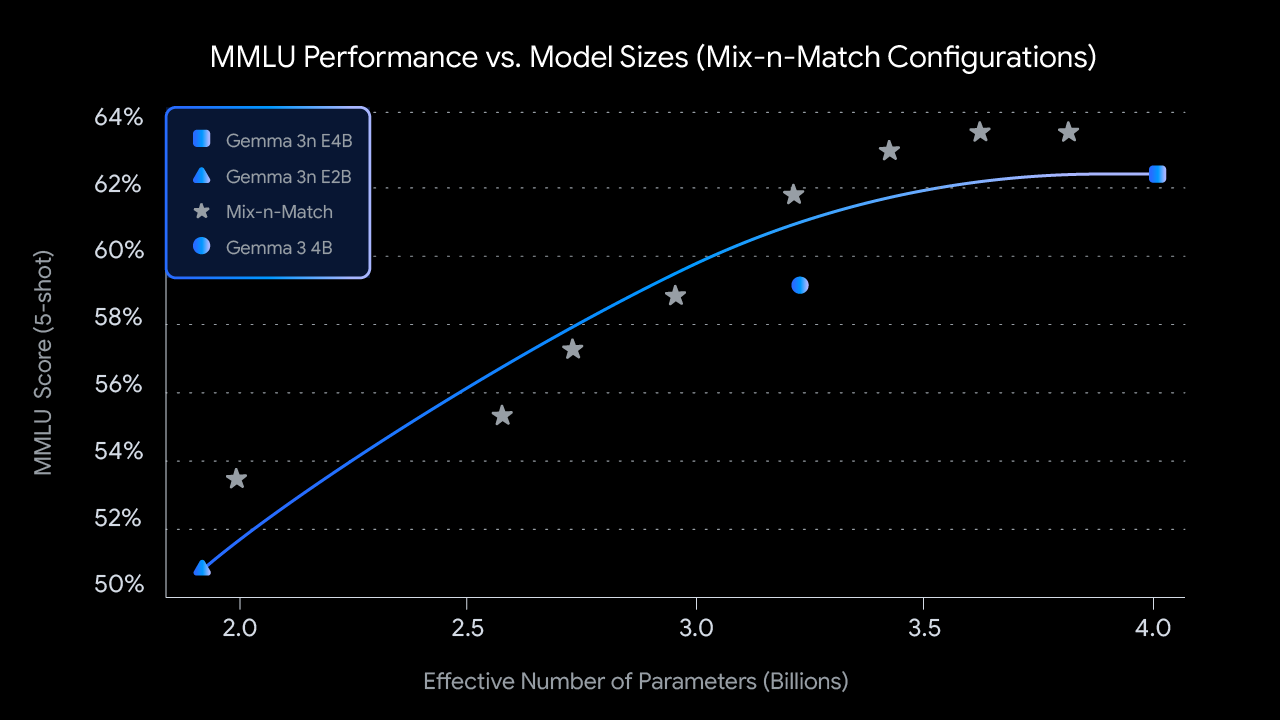
Figure 4. MMLU benchmark: Performance increases with effective parameter size, with Mix-n-Match configurations bridging the gap between E2B and E4B.
- Reasoning and factuality tasks (including HellaSwag, BoolQ, PIQA, and TriviaQA) demonstrate the model's capabilities for structured thought and factual knowledge representation, while coding and STEM benchmarks show the model's skill in code generation and mathematical reasoning.
Gemma 3n E4B also supports over 140 languages for text and 35 languages for multimodal understanding, indicating broad multilingual capabilities.
Training Data, Methods, and Responsible AI
The training regimen for Gemma 3n E4B encompassed approximately 11 trillion tokens with a knowledge cutoff in June 2024. The data corpus spanned diverse domains, including multilingual web documents, code, mathematics, images, and audio, to foster proficiency in a range of tasks.
Advanced filtering pipelines were employed, including content safety protocols to exclude sensitive data and high-risk content, aligned with Google's AI responsibility policies. Model training utilized distributed computing infrastructure, leveraging JAX and ML Pathways for large-scale training efficiency.
These approaches are supported by research into responsible generative AI, addressing risks associated with bias, privacy, and factuality. Evaluations indicate that while the model achieves robust multilinguality and code proficiency, its safety assessments have prioritized English-language prompts, with ongoing efforts to extend these to global languages.
Applications, Use Cases, and Limitations
The design of Gemma 3n E4B centers on on-device deployment, supporting privacy-critical, offline, or low-latency applications in content creation, communication, research, and language learning. Typical applications include conversational AI, summarization, translation, code generation, multimodal information extraction, and educational tools (official developer guide).
Despite its broad applicability, Gemma 3n E4B has limitations inherent to large language models. The quality and scope of its training data influence its capabilities; potential biases, context comprehension challenges, and a lack of common-sense reasoning may affect some outputs. Moreover, while the model performs well when given clear and structured prompts, nuanced or ambiguous queries may yield less reliable results. Factual outputs should be externally verified, as the model does not act as a real-time knowledge base.
Model Family, Deployment, and Accessibility
Gemma 3n models are released in two effective parameter sizes: E2B (2 billion effective, 5 billion raw parameters) and E4B (4 billion effective, 8 billion raw parameters), enabled by the MatFormer framework. The E2B version is extractable as a standalone sub-model, offering improved efficiency at the cost of output quality. Mix-n-Match further allows for tailored models between E2B and E4B, which can be retrieved using MatFormer Lab.
The model and its variants are licensed under terms outlined by Google; users must review and agree to Gemma's usage license before accessing model checkpoints.
Helpful Resources and External Links
- Official Developer Guide for Gemma 3n
- Gemma 3n Technical Documentation
- Gemma 3n E4B Model on Hugging Face
- MatFormer (Matryoshka Transformer) Research Paper
- Universal Speech Model (USM) Paper
- MatFormer Lab (Custom Model Retrieval Tool)
- Responsible Generative AI Toolkit
- Gemma 3n Model Collection on Hugging Face
- Gemma Model Family Ecosystem (Gemmaverse)
- Gemma Terms of Service
More in the Gemma 3 Family
Gemma 3 1B
Gemma 3 4B
Gemma 3 12B
Gemma 3 27B
Gemma 3n E2B
More from Google
Gemma 7B
CodeGemma 1.1 7B
Gemma 2 9B
Gemma 2 27B
Compatible Apps
Open WebUI
A polished, self-hosted chat interface for LLMs with Ollama integration, multimodal prompts, and extensive workspace customization.
Web UI
Chat UIs · Beginner Friendly
llama.cpp
GGUF model inference with a polished web UI and OpenAI-format API. CPU-only build — high hardware compatibility, works on any machine without a GPU.
Web UI · API · CLI
LLM Inference · Chat UIs
llama.cpp (CUDA)
GGUF model inference with a polished web UI and OpenAI-format API. CUDA build — GPU-accelerated for NVIDIA GPUs.
Web UI · API · CLI
LLM Inference · Chat UIs
Text Generation Web UI
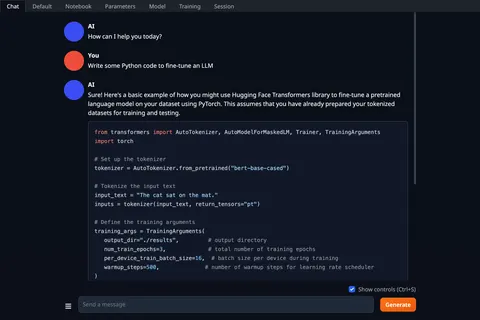
A feature-rich interface for running and experimenting with open-weight LLMs, including multiple inference backends, plugins, and tuning controls.
Web UI · API
Chat UIs · LLM Inference