CodeGemma 1.1 7B
Downloads
Model Report
Overview
CodeGemma 1.1 7B is an open large language model focused on code generation and understanding, developed by the CodeGemma Team at Google LLC. Building upon Google's Gemma model family, CodeGemma specializes in programming tasks such as code completion, infilling, and explanation, while preserving natural language and mathematical reasoning abilities. The 1.1 update, released in May 2024, incorporates changes that relate to model quality and robustness.
Model Architecture and Training
CodeGemma 1.1 7B is based on the architecture of the original Gemma models, adapting their design for enhanced code understanding and code synthesis. Like its predecessors, CodeGemma utilizes the Transformer architecture, optimized for both language and programming-specific challenges.
The training corpus for the 7B variant consists of a mixture of approximately 80% code and 20% natural language, sourced primarily from deduplicated, filtered, publicly available code repositories and technical documents. CodeGemma 1.1 leverages over 500 billion tokens of text for pretraining, combining data on programming languages, mathematics, and general language. Instruction tuning is accomplished using open-source mathematics datasets such as MATH, GSM8K, and MathQA, as well as synthetically generated code and question-answer pairs post-filtered by large language models for correctness.
Notably, the CodeGemma models employ an advanced "Fill-in-the-Middle" (FIM) pretraining objective, which improves the model's ability to generate or fill in missing sections of code given partial context. Multi-file and repository-level heuristics during training further enable CodeGemma to reason about dependencies and broader codebases, mimicking real-world development environments.
Features and Capabilities
Central to CodeGemma 1.1 7B are its code generation and completion capabilities. The model can synthesize functions, complete docstrings, suggest imports, or fill in code sections, according to the user's prompt. Its FIM training enables effective support for tasks where code fragments are missing or need to be completed within a larger file, using specialized control tokens to demarcate code sections. These tokens, such as <|fim_prefix|>, <|fim_middle|>, and <|fim_suffix|>, allow the model to work with both prefix-suffix-middle (PSM) and suffix-prefix-middle (SPM) formats.
Instruction-tuned versions offer enhanced performance on guided and open-ended tasks, with improved abilities for reasoning and following user instructions. CodeGemma preserves a substantial degree of natural language competence inherited from the base Gemma models, enabling it to explain code, process mixed queries, and handle mathematical reasoning challenges. The addition of multi-file packing and training on repository-level context helps the model operate effectively in settings common to real-world software engineering, such as integrated development environments (IDEs).
Evaluation and Benchmarks
Extensive benchmarking demonstrates the performance of CodeGemma 1.1 7B across standard code evaluation datasets. On Python programming benchmarks such as HumanEval and MBPP, CodeGemma 1.1 7B achieves Python HumanEval scores up to 60.4%, outpacing earlier versions and comparable models of similar scale. The 7B instruction-tuned (IT) variant demonstrates particularly strong results, with robust performance across multi-language settings recorded on datasets such as BabelCode, which tests the model’s proficiency in languages including C++, Java, JavaScript, Kotlin, Python, and Rust.
The model’s FIM-aware design is also evaluated with benchmarks targeting code infilling scenarios. Here, CodeGemma exhibits competitive latency and quality, especially in low-latency environments where inference time is critical. For code completion involving both single-line and multi-line infills, CodeGemma compares favorably to other open models such as DeepSeek Coder, StarCoder2, and Code Llama, maintaining high performance and practical response times.
Beyond code synthesis, CodeGemma's natural language abilities remain strong. The 7B instruction-tuned models surpass competitive LLMs, such as Mistral 7B and Llama-2 13B, by notable margins in general language capability. Additionally, on mathematical reasoning tasks using datasets like GSM8K and MATH, CodeGemma 1.1 7B shows advancement over earlier open code LLMs, benefiting from targeted fine-tuning with synthetic and curated mathematical data.
Applications and Use Cases
Owing to its coding proficiency, CodeGemma 1.1 7B is tailored for a range of programming and development scenarios. Its moderate size balances model quality and efficiency, making it suited for integration within software IDEs, local analysis tools, or collaborative development environments. The model supports tasks including code completion, generation, documentation, and repository-level understanding, assisting in both learning and professional engineering workflows.
The model's multi-language coverage and fill-in-the-middle training extend its utility beyond isolated code synthesis. It can be deployed for automated code review, assisting with bug fixes, generating explanations for code snippets, or optimizing existing codebases. The natural language processing capabilities further allow users to issue mix-typed queries that blend code and descriptive instructions, enhancing versatility in daily development tasks.
Model Usage and Prompt Formatting
Successful use of CodeGemma 1.1 7B hinges on effective prompt formatting. For code completion, infilling, or function generation, users are encouraged to employ FIM control tokens in their prompts—such as placing relevant file paths and data within <|fim_prefix|>, <|fim_middle|>, and <|fim_suffix|> sections. For instruction-tuned models, conversational turns should be delineated with <start_of_turn> and <end_of_turn> tokens, aligning with conventions of the broader Gemma family. Output generation can be managed by truncating results when a FIM sentinel token is reached, a straightforward approach for integration into automated tools.
Limitations and Licensing
While CodeGemma 1.1 7B offers a strong balance of language and coding capability, its memory requirements are greater than lightweight models (such as the 2B variant), particularly during inference and interaction with extensive codebases. This can make it less optimal for highly memory-constrained settings, though it remains practical for locally hosted development or research.
As with all open large language models, general limitations apply, including possible errors, incomplete generalization, or outdated knowledge—considerations discussed in the Responsible Deployment section of the Gemma research paper.
CodeGemma is released as an "open code model" with its architecture, weights, and documentation made publicly available by Google. The license terms permit scientific use and research, although specific conditions should be confirmed in the associated model documentation.
Helpful Links
- CodeGemma: Open Code Models Based on Gemma (arXiv)
- MATH Dataset for mathematical problem-solving
- MathQA Dataset for interpretable math word problems
- HumanEval: Evaluating large language models trained on code
- MBPP dataset: Program synthesis with large language models
- BabelCode: Source code is all you need
- GSM8K: Training verifiers to solve math word problems
- Gemma language models and technical documentation
More in the Gemma 1 Family
More from Google
Gemma 2 9B
Gemma 2 27B
Gemma 3 1B
Gemma 3 4B
Gemma 3 12B
Gemma 3 27B
Gemma 3n E2B
Gemma 3n E4B
Compatible Apps
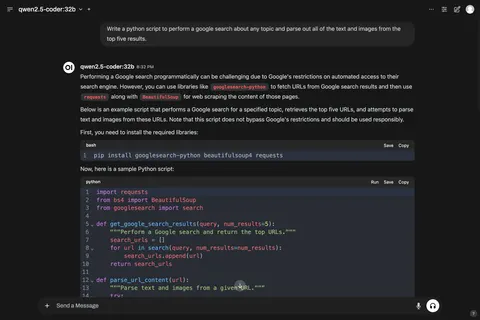
Open WebUI
A polished, self-hosted chat interface for LLMs with Ollama integration, multimodal prompts, and extensive workspace customization.
Web UI
Chat UIs · Beginner Friendly
llama.cpp
GGUF model inference with a polished web UI and OpenAI-format API. CPU-only build — high hardware compatibility, works on any machine without a GPU.
Web UI · API · CLI
LLM Inference · Chat UIs
llama.cpp (CUDA)
GGUF model inference with a polished web UI and OpenAI-format API. CUDA build — GPU-accelerated for NVIDIA GPUs.
Web UI · API · CLI
LLM Inference · Chat UIs
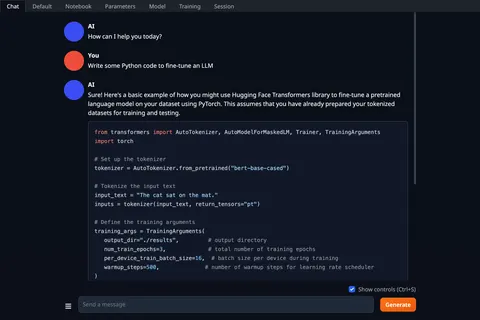
Text Generation Web UI
A feature-rich interface for running and experimenting with open-weight LLMs, including multiple inference backends, plugins, and tuning controls.
Web UI · API
Chat UIs · LLM Inference