danrisi
UltraReal Fine-Tune
Downloads
Model Report
Overview
UltraReal Fine-Tune is a generative AI model developed to produce highly realistic photographic imagery, extending the capabilities of modern checkpoint-trained diffusion models. Building on the foundation of the UltraReal LoRA and the Flux.1 D base model, UltraReal Fine-Tune focuses on the generation of realistic photographic imagery. Its training process incorporates an expanded and diverse dataset, with advancements across versions aimed at improving anatomical accuracy, texture fidelity, and overall aesthetic quality.

Figure 1. Sample output from UltraReal Fine-Tune, illustrating the model's capacity for detailed, lifelike human portraits.
Model Architecture and Technical Details
UltraReal Fine-Tune utilizes a checkpoint-trained architecture based on the Flux.1 D base model. The model is available in multiple file formats and precision modes, including pruned and full versions with quantization options such as FP8, BF16, and NF4. These formats are engineered to support broad compatibility and efficient deployment see technical documentation.
UltraReal Fine-Tune integrates the core improvements from the UltraReal LoRA, further augmented with expanded training steps—reportedly reaching 205,560 steps in certain iterations. From version 2.0 onwards, checkpoint variations include Quant 8 (Q8), which offers quality improvements over FP8. Each version is associated with an AutoV2 hash identifier, supporting consistency and provenance across releases.
Training Data and Optimization Strategies
The development of UltraReal Fine-Tune is characterized by an iterative approach to dataset expansion and curation. The initial version nearly doubled the original UltraReal LoRA dataset, introducing a wide spectrum of styles, lighting conditions, and scene compositions as discussed by the creator. By version 2.0, the dataset comprised approximately 1,800 images, selected to support balanced training across various photographic modalities and improve generalization.
The training regime emphasized anatomical enhancements, especially in challenging aspects such as hands, feet, and complex poses. Additional attention was given to skin texture, lighting, and the rendering of realistic shadows. Later updates, especially in version 4, targeted aesthetic diversity, with explicit improvements in age representation and the portrayal of Asian facial features. Each iteration reflects an ongoing balance between expanding the model's realism and managing potential trade-offs, such as occasional instability in the depiction of hands or text.
Performance, Evaluation, and User Reception
UltraReal Fine-Tune has received positive reception as indicated on its model page, garnering over 650 reviews and more than 10,000 likes as of its most recent version. Community feedback indicates improvements in texture fidelity and anatomical correctness compared to prior iterations or baseline LoRA-only approaches. The model produces images with rich detail, nuanced lighting, and cinematic depth, intended for applications ranging from amateur snapshot realism to high-grade professional renders.
Performance considerations, such as image generation speed, depend on hardware and configuration—one user reported times ranging from five to seven minutes per image on an RTX 4070 12GB. Minor instabilities remain in the generation of hands and text, with version 3 noted for occasional artifacts.

Figure 2. Outdoor portrait created by UltraReal Fine-Tune, demonstrating the model’s proficiency in rendering lifelike skin, natural sunlight, and photographic composition.
Features, Use Cases, and Ecosystem
UltraReal Fine-Tune is engineered for a broad range of photorealistic image generation tasks. Outputs span from casual, amateur-style snapshots to cinematic, high-fidelity visuals. The model features detailed treatment of faces, skin, and lighting, making it applicable for artistic, illustrative, or design-focused tasks requiring realism see usage guidelines.
The model ecosystem includes companion LoRA modules developed specifically for UltraReal Fine-Tune. The Realistic Amplifier for UltraReal Fine-Tune is designed to boost detail and realism when paired with the main checkpoint, while the 2000s Analog Core and SamsungCam UltraReal modules introduce stylistic variation. Users are advised not to combine UltraReal Fine-Tune with UltraRealPhoto LoRA, as their functions are already integrated into the checkpoint, and redundant use may lead to over-saturation or other undesirable visual characteristics.

Figure 3. Output generated with the Realistic Amplifier LoRA for UltraReal Fine-Tune, capturing detailed lighting and natural elements.
Prompting strategies to influence output quality include using complex, clearly structured prompts with comma-separated visual descriptors. Recommendations for settings include a CFG scale around 3, sampling steps between 30 and 50, and the use of DPM++ 2M samplers with a Beta Scheduler. For higher image quality, embedding “high-resolution” in the prompt may help reduce low-resolution artifacts.
Limitations and Ongoing Development
Despite developments in anatomical and aesthetic fidelity, UltraReal Fine-Tune retains certain limitations. Challenges persist in generating hands and fingers with complete stability, especially in versions 1.0, 3, and 4. Text rendering, while improved, may yield incompletely formed words or unusual glyphs. Some users have reported occasional generation of low-resolution images, which can be mitigated through targeted prompting. Further, updates in versions 3 and 4 occasionally introduced instability or performance regressions, particularly concerning anatomical features.
The creator has explored additional fine-tuning efforts and considered integrating Flex.Alpha as a potential future base, indicating ongoing optimization and research within the UltraReal ecosystem.

Figure 4. UltraReal Fine-Tune’s attempt at generating readable text, as demonstrated in a portrait with a smartphone displaying model-generated content.
Release History and Licensing
UltraReal Fine-Tune was initially published in December 2024, with subsequent updates in February 2025 introducing enhanced realism and expanded feature sets. The model is released under the FLUX.1 [dev] Non-Commercial License, which restricts use to non-commercial contexts. The license includes a disclaimer of liability for the developer and associated entities.

Figure 5. Image generated with the 2000s Analog Core LoRA, showcasing UltraReal Fine-Tune’s ability to replicate analog and retro aesthetics.
Helpful Links
- UltraReal Fine-Tune model page and release notes
- FLUX.1 [dev] Non-Commercial License details
- Flux.1 D base model information
- Civitai's guide to checkpoint-trained models
- Realistic Amplifier LoRA for UltraReal Fine-Tune
- 2000s Analog Core LoRA resource
- SamsungCam UltraReal LoRA resource
- Danrisi (model creator) on X
- Danrisi on Reddit
- Danrisi on YouTube
- Danrisi on Instagram
- Danrisi on Tensor.Art
More in the FLUX.1 Family
FLUX.1 [dev]
FLUX.1 [schnell]
Flex.1 Alpha
Compatible Apps
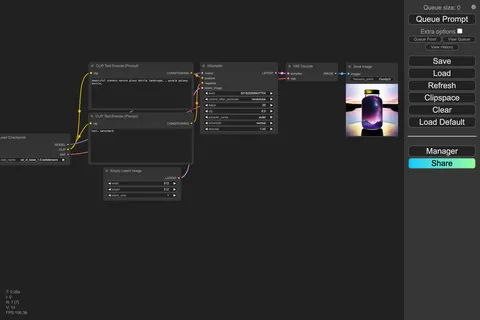
ComfyUI
A node-based workflow builder for advanced image and video generation, ideal for custom pipelines, fine control, and power users.
Web UI · API
Image Generation · Video Generation
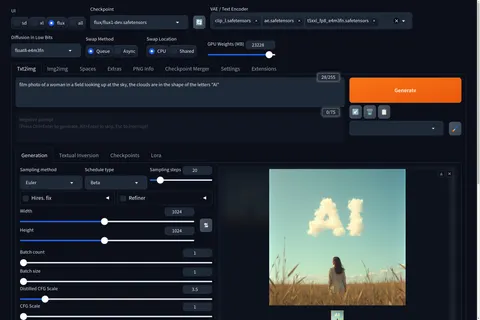
Stable Diffusion WebUI Forge
A faster, more experimental Stable Diffusion WebUI variant focused on improved resource use, quicker inference, and modern model support.
Web UI · API
Image Generation
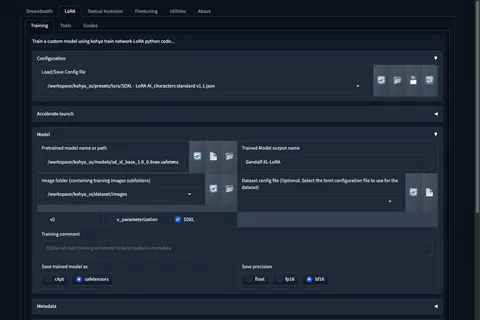
Kohya's GUI
Train LoRAs and fine-tunes for Stable Diffusion and FLUX with a popular GUI for Kohya-based training workflows.
Web UI · API
Fine-Tuning · Image Generation