ostris
Flex.1 Alpha
Downloads
Model Report
Overview
Flex.1 Alpha is a pre-trained generative artificial intelligence model designed for high-fidelity text-to-image synthesis. Developed using a rectified flow transformer architecture, Flex.1 Alpha features 8 billion parameters and was designed to be both efficient and flexible in deployment. The model builds upon the evolutionary lineage of the FLUX.1 family, particularly as a fine-tuned derivative of FLUX.1-schnell, and incorporates innovations such as a guidance embedder for improved image generation without reliance on Classifier-Free Guidance (CFG). Released under the Apache 2.0 open-source license, Flex.1 Alpha is positioned for research, fine-tuning, and creative applications in scientific and artistic domains.

Figure 1. A promotional banner featuring the Flex.1 Alpha model, setting a vibrant and energetic theme.
Model Architecture and Innovations
At its core, Flex.1 Alpha utilizes a rectified flow transformer architecture, characterized by its capacity for efficient and high-quality image synthesis from text inputs. The model comprises 8 double transformer blocks, a reduction from the 19 blocks present in the related FLUX.1-dev model. This architectural choice enhances computational efficiency while maintaining robust generative abilities, as described in the model's technical documentation.
A notable innovation within Flex.1 Alpha is its dedicated guidance embedder. This component allows the model to generate images without dependency on Classifier-Free Guidance, a feature that distinguishes it from traditional approaches. Users retain the option to bypass this embedder, granting flexibility for both training and inference. Furthermore, Flex.1 Alpha remains fully compatible with classic CFG workflows if required, supporting a diverse range of experimental setups.
The model processes input text up to 512 tokens in length, accommodating complex and detailed prompts. Its open architecture and flexible configuration offer compatibility with various inference engines that support the FLUX.1 family, enabling easy integration into existing workflows.
Training Process and Dataset Lineage
Flex.1 Alpha's development is closely linked to the FLUX.1 and OpenFLUX model lines. Initially, it was derived via fine-tuning from FLUX.1-schnell, ensuring continuity of the Apache 2.0 licensing. To facilitate training enhancements such as Low-Rank Adaptation (LoRA), the FLUX.1-schnell-training-adapter was employed.
The continual training phase involved the creation of OpenFLUX.1, a model refined through successive exposure to outputs it generated, aiming to mitigate compression artifacts and integrate novel image data. As documented on OpenFLUX.1's project page, this iterative process produced ten prominent versions prior to adopting new external datasets and implementing architectural pruning strategies.
Subsequent to the OpenFLUX.1 releases, experimental pruning yielded several unreleased models with 7B and 4B parameters, ultimately inspiring the development of an 8B-parameter version through strategies adapted from flux.1-lite-8B-alpha. Flex.1 Alpha's guidance embedder was independently trained as an auxiliary module, designed to act as an optional adapter, further enhancing generation quality.

Figure 2. A chalk-style illustration symbolizing the transition from OpenFLUX to Flex.1 Alpha, marking an an evolution in model development.
Image Generation Capabilities
Flex.1 Alpha demonstrates robust capabilities in generating a wide variety of images from natural language descriptions. The model can produce highly detailed portraits, conceptual compositions, technical illustrations, and imaginative scenes, all while maintaining a high degree of fidelity to the input prompt and stylistic variability.

Figure 3. Example of the model generating a detailed cyborg portrait, demonstrating intricate textures and lighting.

Figure 4. A conceptual portrait with futuristic digital overlays, illustrating the model's ability to combine realistic and stylized elements.

Figure 5. A scientifically themed scene generated by Flex.1 Alpha, reflecting strong control over color and atmosphere.
These examples, sourced from the official Flex.1 Alpha model gallery, reflect the model's proficiency in rendering diverse content, ranging from close portraits and science fiction illustrations to conceptual art and technical scenes. The model's flexibility is further demonstrated through its output of both photorealistic and stylized images.
Applications and Usage
Flex.1 Alpha is primarily oriented toward text-to-image synthesis for creative, educational, and research applications. The model is carefully constructed as a base architecture, allowing users to not only generate images directly from prompts but also to fine-tune it to specialized domains, artistic styles, or technical fields.
Within the software ecosystem, Flex.1 Alpha shows compatibility with a range of inference engines and frameworks that accommodate the FLUX.1 model family. For example, it functions seamlessly with popular toolkits such as ComfyUI and Diffusers, and supports state-of-the-art techniques including LoRA-based fine-tuning through the AI-Toolkit. For best performance in fine-tuning, users are advised to bypass the guidance embedder, whereas direct generation tasks can leverage its benefits for high-quality outputs.

Figure 6. A science fiction-themed illustration featuring an alien at a desk, showcasing the model's imaginative output range.
Flex.1 Alpha excels in the generation of scientific visualizations, character and environment design for creative industries, and the production of conceptual artwork for education, communication, and prototyping purposes.
Model Family, Limitations, and Licensing
Belonging to the FLUX.1 lineage, Flex.1 Alpha is directly comparable to models such as FLUX.1-dev and OpenFLUX.1. While it shares much of the architectural philosophy with FLUX.1-dev, Flex.1 Alpha opts for fewer double transformer blocks and implements unique mechanisms for conditional guidance. Its approach to training and architectural pruning was informed by the strategies of flux.1-lite-8B-alpha.

Figure 7. A surreal output demonstrating Flex.1 Alpha's creative scene composition abilities.
One initial limitation of the model was the requirement of CFG for successful image generation. This constraint was subsequently addressed by the introduction and training of the optional guidance embedder.
Flex.1 Alpha inherits the Apache 2.0 license, ensuring that it remains fully open-source and accessible for modification and redistribution. This compliance facilitates broad adoption in both research and applied settings.
Additional Resources
For in-depth technical details, additional sample outputs, and guidance on implementation or fine-tuning, the following resources provide comprehensive information and support:
More in the FLUX.1 Family
FLUX.1 [dev]
UltraReal Fine-Tune
FLUX.1 [schnell]
Compatible Apps
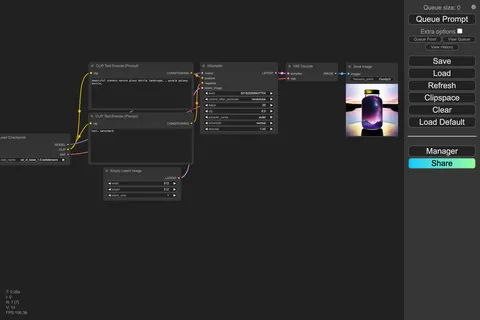
ComfyUI
A node-based workflow builder for advanced image and video generation, ideal for custom pipelines, fine control, and power users.
Web UI · API
Image Generation · Video Generation
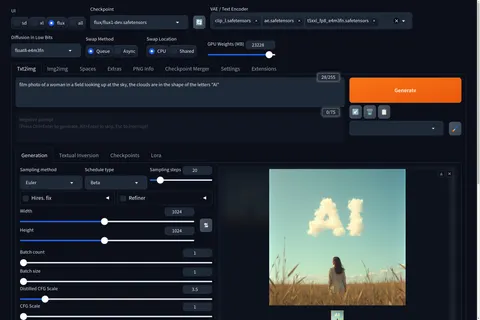
Stable Diffusion WebUI Forge
A faster, more experimental Stable Diffusion WebUI variant focused on improved resource use, quicker inference, and modern model support.
Web UI · API
Image Generation
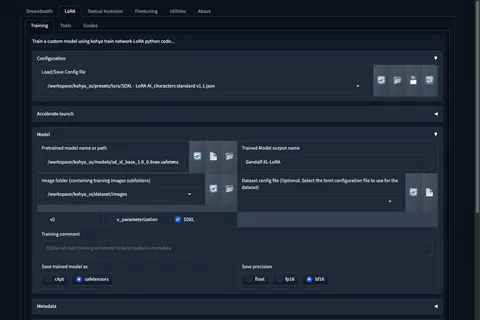
Kohya's GUI
Train LoRAs and fine-tunes for Stable Diffusion and FLUX with a popular GUI for Kohya-based training workflows.
Web UI · API
Fine-Tuning · Image Generation