microsoft
Phi-3.5 Vision Instruct
Model Report
Overview
Phi-3.5 Vision Instruct is a multimodal generative AI model developed by Microsoft, extending the Phi-3.5 family of Small Language Models (SLMs) with both textual and visual reasoning capabilities. Released in August 2024, Phi-3.5 Vision Instruct is engineered to deliver efficient, high-quality performance across a variety of commercial and research tasks, focusing primarily on English language use. The model emphasizes robust multi-frame image analysis, instruction following, and scalable deployment within constrained computational environments, supporting uses ranging from general visual understanding to advanced document summarization and reasoning. For further details, consult the model documentation on Hugging Face and technical disclosures from Microsoft's release announcement.
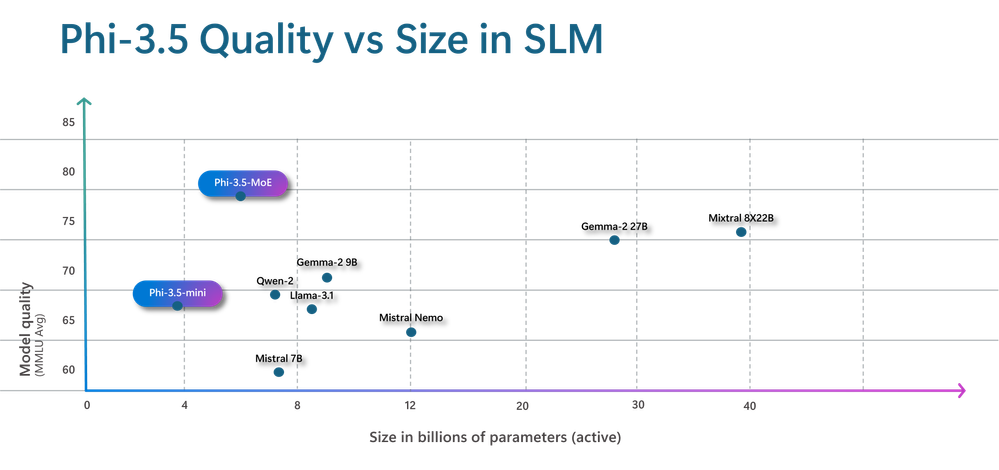
Figure 1. Phi-3.5 model family efficiency and performance, highlighting Phi-3.5-mini and Phi-3.5-MoE in comparison to other small language models.
Model Architecture and Training
Phi-3.5 Vision Instruct is built on a 4.2-billion-parameter architecture that integrates an image encoder, connector, projector, and the Phi-3 Mini language model core. The system uses supervised fine-tuning (SFT) and direct preference optimization (DPO) to ensure instruction adherence, as well as Reinforcement Learning from Human Feedback (RLHF) to further align outputs with safety and usability standards, as outlined in the model card. This architecture allows the model to process and reason over both text and multiple images within the same context.
The model training set is a composite of rigorously filtered publicly available documents, educational datasets, synthetic structured data (including "textbook-like" materials for math, coding, and reasoning), and diverse image-text pairs. Specialized datasets for multi-image and short video understanding were newly created, ensuring that Phi-3.5 Vision Instruct could handle summarization, comparison, and storytelling tasks over sequences of images or video frames. Data collection procedures include filtering to remove undesirable content and scrubbing of potentially personal information to enhance privacy, in accordance with Microsoft’s Responsible AI guidelines.
The implementation leverages PyTorch, Hugging Face Transformers, and Flash-Attention, optimizing performance for modern GPU accelerators and supporting context windows of up to 128,000 tokens.
Technical Capabilities
Phi-3.5 Vision Instruct offers a broad set of multimodal capabilities. Its primary strength is the ability to process both single and multi-frame images in conjunction with textual prompts, enabling detailed visual question answering, comparison across multiple images, chart and table understanding, document OCR, and video or sequential image summarization. The model demonstrates enhanced performance in reasoning tasks that require understanding temporal or comparative relationships across multiple frames—a feature developed in response to user demand for richer context handling, as described in the official release.
A typical usage paradigm involves structured chat-style inputs, where image and text data are presented sequentially within the supported context window. The model is particularly suited to scenarios where computational or memory constraints demand high efficiency, and where latency requirements are paramount.
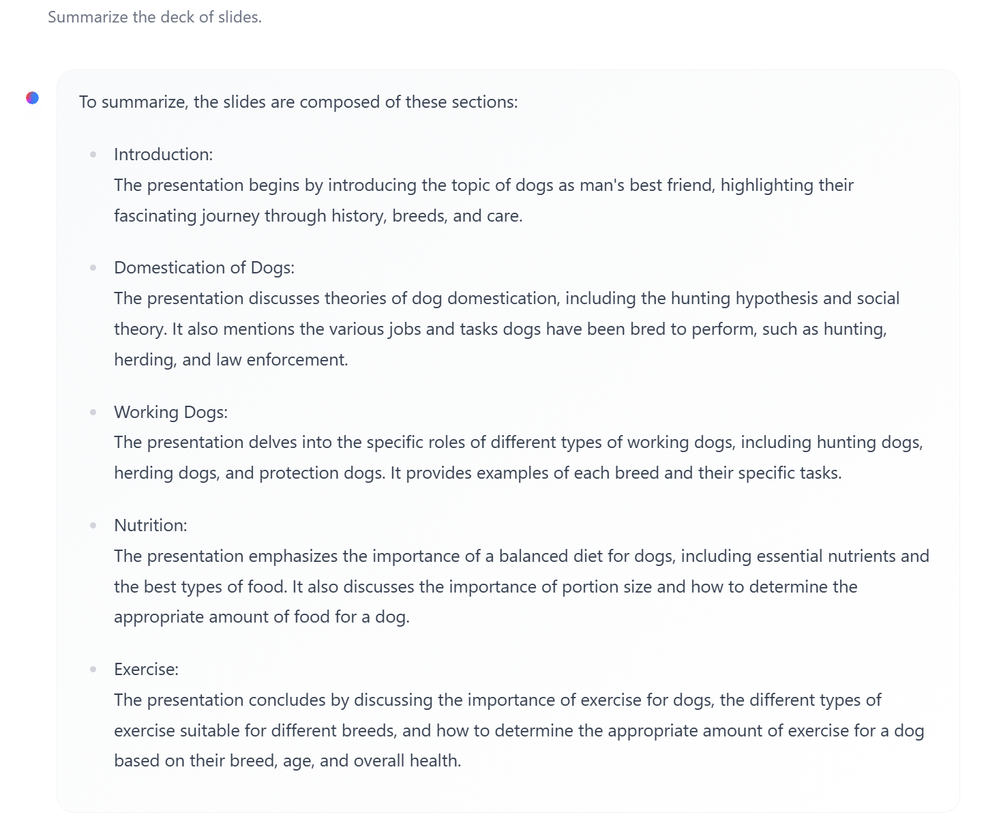
Figure 2. Example output of Phi-3.5 Vision Instruct summarizing a presentation about dogs. Prompt: 'Summarize the deck of slides.'
Performance and Benchmark Evaluation
Phi-3.5 Vision Instruct demonstrates substantial improvements across established vision-language and multi-frame benchmarks, particularly in single-image and sequence-based reasoning. On single-image tasks, the model records increased scores in key benchmarks such as MMMU (43.0), MMBench (81.9), and TextVQA (72.0), as reported in the benchmark summary on Hugging Face. For multi-image and video benchmarks, Phi-3.5 Vision Instruct achieves an overall score of 57.0 on the BLINK suite—outperforming models like LlaVA-Interleave-Qwen-7B and InternVL-2-8B, and remaining competitive with significantly larger systems.
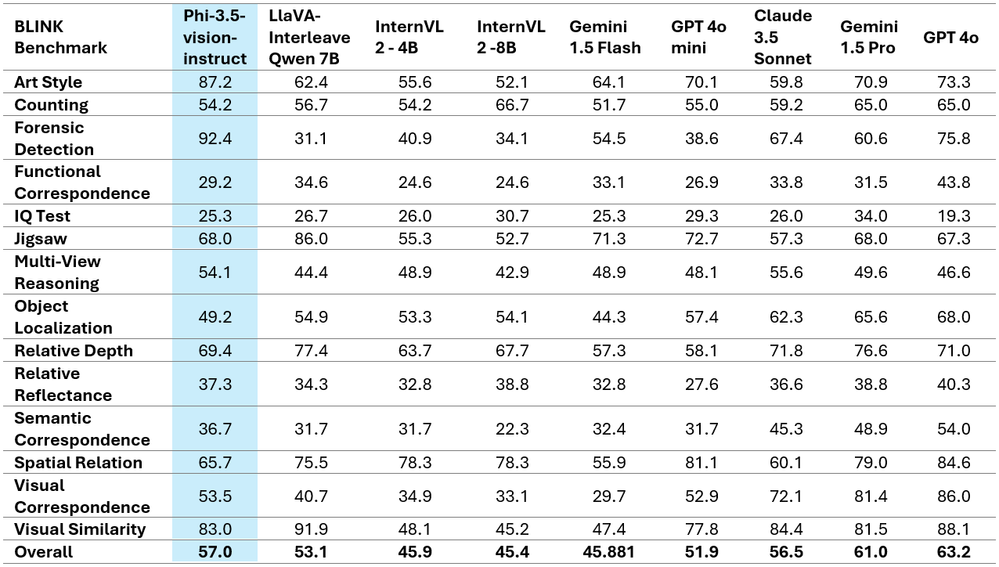
Figure 3. BLINK multi-frame visual reasoning benchmark comparison. Phi-3.5 Vision Instruct demonstrates strong performance across diverse sub-tasks.
In video-oriented evaluation (Video-MME), the model secures a score of 50.8, surpassing several competing small and mid-sized LLMs. Across representative datasets—such as ScienceQA, MathVista, ChartQA, and POPE—Phi-3.5 Vision Instruct maintains robust performance, illustrating versatility not only in general visual analysis but also in structured document interpretation and educational domains. Full results and comparative data are accessible via the official model benchmark table on Hugging Face.
Relationship to Phi-3.5 Model Family
Phi-3.5 Vision Instruct is released alongside other notable Phi-3.5 models, including Phi-3.5-mini and Phi-3.5-MoE. Phi-3.5-mini features 3.8 billion parameters and emphasizes multi-lingual support across over twenty languages, with a 128K token context window and competitive performance in language and reasoning tasks, as detailed in the Tech Community blog post. Phi-3.5-MoE introduces a Mixture-of-Experts architecture, activating subsets of its total 42B parameter model to offer high performance at lower active compute, particularly in multi-lingual and long-context scenarios.
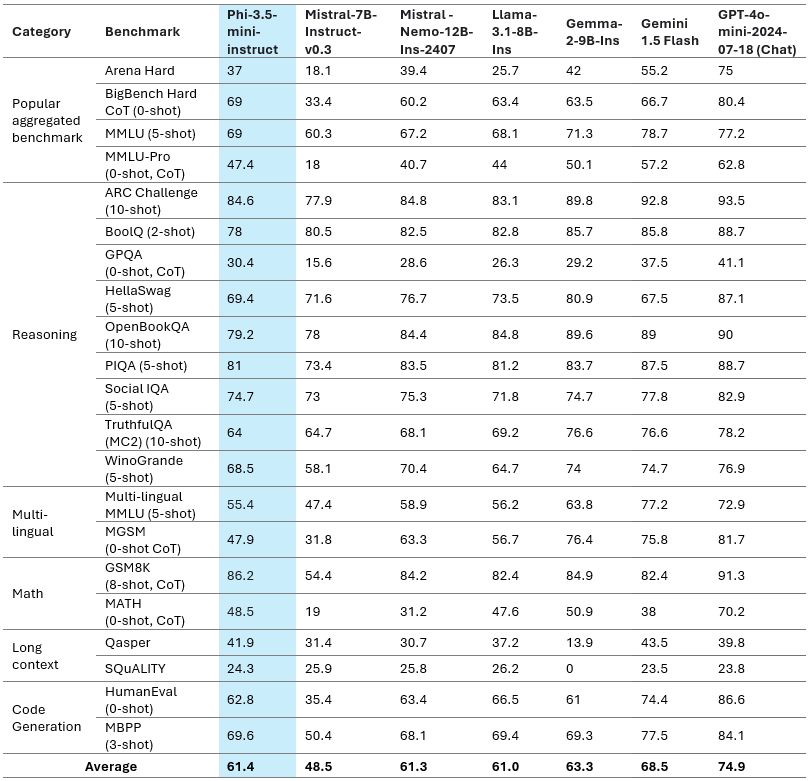
Figure 4. Phi-3.5-mini performance on central benchmarks relative to other open and proprietary large language models.
Though Phi-3.5-mini and MoE variants excel in multi-lingual and conversational contexts, Phi-3.5 Vision Instruct is principally optimized for English and advanced multimodal tasks, focusing on vision-language integration and multi-frame analysis.
Limitations and Responsible Use
While Phi-3.5 Vision Instruct demonstrates high accuracy and efficiency, certain constraints and responsibilities should be considered in deployment. The model is primarily optimized for English, and its performance may degrade in other languages unless fine-tuned for multi-lingual use. As with other large AI models, outputs may contain inaccuracies, reflect biases or stereotypes, or generate content that is inappropriate for sensitive applications. It is not intended for high-risk decision-making without further validation, and developers are advised to implement user transparency, feedback mechanisms, and additional mitigations for safety and fairness, as outlined in the responsible AI statement and Microsoft Responsible AI Standard.
Special caution is warranted in scenarios that might involve identification of individuals in images, or any context where the reliability and provenance of generated information are critical. The model is distributed under the MIT License information.
Typical Applications
Phi-3.5 Vision Instruct is suitable for deployment in memory- or compute-constrained environments, latency-sensitive use cases, and applications involving complex visual reasoning. Example scenarios include detailed analysis of document layouts, chart and table extraction, multi-image comparison, summarization of slide decks or video sequences, and serving as an intelligent assistant for visually-rich workflows in domains such as education, office automation, and analytics.
Further Resources
- Phi-3.5 Vision Instruct Hugging Face Model Card
- Microsoft Tech Community Blog on Phi-3.5 SLMs
- Phi-3 Model Collection Overview
- Phi-3 Technical Report on arXiv
- Phi-3 Cookbook for model usage and recipes
- Microsoft Responsible AI Standard
- Phi-3 Safety Post-Training Paper
- PyTorch GitHub repository
- Hugging Face Transformers GitHub repository
- Flash-Attention GitHub repository
More in the Phi 3 Family
Phi-3 Mini Instruct
Phi-3.5 Mini Instruct
More from microsoft
Compatible Apps
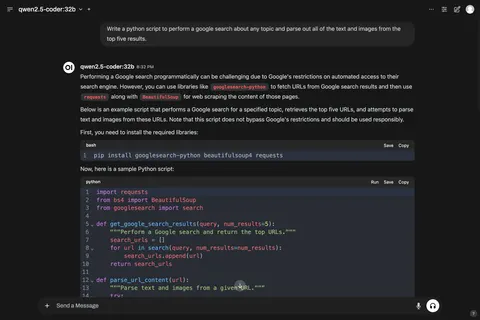
Open WebUI
A polished, self-hosted chat interface for LLMs with Ollama integration, multimodal prompts, and extensive workspace customization.
Web UI
Chat UIs · Beginner Friendly
llama.cpp
GGUF model inference with a polished web UI and OpenAI-format API. CPU-only build — high hardware compatibility, works on any machine without a GPU.
Web UI · API · CLI
LLM Inference · Chat UIs
llama.cpp (CUDA)
GGUF model inference with a polished web UI and OpenAI-format API. CUDA build — GPU-accelerated for NVIDIA GPUs.
Web UI · API · CLI
LLM Inference · Chat UIs
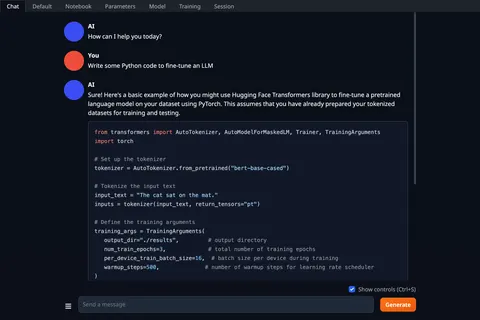
Text Generation Web UI
A feature-rich interface for running and experimenting with open-weight LLMs, including multiple inference backends, plugins, and tuning controls.
Web UI · API
Chat UIs · LLM Inference