Deepseek AI
DeepSeek R1 (0528)
Model Report
Overview
DeepSeek-R1 (0528) is an advanced generative AI model within the DeepSeek-R1 family, developed by DeepSeek-AI as part of their efforts to improve automated reasoning in large language models. This release builds upon the original DeepSeek-R1, introducing enhancements in reasoning ability, inference depth, and response reliability. The model has been evaluated against various benchmarks to assess its reasoning, coding, and general language processing capabilities, and incorporates novel training methodologies to address shortcomings observed in its predecessors.
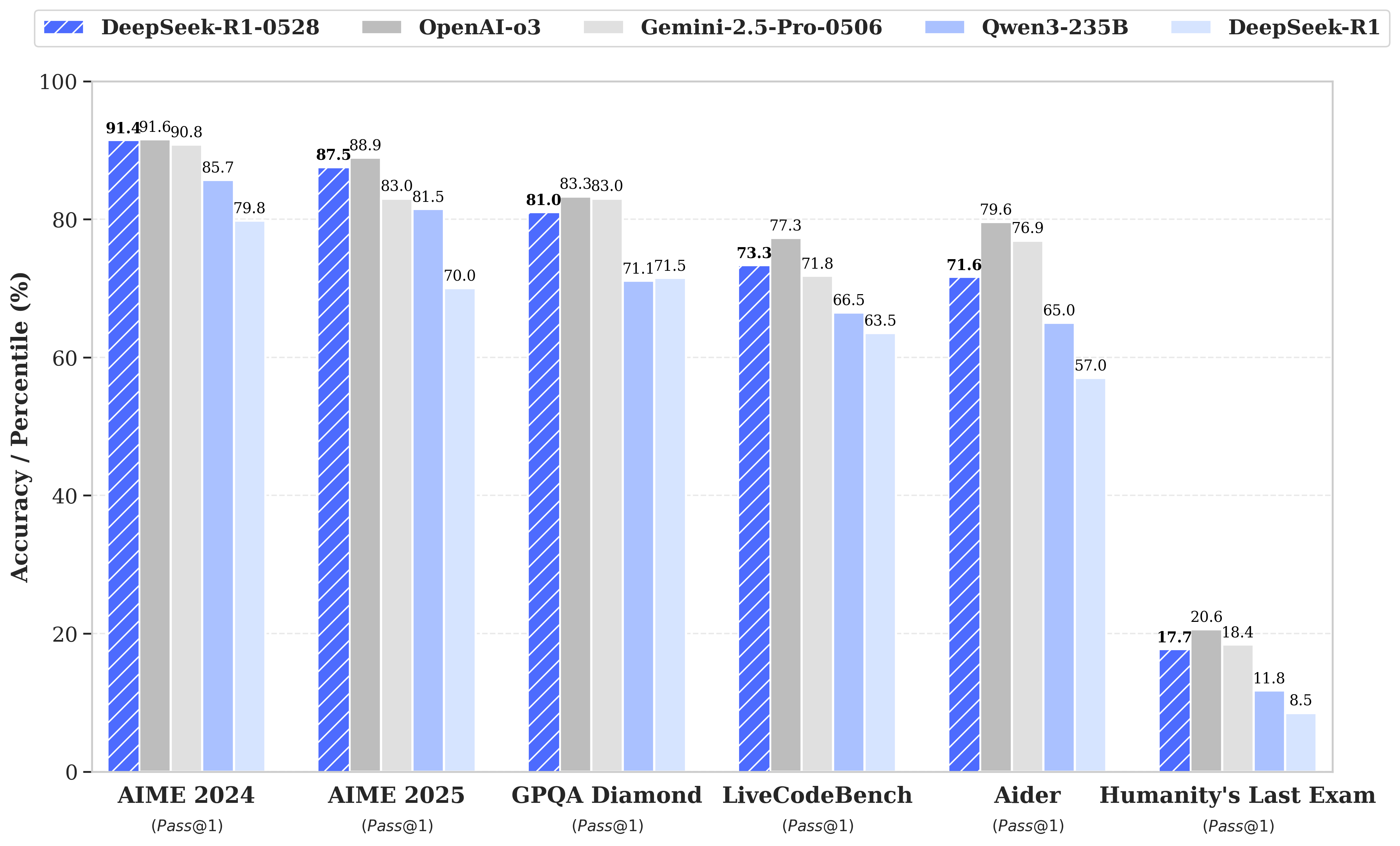
Figure 1. Performance comparison of DeepSeek-R1-0528 and other advanced models on diverse academic and code benchmarks, including AIME, GPQA Diamond, and LiveCodeBench.
Technical Features and Training Methodology
DeepSeek-R1 (0528) is distinguished from earlier versions through its optimized post-training algorithms and the inclusion of a refined multi-stage learning pipeline. The model employs reinforcement learning methods—particularly Group Relative Policy Optimization (GRPO)—to maximize rewards without requiring a separate critic model, thereby streamlining the policy optimization process. Training proceeds through two supervised fine-tuning (SFT) stages and two reinforcement learning (RL) stages, with the initial phase leveraging "cold-start" data comprised of thousands of curated long-form Chain-of-Thought (CoT) reasoning samples.
The model incorporates a language consistency reward during reinforcement learning to mitigate language mixing, especially in multilingual prompts, enhancing readability and user preference alignment. Additionally, DeepSeek-R1 (0528) introduces support for system prompts and relaxes earlier requirements to initiate responses with explicit reasoning tags. These elements collectively contribute to reduced hallucination rates, improved function calling, and more reliable output formatting compared to earlier iterations.
Performance and Benchmark Evaluation
DeepSeek-R1 (0528) exhibits competitive results across a range of established benchmarks. Evaluations show notable improvements in reasoning-intensive tasks, code generation, and mathematical problem-solving compared to its predecessors. For instance, on the AIME 2025 mathematics benchmark, DeepSeek-R1 (0528) achieved an accuracy of 87.5%, a substantial increase over the original DeepSeek-R1's 70%. The model also demonstrates lower hallucination rates and enhanced inference depth, averaging 23,000 tokens per question—a statistic indicative of its deeper processing capability.
In comparative studies against other prominent models such as OpenAI O3 and Gemini 2.5 Pro, DeepSeek-R1 (0528) closely approaches or, in certain cases, surpasses their scores on tasks like AIME 2024, GPQA Diamond, LiveCodeBench, and complex general reasoning benchmarks.
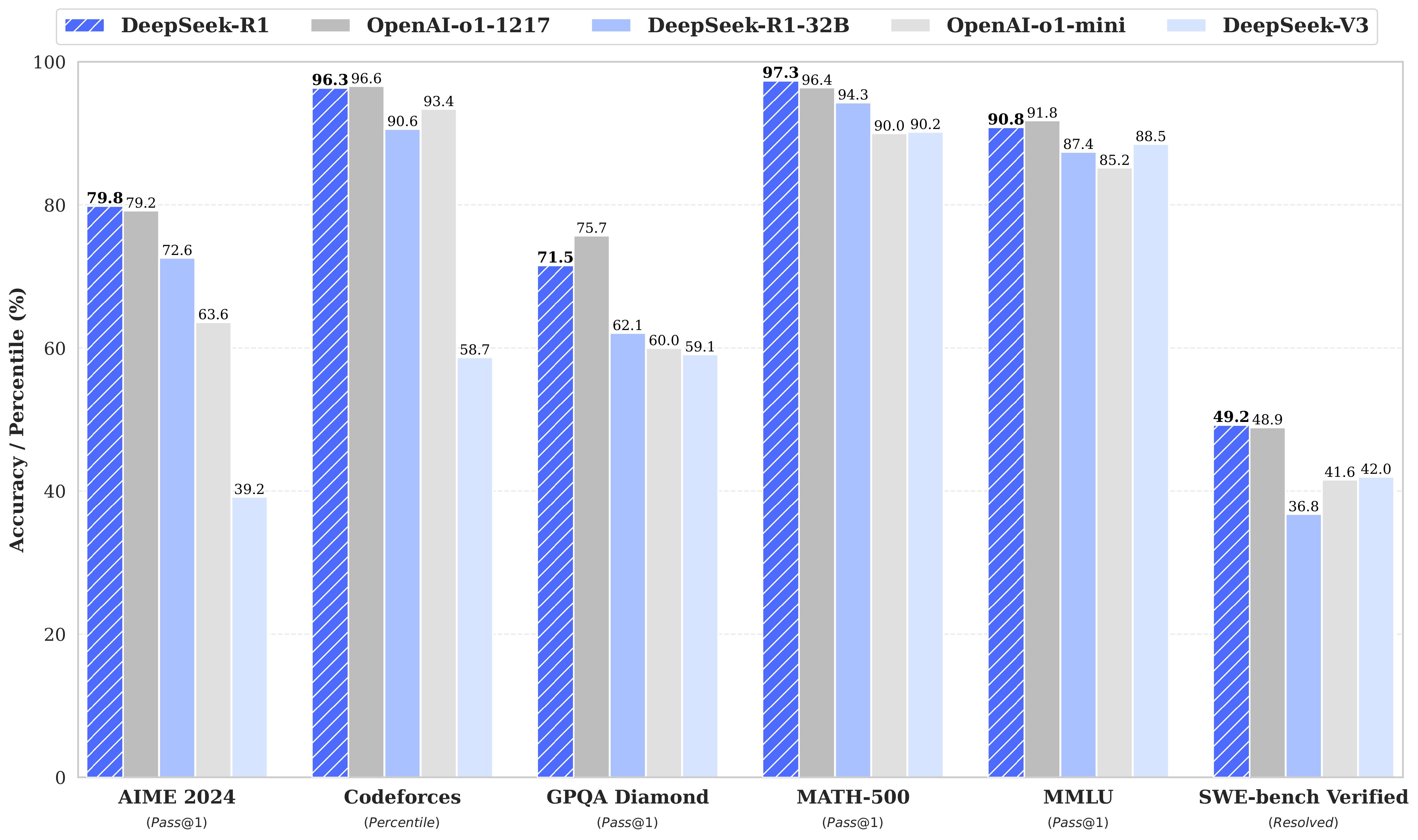
Figure 2. Comparative analysis highlighting DeepSeek-R1's relative accuracy on mathematics (AIME 2024, MATH-500), coding (Codeforces, SWE-bench Verified), and general reasoning (GPQA Diamond, MMLU) tasks.
Additionally, DeepSeek-R1 (0528) has shown improvements in computer science benchmarks such as LiveCodeBench and SWE-bench Verified, with enhanced support for code-related tasks and increased robustness in software engineering evaluations.
Model Architecture and Underlying Technology
DeepSeek-R1 (0528) is based on the DeepSeek-V3-Base model and utilizes a Mixture-of-Experts (MoE) architecture. The model comprises a total of 671 billion parameters, of which 37 billion are activated during inference. It supports a context length of up to 128,000 tokens, with the 0528 version specifically tailored for outputs up to 64,000 tokens per generation. The RL approach is grounded in GRPO, which facilitates efficient and stable policy improvement based on relative reward advantages.
Reward modeling primarily employs rule-based metrics, assessing both the accuracy of model outputs (such as correct answers for deterministic tasks and successful code execution feedback) and the clarity of reasoning structure. By contrast, neural reward models are generally eschewed due to the risk of reward hacking and elevated training complexity.
Data, Distillation, and Model Family
Training data for DeepSeek-R1 (0528) places strong emphasis on the quality and diversity of reasoning examples. The cold-start phase involves a curated selection of long-form CoT samples, enhanced by human annotation, to address repetitive or unreadable responses and to avoid unwanted language blending. Subsequent SFT datasets combine new reasoning samples identified through RL sampling with general language tasks, further refining the model's broad capabilities.
A significant innovation in the DeepSeek-R1 program is the use of distillation, where the model's reasoning patterns are transferred to smaller, open-source models—including the Qwen2.5 and Llama3 series. This approach allows models with parameter counts ranging from 1.5B to 70B to achieve improved reasoning performance compared to models trained via direct RL at smaller scales, demonstrating the efficacy of distilled reasoning in compact architectures.
Limitations and Model Licensing
While DeepSeek-R1 (0528) demonstrates advances in reasoning and general language processing, certain limitations persist. The model, though improved, may still be sensitive to input prompts and can exhibit language mixing outside of Chinese and English use cases. Performance in some areas, such as advanced multi-turn conversations or highly structured outputs, may not fully match that of DeepSeek-V3 or other highly specialized models.
DeepSeek-R1 (0528), along with its associated code and model weights, is released under the MIT License, permitting broad use, modification, and further derivative works. Distilled variants built on other base architectures inherit their respective open-source licenses, such as Apache 2.0 for Qwen models or specific Llama licenses for Llama-based derivatives.
Applications
DeepSeek-R1 (0528) is applicable across a spectrum of tasks requiring advanced reasoning ability, including mathematical contests (e.g., AIME, HMMT, CNMO), competitive programming (e.g., Codeforces), software engineering assessment (e.g., SWE Verified, Aider-Polyglot), and general language tasks involving long-context understanding, document analysis, creative writing, and summarization. The model's enhancements position it for effective use in research, data analysis, and problem-solving domains that demand reliable and interpretable automated reasoning.
External Resources
More in the DeepSeek R1 Family
More from Deepseek AI
DeepSeek R1 Distill Qwen 1.5B
DeepSeek R1 Distill Qwen 7B
DeepSeek R1 Distill Qwen 14B
DeepSeek R1 Distill Qwen 32B
DeepSeek R1 Distill Llama 8B
DeepSeek R1 Distill Llama 70B
DeepSeek V3 (0324)
DeepSeek V3
DeepSeek VL2
DeepSeek VL2 Small
DeepSeek VL2 Tiny
DeepSeek V2.5
DeepSeek V2
DeepSeek Coder V2
DeepSeek Coder V2 Lite
Compatible Apps
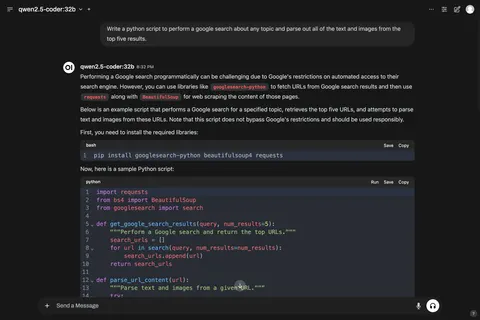
Open WebUI
A polished, self-hosted chat interface for LLMs with Ollama integration, multimodal prompts, and extensive workspace customization.
Web UI
Chat UIs · Beginner Friendly
llama.cpp
GGUF model inference with a polished web UI and OpenAI-format API. CPU-only build — high hardware compatibility, works on any machine without a GPU.
Web UI · API · CLI
LLM Inference · Chat UIs
llama.cpp (CUDA)
GGUF model inference with a polished web UI and OpenAI-format API. CUDA build — GPU-accelerated for NVIDIA GPUs.
Web UI · API · CLI
LLM Inference · Chat UIs
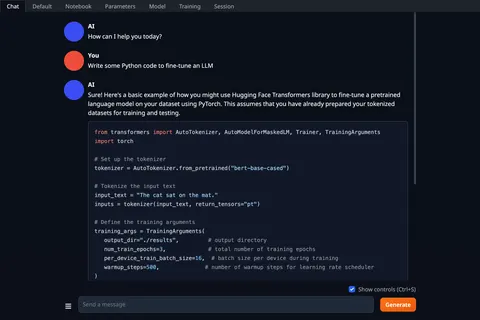
Text Generation Web UI
A feature-rich interface for running and experimenting with open-weight LLMs, including multiple inference backends, plugins, and tuning controls.
Web UI · API
Chat UIs · LLM Inference